 Section 15 — Inspection
QA/QC Procedures for Fasteners
IPE Engineering Practice IPE-EP-15-5-6
Document number: IPE-EP-15-5-6 · Section: 15 — Inspection
SCOPE
- This Engineering Practice provides instructions for the receiving inspection of fasteners.
- This instruction shall be applicable for all grades and sizes of fasteners (nuts, bolts, and studs).
- A revision bar indicates all changes made to this Revision.
2.0 REFERENCES
The latest edition of the following standards and publications are referred to herein.
STANDARDS AND PUBLICATIONS
DEFINITIONS
- Certified Material Test Report (CMTR) – A document, or documents, on which are recorded the results of tests, examinations, repairs, or treatments required by the Material Specification. Supplementary or special requirements, in addition to the requirements of the Material Specification, as required by the Purchase Order shall also be included on the CMTR. The specification of the material being represented including the year of issue, and the material heat number shall also be included on the CMTR. All such documents shall identify the applicable Material Specification and shall be identified to the material represented.
- Commodity – Any item of standard design and/or mass manufacture which is purchased in quantity and maintained in stock for routine or specialized Plant use.
- Inspection Lot – Unless otherwise specified by the Owner’s Engineer, the inspection lot shall be as follows:
| Lot Size | Inspection Lot |
|---|---|
| 5 or less | 2 |
| 6–20 | 3 |
| 21–40 | 4 |
| 41 and over | 10% rounded to the next highest whole number |
- Manufacturer – The recipient of a direct or indirect purchase order for materials and/or equipment. In this context, a direct order is one issued to a Manufacturer by a Contractor or the Owner. An indirect order is one issued to a Manufacturer by a vendor (recipient of a direct order) for materials, fabricated components, or subassemblies.
- Lot – A group of items with the same heat number.
- Owner – Inflection Point Engineering, LLC.
- Positive Materials Identification (PMI) – A procedure used to insure that alloy materials purchased by or for the Owner are properly identified, and meet the chemical composition of alloy materials as specified in Section II of the ASME Code or an applicable ASTM Specification, and the CMTR.
- Receiving Inspection – A receiving inspection shall be that inspection necessary to ensure that the dimensions, physical integrity, chemical composition, and mechanical properties of representative samples of commodity items are in conformance with those detailed by the applicable quality specifications. A receiving inspection shall require performance of specified examinations and tests of an inspection lot of the commodity, and review of documentation and reports that accompany the item(s).
- Receiving Q/A Authority – The person or department designated by the Owner responsible for assuring quality of incoming commodity material.
- Vendor – Recipient of a direct purchase order.
PROCEDURE
- Fastener CMTR’s shall be reviewed for conformance with chemical and physical requirements.
- Inspection Lot of each received lot of fasteners shall be inspected as follows:
- Fasteners shall be examined to ensure correct marking/stamping of bolt type and Manufacturer.
- Alloy fasteners shall be checked to ensure correct alloy content using the Texas Nuclear Portable Alloy Analyzer or similar instrument.
- Bolting shall be inspected for condition of threads and to ensure that nuts run onto bolts with little or no resistance.
- Bolts shall be examined for adequate lubrication or coating application.
DOCUMENTATION
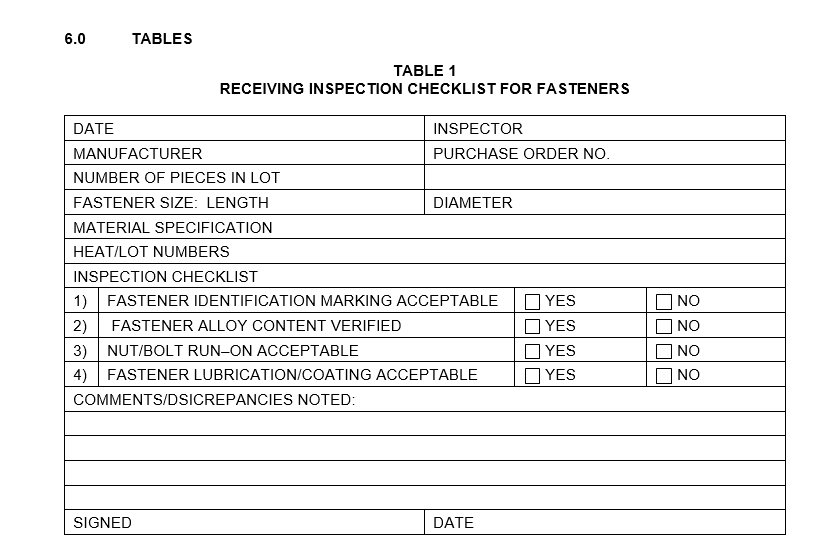
- Inspection of each lot of fasteners shall be documented using the Receiving Inspection Checklist Form Table 1 or an equivalent method that includes all of the elements of the Inspection Checklist.
© 2026 Inflection Point Engineering, LLC. All rights reserved. The content of this page — including calculation methods, reference data, written analysis, interactive tools, and source code — is the intellectual property of Inflection Point Engineering, LLC and is protected under applicable copyright, trademark, and trade secret laws. Unauthorized reproduction, redistribution, modification, or derivative use in whole or in part is prohibited without prior written consent.
Disclaimer. This material is provided for informational and educational purposes only and does not constitute professional engineering advice. Calculations, reference data, and methodologies are based on published standards and accepted engineering practice but are not a substitute for engineering judgment, site-specific analysis, or review by a licensed Professional Engineer. Inflection Point Engineering, LLC makes no warranties, express or implied, regarding the accuracy, completeness, or fitness for a particular purpose of any content presented here, and shall not be liable for any direct, indirect, incidental, or consequential damages arising from its use. Users assume all risk associated with applying this content to real-world design, operations, or decisions.
© 2026 Inflection Point Engineering, LLC. All rights reserved.