 Section 15 — Inspection
QA/QC Procedures for Valves
IPE Engineering Practice IPE-EP-15-5-4
Document number: IPE-EP-15-5-4 · Section: 15 — Inspection
SCOPE
- This Engineering Practice provides instructions for the receiving inspection of valves.
- This instruction shall be applicable for all commodity grades of welded, screwed, and bolted check, gate, pressure relief, and control valves of all sizes and pressure ratings.
- A revision bar indicates all changes made to this Revision.
2.0 REFERENCES
The latest edition of the following standards and publications are referred to herein.
STANDARDS AND PUBLICATIONS
| IPE Engineering Practices |
|---|
| EP 5–3–1 Valve Design and Selection Criteria EP 5–3–3 Gate Valves EP 5–3–4 Cast Iron and Ductile Iron Gate Valves, Flanged Ends EP 5–3–5 Globe Valves EP 5–3–6 Compact and Extended Body Steel Gate and Globe Valves EP 5–3–7 Bellows Seal Valves EP 5–3–8 Check Valves EP 5–3–9 Plug Valves EP 5–3–10 Ball Valves EP 5–3–11 Butterfly Valves for Hydrocarbon Services EP 5–3–12 Butterfly Valves for Utility Service EP 5–3–14 Pressure Relief Valves EP 5–3–16 Three–Way Valves for Tandem PRV Installations EP 5–3–21 Supplemental Requirements for Valves EP 5–3–23 Valve Packing EP 5–3–24 Valve Inspection and Testing EP 10–2–2 Supplemental Requirements for Metallic Materials EP 15–1–1 Shop Inspection and Testing of New Refinery Equipment EP 15–1–5 Color Coding For Material Identification EP 15–5–1 QA/QC Procedures for Commodity Purchases |
| API Recommended Practices |
| RP574 Inspection of Piping, Tubing, Valves, and Fittings |
DEFINITIONS
- Certified Material Test Report (CMTR) – A document, or documents, on which are recorded the results of tests, examinations, repairs, or treatments required by the Material Specification. Supplementary or special requirements, in addition to the requirements of the Material Specification, as required by the Purchase Order shall also be included on the CMTR. The specification of the material being represented including the year of issue, and the material heat number shall also be included on the CMTR. All such documents shall identify the applicable Material Specification and shall be identified to the material represented.
- Commodity – Any item of standard design and/or mass manufacture which is purchased in quantity and maintained in stock for routine or specialized Plant use.
- Inspection Lot – Unless otherwise specified by the Owner’s Engineer, the inspection lot shall be as follows:
| Lot Size | Inspection Lot |
|---|---|
| 5 or less | 2 |
| 6–20 | 3 |
| 21–40 | 4 |
| 41 and over | 10% rounded to the next highest whole number |
- Manufacturer – The recipient of a direct or indirect purchase order for materials and/or equipment. In this context, a direct order is one issued to a Manufacturer by a Contractor or the Owner. An indirect order is one issued to a Manufacturer by a Vendor (recipient of a direct order) for materials, fabricated components, or subassemblies.
- Lot – A group of items with the same heat number.
- Owner – Inflection Point Engineering, LLC.
- Receiving Inspection – A receiving inspection shall be that inspection necessary to ensure that the dimensions, physical integrity, chemical composition, and mechanical properties of representative samples of commodity items are in conformance with those detailed by the applicable quality specifications. A receiving inspection shall require performance of specified examinations and tests of an inspection lot of the commodity, and review of documentation and reports that accompany the item(s).
- Receiving Q/A Authority – The person or department designated by the Owner responsible for assuring quality of incoming commodity material.
- Positive Materials Identification (PMI) – A procedure used to insure that alloy materials purchased by or for the Owner are properly identified, and meet the chemical composition of alloy materials as specified in Section II of the ASME Code or an applicable ASTM Specification, and the CMTR.
- Vendor – Recipient of a direct purchase order.
PROCEDURE
- Certified test reports shall be reviewed for conformance to the material requirements of the applicable valve Data Sheet and test requirements of EP 5–3–24 for all valves, except pressure relief valves which shall be certified as complying with EP 5–3–1.
- Each received lot of valves shall be inspected as follows:
- Valves shall be visually examined to ensure conformance with purchase order and quality specification requirements.
- Valves shall be inspected to ensure legible marking and valve wheel tagging in accordance with the appropriate ANSI/API specification and color coding identification is correctly applied.
- Alloy valve bodies and stems shall be PMI checked per the requirements of EP 15–1–4 .
- Threaded end valves shall be checked with a plug gauge to ensure proper thread element dimensions.
- Weld end valve bevel dimensions shall be verified acceptable.
- Valves shall be examined to ensure that handwheel retaining features are provided.
- Valve bonnet bolts shall be proved tight as determined by light tapping with a hammer. Valves with loose bolting shall be rejected.
- Stuffing boxes shall be filled with packing before compression. This should permit ample room for adjustment. Valves, other than APl 600 and 602 valves, received with the packing gland follower turned down more than 1/3 the total distance shall be rejected.
- Reserve packing adjustment for APl 600 valves shall be as follows:
| Stem O.D. (inches) | Minimum Reserve Packing Adj. (inches) |
|---|---|
| 5/8 – 1 1 1/8 – 1 3/8 1 1/2 – 1 7/8 2 – 2 1/8 2 1/4 – 2 3/4 3 |
7/16 9/16 11/16 3/4 7/8 1 |
- Reserve packing gland adjustment for APl 602 category valves shall conform with APl 602–2.14.2; Table 8.
- Rebuilt valves shall be examined to ensure conformance with appropriate codes and standards.
DOCUMENTATION
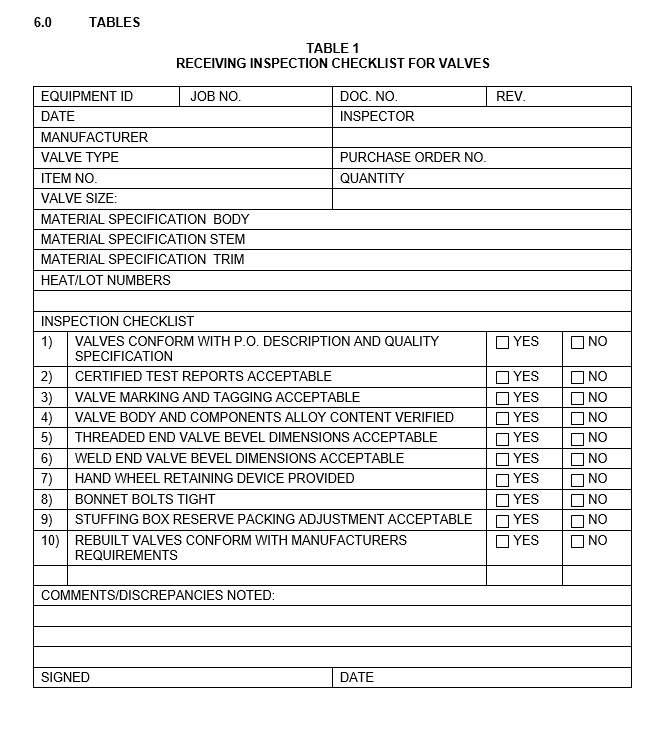
- Inspection of each lot of valves shall be documented using the Receiving Inspection Checklist Form Table 1 or an equivalent method that includes all of the elements of the Inspection Checklist.
© 2026 Inflection Point Engineering, LLC. All rights reserved. The content of this page — including calculation methods, reference data, written analysis, interactive tools, and source code — is the intellectual property of Inflection Point Engineering, LLC and is protected under applicable copyright, trademark, and trade secret laws. Unauthorized reproduction, redistribution, modification, or derivative use in whole or in part is prohibited without prior written consent.
Disclaimer. This material is provided for informational and educational purposes only and does not constitute professional engineering advice. Calculations, reference data, and methodologies are based on published standards and accepted engineering practice but are not a substitute for engineering judgment, site-specific analysis, or review by a licensed Professional Engineer. Inflection Point Engineering, LLC makes no warranties, express or implied, regarding the accuracy, completeness, or fitness for a particular purpose of any content presented here, and shall not be liable for any direct, indirect, incidental, or consequential damages arising from its use. Users assume all risk associated with applying this content to real-world design, operations, or decisions.
© 2026 Inflection Point Engineering, LLC. All rights reserved.