 Section 15 — Inspection
Training, Qualifying & Certifying Personnel for Inspection & Testing of Refinery Equipment
IPE Engineering Practice IPE-EP-15-3-1
Document number: IPE-EP-15-3-1 · Section: 15 — Inspection
SCOPE
- This Practice provides guidelines for the training and defines the requirements for certification of owner personnel engaged in the inspection of pressurized static equipment, piping, and aboveground storage tanks.
- Provides guidelines for the qualifications of personnel who perform inspection activities for: fabrication, installation and commissioning, materials receiving, in service, and maintenance turnaround.
- Describes a system by which accurate records of the training, qualification, and certification of owner inspection personnel shall be produced and maintained.
- Provides a uniform format for gathering and assessing information pertaining to the qualifications and performance of contract inspection personnel and contract inspection organizations.
- Any deviation to this Practice must be approved by the procedure in EP 1–1–3.
- An Asterisk (*) indicates that a decision or action by the Owner or Inspection Authority is required.
- A revision bar indicates all changes made to this Revision.
2.0 REFERENCES
The latest edition of the following standards and publications are referred to herein.
STANDARDS AND PUBLICATIONS
| IPE Engineering Practices |
|---|
| EP 1–1–3 Deviations to IPE Engineering Practices EP 15–1–4 Positive Materials Identification (PMI) EP 15–1–5 Color Coding For Material Identification EP 15–3–2 Training, Qualifying and Certifying Personnel for NDE of Plant Equipment EP 15–5–1 QA/QC Procedures for Commodity Purchases |
| ANSI Standards |
| NB–23 National Board Inspection Code |
| API Standards and Recommended Practices |
| RP 571 Conditions Causing Deterioration or Failures RP 572 Inspection of Pressure Vessels RP 573 Inspection of Fired Boilers and Heaters RP 574 Inspection of Piping, Tubing, Valves, and Fittings RP 575 Inspection of Atmospheric and Low Pressure Storage Tanks RP 620 Design and Construction of Large, Welded Low–Pressure Storage Tanks RP 650 Welded Steel Storage Tanks for Oil Storage |
STANDARDS AND PUBLICATIONS (Cont.)

DEFINITIONS
- Certification – Written testimony of qualification.
- Experience – Time during which an individual is engaged in performing and/or evaluating the results of specific plant equipment inspections, or time spent directing, supervising, and/or monitoring the performance of plant equipment inspections.
- Inspection Authority – The Plant Chief Inspector, Inspector Supervisor, or Chief Inspection Engineer as defined by the Plant management.
- Manufacturer – The recipient of a direct or indirect purchase order for materials and/or equipment. In this context, a direct order is one issued to a Manufacturer by a Contractor or the Owner. An indirect order is one issued to a Manufacturer by a vendor (recipient of a direct order) for materials, fabricated components, or subassemblies.
- Owner – Inflection Point Engineering, LLC.
- Qualification – Demonstrated skill, training, knowledge and experience required for personnel to properly perform the duties of a specific job.
- Training – The program developed to impart the knowledge and skills necessary for qualification.
- Equipment – Plant static equipment used directly in the processing of petroleum and petroleum products. This includes pressure vessels, exchangers, piping, safety valves, storage tanks, fired heaters, and boilers.
GENERAL
- Equipment inspection is a key element in ensuring the safe and reliable operation of plant facilities.
- An effective equipment inspection program includes inspecting equipment and materials during manufacture, receiving and installation at the plant and throughout the service life of the equipment. Inspection personnel with different skills, knowledge, and qualifications are required for each of these areas. This Practice recognizes five general categories of equipment inspection personnel. A brief description of each category and typical activities follows:
- Shop Inspector
- A shop inspector typically conducts inspections at a fabrication or manufacturing facility remote from the plant in which the equipment is to be installed.
- The shop inspector may also be involved in expediting, or may be involved in conducting quality audits of Manufacturers and suppliers.
- Shop inspection personnel normally establish a relationship with a variety of Manufacturer/supplier/fabricators in a given geographic area and, if contracted, may conduct inspections for a number of clients having equipment being manufactured within that area.
- They are employed by either the Owner or a contracted agency for plant purchases, or an engineering company for major contracts.
- Construction Inspector
- A construction inspector is typically involved in on–site fabrication or erection of equipment at a plant location.
- Construction inspectors normally remain at the plant location until a specific project is complete.
- They may be employees of the Owner, a contracted agency, or engineering company.
- Receiving Inspector
- A receiving inspector typically works at a plant receiving warehouse and is engaged in inspecting commodity items.
- This individual may have other responsibilities in addition to receiving inspection.
- Receiving inspectors usually are Owner’s Employees, but may be a contract inspector employed by the Owner.
- Plant inspector
- A plant inspector is involved in the daily operation and maintenance of equipment within an operating plant.
- The plant inspector usually serves as lead or supervisory role during plant turnarounds, and may act as the plant inspection contact during construction of new plant facilities.
- The plant inspector may also perform shop inspections for specialized equipment destined for the operating facility (see paragraph 4.2.1.4 above), or for equipment being manufactured near the facility for other Owner’s Plants.
- The Plant inspector also provides guidance and support for the receiving inspectors or serve as the Receiving Inspector for the more critical equipment.
- Plant Inspectors are usually employees of the Owner but may, under certain circumstances, be employed by a contracted agency.
- Contract Inspector
- A Contract inspector typically works while a plant is operation and/or during a shutdown and is responsible for inspecting equipment for evidence of deterioration during operation, and may ensure correct equipment reassembly when requested.
- Contract Inspectors move to various clients’ facilities shortly before a turnaround begins or during the initial stages of a turnaround, or may work for periods of time while the plant is in operation.
- Some Contract Inspectors have extensive experience working as plant inspectors or as construction inspectors.
- Contract Inspectors usually work for a contracted agency.
SHOP INSPECTOR
- A shop inspector is expected to perform the following activities:
- Review purchase requisitions, specifications, codes, standards, and fabrication drawings in order to determine what types of inspections are required.
- Meet with Manufacturers/fabricators to review equipment manufacturing/fabrication schedules, to discuss witness and hold points for inspections, and to assist in resolving questions concerning the Owner’s requirements.
- Monitor equipment manufacture/fabrication operations to ensure conformance with the Owner’s and other specified requirements, and to ensure that good workmanship is observed.
- Produce and maintain detailed inspection records and reports.
- Audit and evaluate quality systems, particularly quality control aspects.
- A shop inspector is expected to possess the following basic skills and abilities:
- Read and interpret engineering drawings. This includes understanding welding symbols.
- Take accurate physical measurements using rules, tapes, calipers, micrometers, welding gauges, and similar devices.
- Interpret all relevant codes and standards.
- Identify the need for specialist assistance as and when required.
- Be familiar with inspection control systems, certification and documentation, including the use of quality plans.
- Understand the basics of manufacturing processes such as welding, rolling, forging, and casting, and a basic understanding of materials and metallurgy.
- Monitor and interpret destructive tests and nondestructive examinations.
- Be knowledgeable of the normal design and manufacturing techniques of the specific type of equipment for which an inspection is being performed.
- Be knowledgeable of any performance or functionality testing required by applicable EPs or other requirements of the purchase order.
- The education/experience required for shop inspectors are either:
- A minimum of an associate of applied science degree in engineering technology, plus two years of work experience as a shop inspector or work assisting a shop inspector; or
- A minimum of four years work experience as a shop inspector; or,
- A minimum of four years work experience in the design, construction, operation, or maintenance of similar types of plant equipment.
- The qualifications/certifications required for Shop Inspectors are:
- For welding inspection, AWS Welding Inspector Certification (CWI).
- For critical painting or coating applications either:
- National Association of Corrosion Engineers (NACE) Coating Inspector Certification, Level 2 or higher; or
- NACE Corrosion Technician certification or higher.
- For the inspection of boilers or pressure vessels, API 510 Inspector Certification is preferred but not required.
- For performing or evaluating non–destructive examinations, ASNT SNT TC–1A, Level II or Level III Certification by examination.
- For witnessing performance or functionality testing of control, electrical, or rotating equipment, classroom training in the test(s) being performed.
CONSTRUCTION INSPECTOR
- A construction inspector is expected to perform the following activities:
- Review plot plans, drawings, and specifications to determine the extent and type of examinations and inspections that are necessary.
- Review construction schedules and coordinating examination/inspection efforts with schedule critical path.
- Monitor construction activities to ensure conformance with Owner and other applicable quality requirements.
- Produce and maintain accurate inspection records.
- A Construction Inspector is expected to possess the following basic skills and abilities appropriate to the type of equipment and task in progress:
- Read engineering drawings.
- Be familiar with inspection control systems certification and documentation.
- Interpret the relevant codes and standards.
- Take physical measurements using rules, tapes, calipers, micrometers, welding gauges, and similar devices.
- Understand optical survey techniques.
- Understand the basics of site preparation procedures including earthwork, pile driving, concrete and foundation work, structural steel erection.
- Understand the basics of welding processes, including the ability to monitor welder and welding procedure qualifications.
- Perform, monitor, and/or interpret destructive tests and nondestructive examinations.
- Ensure all deficiencies and non–conformances are adequately resolved and recorded.
- Be knowledgeable of the normal design and manufacturing/ fabrication techniques of the specific types of equipment for which an inspection is being performed.
- The education/experience required for Construction Inspectors are either:
- A minimum of an associate of applied science degree in engineering technology, plus two years of work experience as a construction inspector or work assisting a construction inspector; or,
- A high school graduate with a minimum of four years work experience as a construction inspector; or,
- A high school graduate with a minimum of four years experience in the design, operation, or maintenance of similar types of plant equipment; or,
- A high school graduate with four years work experience in a construction trade.
- The qualifications/certifications required for Construction Inspectors are:
- For inspection of earthwork and foundations, formal training in surveying and/or civil engineering.
- For welding inspection, AWS Welding Inspector Certification (CWI).
- For critical painting or coating applications either:
- National Association of Corrosion Engineers (NACE), Coating Inspector Certification, Level 2 or higher; or
- NACE Corrosion Technician certification or higher.
- For the inspection of field constructed boilers or pressure vessels, API 510 Inspector Certification is preferred but not required.
- For performing or interpreting non–destructive examinations, ASNT SNT–TC–1A, Level II or Level III Certification by examination.
- For witnessing performance or functionality testing of control, electrical, or rotating equipment, classroom training in the test(s) being performed.
RECEIVING INSPECTOR
- Receiving inspectors shall be capable of performing the following basic functions:
- Review purchase requisitions and specifications for commodity items to determine the type and extent of inspection that an item is to receive upon receipt at the plant.
- Produce and maintain inspection records.
- Ensure adequate quality documentation is available.
- A receiving inspector is expected to possess the following basic skills and abilities:
- Take physical measurements using rules, tapes, calipers, micrometers, welding gauges, and similar devices.
- Be fully familiar with certification and documentation requirements of various codes/standards and equipment types.
- Be familiar with the requirements of EP 15–1–4, EP 15–1–5 and EP 15–5–1.
- Operate a portable alloy analyzer and interpret the results with respect to required material specification and/or code requirements.
- The following education and experience is required for a Receiving Inspector:
- A minimum of a high school graduate or the equivalent, and
- Three years of experience in plant construction, operation, or maintenance.
CONTRACT INSPECTOR
- A Contract Inspector is expected to produce inspection records and reports, and perform one or more of the following activities:
- Inspect equipment to determine the presence and/or extent of deterioration. This includes
taking physical measurements and performing and evaluating nondestructive examinations.
- Monitor in–plant equipment fabrication, alteration, and/or repair to ensure compliance with applicable codes, standards, and specifications.
- Monitor the disassembly and/or reassembly of plant equipment to ensure equipment integrity and operability, if required by the Plant Inspection Authority.
- A Contract Inspector is expected to possess the following basic skills and abilities:
- Read blueprints, engineering drawings, and isometric sketches. This includes understanding welding symbols.
- Take physical measurements using rules, tapes, calipers, micrometers, welding gauges, and similar devices.
- Understand welding, materials, and metallurgy.
- Perform, monitor, and interpret destructive tests and nondestructive examinations, if required by assignment.
- Understand the basics of normal design and manufacturing/fabrication techniques of the specific type of equipment for which an inspection is being performed.
- The education/experience required for Contract Inspectors is either:
- A minimum of an Associate of Applied Science Degree in Engineering Technology, plus two years of work experience as a plant inspector or work assisting a plant inspector; or,
- A high school graduate and a minimum of four years work experience as a contract or
plant inspector; or,
- A high school graduate and a minimum of four years of experience in the design, construction, operation, or maintenance of similar types of plant equipment.
- Qualifications/certifications which a contract inspector may have are:
- For welding inspection, be an AWS Certified Welding Inspector (CWI).
- For inspection of the application of critical protective coatings be a:
- National Association of Corrosion Engineers (NACE) Certified Inspector, Level 2 or higher; or,
- NACE Certified Corrosion Technician or higher.
- For inspection of boilers, a National Board (NB) Certified Inspector; and for pressure vessels, a NB Certified Inspector or API 510 Certified Inspector.
- For inspection of piping, a API 570 Certified Piping Inspector (This does not apply to NDE thickness data collection).
- For inspection of above ground storage tanks, a Certified API 653 Tank Inspector.
- For performing or interpreting nondestructive examinations required by codes, certified per ASNT document SNT–TC–1A, Level II or higher for the method being used.
PLANT INSPECTOR
- (*) This Practice recognizes that a plant inspection department may consist of personnel with varying degrees of training, experience, and competency. Therefore, only the activities, skills, knowledge, and qualifications of a completely trained and experienced inspector shall be addressed. The plant Inspection Authority shall develop guidelines for defining experience, education, and training requirements for all levels of inspection personnel.
- (*) The plant Inspection Authority shall develop a plan for the certification of the Owner’s plant
inspection personnel.
- The plan shall take into account:
- The jurisdictional requirements,
- The requirements of this Practice, and
- The need for the number and kinds of certified inspectors required by plant inspection assignments.
- The plan shall provide for sufficient time required to gain experience to qualify for certification.
- The plan shall define appropriate training to assist in the preparation for certification.
- (*) Non–certified plant or contract inspection personnel may perform routine periodic inspections on any plant in–service equipment, unless prohibited by jurisdictional requirements, provided an appropriately certified inspector or the Plant Inspection Authority has reviewed the inspection results and accepted the inspection documentation.
- A plant inspector is expected to perform the following activities:
- Review specifications, codes, standards, and fabrication drawings in order to determine what types of inspections are required.
- Perform equipment inspections to ensure safety and reliability. This includes taking physical measurements and performing and/or evaluating nondestructive examinations.
- Monitor in–plant equipment fabrication, alteration, and/or repair to ensure compliance with applicable codes, standards, and specifications.
- Produce and maintain inspection records and reports. This includes:
- Preparing and maintaining code/jurisdictional pressure equipment records.
- Analyzing data, including determination of remaining equipment service life (where practical).
- Providing recommendations for future inspection, repair, and/or replacement.
- Monitor the operating conditions of plant equipment and determine the probable effect of operating upsets on equipment life expectancy and integrity based upon the understanding of the operating unit process, equipment design, and equipment materials.
- A plant inspector is expected to possess the following basic skills and abilities:
- Read blueprints, engineering drawings, and isometric sketches. This includes understanding welding symbols.
- Take physical measurements using rules, tapes, calipers, micrometers, welding gauges, and similar devices.
- Understand the basics of manufacturing processes such as welding, rolling, forging, and casting, and a basic understanding of materials and metallurgy.
- Understand all mainstream inspection methods to ensure these are adequately performed, interpreted and controlled.
- Understand the basics of normal design and manufacturing/fabrication techniques of the specific type of equipment for which inspection is performed.
- Understand the basics of the process design and operating unit function associated with plant equipment.
- Produce concise and accurate inspection reports.
- The education/experience recommended for a plant inspector is either:
- A minimum of an associate of applied science degree in engineering technology, plus two years of work experience as a plant inspector or work assisting a plant inspector; or,
- A high school degree and a minimum of four years work experience in an inspection department; or,
- A high school degree and a minimum of four years experience in the design, construction, operation, or maintenance of similar types of plant equipment.
- Qualifications/certifications which a plant inspector may have are:
- For welding inspection, an AWS Certified Welding Inspector (CWI).
- For inspection of critical protective coating application:
- National Association of Corrosion Engineers (NACE) Certified Coating Inspector, Level 2 or higher; or,
- NACE Certified Corrosion Technician or higher.
- For the inspection of boilers he shall be a National Board (NB) Certified Inspector. For the inspection of pressure vessels, a Certified API 510 Pressure Vessel Inspector.
- For the inspection of piping, a Certified API 570 Piping Inspector.
- For the inspection of above ground storage tanks, a Certified API 653 Tank Inspector.
- For performing or interpreting nondestructive examination required by code, certified per the requirements of RP 15–3–2 for the method being used.
- Plant Inspector Training and Work Experience
- Table 1 provides a suggested (not required) knowledge base for the plant inspector category. The fully trained inspector should have a working knowledge in those subjects specified by the outline within seven years of entering the plant inspection department.
- Training may be provided by any combination of courses from accredited colleges, junior colleges, technical institutes, professional organizations, company sponsored courses of training programs, and on–the–job–training (provided it can be documented).
- A detailed resume documenting experience citing previous employer, supervisor, and dates of employment for which training/experience was received.
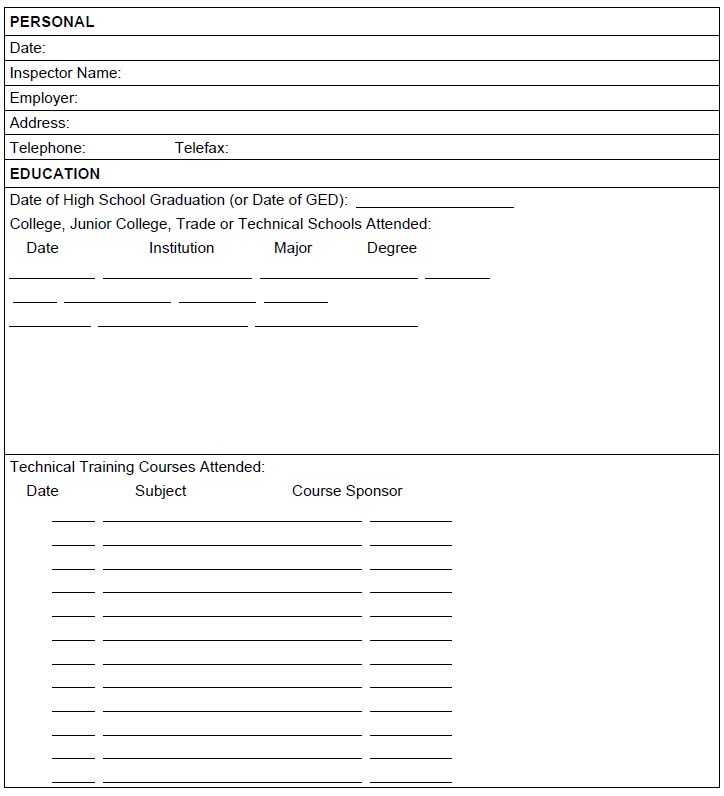
- (*) Evaluation of an individuals’ training and work experience shall be conducted by the Inspection Authority at each Owner Plant utilizing Form 1 and Form 2 or other suitable documentation.
- (*) The Inspection Authority or his designee shall maintain current documentation that lists the training and work experience level of each inspector.
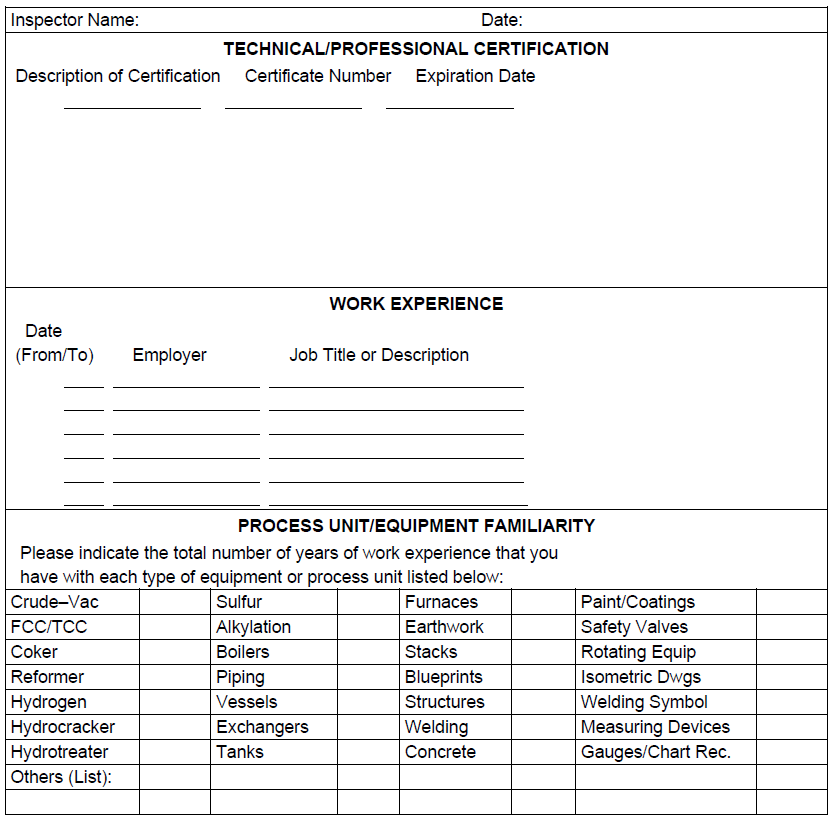
- In order to document each inspector’s training and work experience the survey form provided by Form 2 or other suitable documentation shall be completed. This form is subsequently used for data entry.
SHOP, CONSTRUCTION, AND CONTRACT INSPECTOR REQUIREMENTS
- All contracted inspectors, regardless of category, performing inspections for the Owner shall be required to provide evidence of their qualifications to the Plant Inspection Authority for whom inspection is being performed.
- The inspector shall demonstrate his qualifications by documenting past experience by completing Form 2 or other suitable documentation:
- Records of inspector qualifications shall include:
- A currently completed listing of the inspector’s training and work experience.
- A copy of training documentation.
- The most recent eye test (visual acuity test) results.
- Copies of all supplemental certificates/credentials (i.e. AWS CWI certificate, Level II NDT certificate).
- (*) The Inspection Authority shall maintain on file suitable documentation that demonstrates the qualifications of contract inspectors.
- Copies of all documented qualifications shall be provided to all the other Owner’s Inspection Authorities and to the Engineering Services Inspection Specialist, who shall maintain a data base of all contracted inspection personnel.
- (*) The Plant Inspection Authority has the right to waive specific education, experience, and/or certification requirements for any contracted inspector as long as the reasons are documented.
CONTRACT INSPECTION AGENCY EVALUATION
- If requested, contract inspection organizations shall complete the Contractor Information Form, Form 3, or other suitable documentation, and return it to the Owner’s representative requesting services prior to issuance of inspection contracts.
- Contract inspection organizations shall complete the Contractor Information Form, Form 3, and return it to the Owner’s representative requesting services prior to issuance of inspection contracts. This form shall be used for a Contract Inspection Agency database.
- A separate training and work experience survey form, provided as Form 2 or other suitable documentation, shall be completed by the contractor for each inspector offered for service.
- Contract organizations shall be evaluated by the Owner’s Representative as applicable.
- Contractors shall either directly employ, or represent the personnel whose services they offer.
- Contractors shall submit only personnel for services whose credentials currently meet or exceed those listed in Sections 5.0, 6.0, and 8.0 of this Practice for the applicable inspector category.
- Contractors shall have written procedures for training, qualifying, and certifying in–house personnel and fully evaluating external sub–contract personnel for inspection and non– destructive examination.
- Contract inspection agencies selected for in–plant contracts shall be evaluated for performance upon completion of the contract term.
- Evaluation shall be made using the Contractor Performance Evaluation form, Form 4 or other suitable documentation.
- (*) Information provided by these forms shall be maintained by the Inspection Authority for future reference.
- Copies of the databases shall be sent to the Engineering Services Inspection Specialist. The data from each plant will be merged, and a master database will be produced for distribution.
CONTRACT INSPECTOR EVALUATION
- (*) Contract Inspectors shall be evaluated by the Plant Inspection Authority or a member of his department who is knowledgeable of the Contract Inspector’s performance upon completion of the contract term.
- Contract Inspector evaluations shall be made using the Contract Inspector Performance Evaluation form, Form 5 or other suitable documentation. This form permits assignment of a five level performance rating for each individual for each task, skill, or objective and permits assignment of an overall rating for each individual.
- Individuals given a level 5 rating are above standard. This individual will consistently exceed all objectives and expectations.
- Level 4 individuals maintain a high standard. This individual consistently provides better than normal performance.
- Level 3 individuals are standard. This individual will consistently meet expectations and occasionally exceed them.
- Level 2 Individuals are below standard. This individual does not regularly meet his/her assignment objectives.
- Level 1 is the lowest level. This individual is a non–performer, and seldom or never meets his/her objectives.
- (*) The results of Contract Inspector evaluations shall be maintained by the Inspection Authority.
- The results of Contract Inspector evaluations will become part of a database. Once each year the database from each plant will be consolidated by Engineering Services and a print out will be provided for use by all plant locations.
13.0 TABLES
TABLE 1
PLANT INSPECTOR SUGGESTED KNOWLEDGE LEVEL OUTLINE
| SUBJECT | LEVEL OF KNOWLEDGE SUGGESTED |
|---|---|
| DRAWING INTERPRETATION Orthographic Projection |
Principles Only |
| B. Isometric Drawings | Principles Only |
| Drawing Symbols Welding Symbols Machining and Finishing Symbols |
Principles Only |
| D. Drawing Notes | Principles Only |
| VISUAL INSPECTION TOOLS AND EQUIPMENT Optical Devices Magnifiers and Mirrors Borescope Measuring Devices Direct Reading Rules and Scales Vernier Scales Micrometers Welding Gauges Pit Gauges UT Electronic Calipers Pyrometers and Temperature Indicating Crayons Hardness Testing Devices Rockwell Tester Brinnell Tester Telebrinneller Equotip Hardness Tester Other testers as applicable |
Detail |
| 3. NONDESTRUCTIVE EXAMINATION | See EP 15–3–2 |
| BASIC PLANT METALLURGY Principles of Alloying Reasons for Alloying Classifications of Alloys Mechanical Properties of Alloys |
Principles Only |
TABLE 1 (Continued)
PLANT INSPECTOR SUGGESTED KNOWLEDGE LEVEL OUTLINE
| SUBJECT | LEVEL OF KNOWLEDGE REQUIRED |
|---|---|
| BASIC PLANT METALLURGY (Continued) Carbon Steel Roll of carbon in steel Advantages and Disadvantages Uses |
Principles Only |
| Low Alloy Steels Roll of Chromium in Steel Advantages and Disadvantages Uses |
Principles Only |
| Stainless Steels Types of Stainless Steels Advantages and Disadvantages Uses |
Principles Only |
| Non–Ferrous Alloys Classifications of Non–ferrous Alloys Advantages and Disadvantages Uses |
Principles Only |
| Deterioration and Failure Modes of Materials Overload Fatigue (mechanical and thermal) Brittle Failure Graphitization Carburization Creep and Creep Rupture Embrittlement |
Details |
| BASIC PLANT CORROSION Definition of Corrosion Classification of Corrosion Mechanisms and their causes. Description of each mechanism and where they are likely to occur in plant processes. Description of each mechanism and where they are likely to occur in plant processes. Inspecting for corrosion. |
Details |
TABLE 1 (Continued)
PLANT INSPECTOR SUGGESTED KNOWLEDGE LEVEL OUTLINE
| SUBJECT | LEVEL OF KNOWLEDGE REQUIRED |
|---|---|
| MANUFACTURING PROCESSES Welding Welding Terminology |
Detail |
| 2. Welding Processes (Advantages/Disadvantages/Problems) | Principles Only |
| 3. Post Weld Heat Treatment | Principles Only |
| 4. Weld Discontinuities | Principles Only |
| Welder and Welding Procedure Welding Procedure Specification Welding Procedure Qualification Record Welder Performance Qualification Testing |
Detail |
| Weld Joint Design Weld Joint Nomenclature Typical Weld Joint Configurations |
Principles Only |
| Welding Techniques Typical Pipe Welding Techniques Typical Pressure Vessel Welding Techniques Typical Structural Welding Techniques Weld Repair Methods and Techniques |
Principles Only |
| Pre–Inspection Joint Preparation Welding Parameters Fit–Up Preheat |
Detail |
| In–Process Inspection Control of Welding Consumables Tack Weld Inspection Control of Interpass Temperature Weld Root Inspection Interpass Cleaning Backgouging Hot Pass Inspection Inspection of Filler Passes |
Detail |
TABLE 1 (Continued)
PLANT INSPECTOR SUGGESTED KNOWLEDGE LEVEL OUTLINE
| SUBJECT | LEVEL OF KNOWLEDGE REQUIRED |
|---|---|
| MANUFACTURING PROCESSES (Continued) Welding (Continued) Final Weld Inspection Weld Cap Profile and Appearance Welder Stencils |
Detail |
| Paint and Coating Application Surface Preparation Wet Coating Thickness Dry Coating Thickness Holiday Detectors Humidity Measurements |
Detail |
| 1. Refractory Application Refractory Types Refractory Application Inspection of Mix Inspection of Anchors and Mesh Inspection of Applied Refractory Inspection of Cured Refractory Inspection of Existing Refractory Refractory Repair |
Principles Only |
| Casting Green Sand Casting Investment Casting |
Principles Only |
| E. Forging | Principles Only |
| Manufacture of Pipe/Tubing Seamless Welded Electric Resistance Welded Fusion Welded |
Principles Only |
TABLE 1 (Continued)
PLANT INSPECTOR SUGGESTED KNOWLEDGE LEVEL OUTLINE
| SUBJECT | LEVEL OF KNOWLEDGE REQUIRED |
|---|---|
| MANUFACTURING PROCESSES (Continued) Manufacture of Pipe Fittings Elbows Forged Static Cast Fabricated Tees Hot Formed Cold Formed Fabricated Reducers |
Principles Only |
| H. Drawing | Principles Only |
| I. Extrusion | Principles Only |
| J. Machining | Principles Only |
| PLANT EQUIPMENT Towers Drums Shell and Tube Exchangers Air Cooled Exchangers Storage Tanks Furnaces, Heaters, and Stacks Pressure Relief Safety Valves Pipe, Fittings, and Valves |
Principals Only |
TABLE 1 (Continued)
PLANT INSPECTOR SUGGESTED KNOWLEDGE LEVEL OUTLINE
| SUBJECT | LEVEL OF KNOWLEDGE REQUIRED |
|---|---|
| CODES AND STANDARDS American Petroleum Institute (API) API 510 API 570 API 571 API 572 API 573 API 574 API 575 API 620 and 650 API 653 API 750 |
Detail Detail Detail Detail Detail Detail Detail Detail Principals Only Detail Principals Only |
| American National Standards Institute (ANSI) ANSI B31.1 ANSI B31.3 |
Principals Only |
| American Society of Mechanical Engineers (ASME) ASME Section I ASME Section II, Parts A, B, and C ASME Section V ASME Section VIII |
Principals Only |
| D. Tubular Exchangers Manufacturers Assoc. (TEMA) | Principals Only |
| E. American Society for Testing of Materials (ASTM) | Principles Only |
| American Welding Society (AWS) AWS D1.1 |
Principles Only |
| G. National Association of Corrosion Engineers (NACE) | Principles Only |
| H. IPE Engineering Practices | Principals Only |
TABLE 1 (Continued)
PLANT INSPECTOR SUGGESTED KNOWLEDGE LEVEL OUTLINE
| SUBJECT | LEVEL OF KNOWLEDGE REQUIRED |
|---|---|
| PROCESSES Crude–Vac FCC/TCC Coker Reformer Hydrogen Hydrocracker Hydrotreater Sulfur Alkylation |
Principles Only |
| PREPARATION OF REPORTS Data Collection Checklists Report Forms Technical Writing Personal Computers |
Detail |
14.0 FORMS
FORM 1
PLANT INSPECTOR KNOWLEDGE LEVEL EVALUATION CHECKLIST
| Date: | Date: |
|---|---|
| Inspector Name: | Inspector Name: |
| Employer : | Employer : |
| Address : | Address : |
| Inspector Category: | Inspector Category: |
| TRAINING COMPLETE TRAINING SUBJECT (List Training Source) |
TRAINING COMPLETE TRAINING SUBJECT (List Training Source) |
| 1. Blueprint Reading: | |
| 2. Visual Inspection Tools: | |
| 3. Nondestructive Examination: | |
| 4. Basic Metallurgy: | |
| 5. Mechanical Properties of Metals: | |
| 6. Corrosion and Erosion: | |
| 7. Manufacturing Processes: | |
| 8. Plant Equipment: | |
| 9. Codes and Standards: | |
| 10. Process Units: | |
| 11. Report Preparation: |
FORM 2
INSPECTOR TRAINING AND WORK EXPERIENCE SURVEY FORM
FORM 2 (Continued)
INSPECTOR TRAINING AND WORK EXPERIENCE SURVEY FORM
FORM 3
CONTRACT INSPECTOR INFORMATION FORM
NOTE: A COMPLETED TRAINING AND WORK EXPERIENCE SURVEY FORM MUST BE PROVIDED FOR EACH
INSPECTOR AVAILABLE FOR Inflection Point Engineering, LLC WORK.
| Date: | |||
|---|---|---|---|
| Contractor Name: | |||
| Mailing Address: | |||
| Physical Address: | |||
| Phone Number: | Telefax Number: | ||
| Contact: | |||
| List any additional office locations: | |||
| Length of time Contractor has been involved in providing Inspector services: | Length of time Contractor has been involved in providing Inspector services: | Length of time Contractor has been involved in providing Inspector services: | Length of time Contractor has been involved in providing Inspector services: |
| Total number of personnel directly employed by Contractor: | Total number of personnel directly employed by Contractor: | Total number of personnel directly employed by Contractor: | Total number of personnel directly employed by Contractor: |
| Total number of Inspectors directly employed: | Total number of Inspectors directly employed: | Total number of Inspectors directly employed: | Total number of Inspectors directly employed: |
| Total number of Contract Inspectors represented: | Total number of Contract Inspectors represented: | Total number of Contract Inspectors represented: | Total number of Contract Inspectors represented: |
| How many of the above listed Contract Inspectors are represented exclusively by Contractor? | How many of the above listed Contract Inspectors are represented exclusively by Contractor? | How many of the above listed Contract Inspectors are represented exclusively by Contractor? | How many of the above listed Contract Inspectors are represented exclusively by Contractor? |
| Please indicate the total number of Inspectors possessing each of the following Certifications: NBIC Owner/User Certification: |
Please indicate the total number of Inspectors possessing each of the following Certifications: NBIC Owner/User Certification: |
Please indicate the total number of Inspectors possessing each of the following Certifications: NBIC Owner/User Certification: |
Please indicate the total number of Inspectors possessing each of the following Certifications: NBIC Owner/User Certification: |
| State/Jurisdictional Owner/User Certification: | State/Jurisdictional Owner/User Certification: | State/Jurisdictional Owner/User Certification: | State/Jurisdictional Owner/User Certification: |
| API 510 Pressure Vessel Inspector: | API 510 Pressure Vessel Inspector: | API 510 Pressure Vessel Inspector: | API 510 Pressure Vessel Inspector: |
| AWS Certified Welding Inspector: | AWS Certified Welding Inspector: | AWS Certified Welding Inspector: | AWS Certified Welding Inspector: |
| SNT–TC–1A Level II or III: | MT: PT: | RT: | UT: |
| NACE Coating Inspector Level II or III: | NACE Coating Inspector Level II or III: | NACE Coating Inspector Level II or III: | NACE Coating Inspector Level II or III: |
| NACE Accredited Corrosion Technician: | NACE Accredited Corrosion Technician: | NACE Accredited Corrosion Technician: | NACE Accredited Corrosion Technician: |
| Registered Land Surveyor: | Registered Land Surveyor: | Registered Land Surveyor: | Registered Land Surveyor: |
| Registered Professional Engineer: | Registered Professional Engineer: | Registered Professional Engineer: | Registered Professional Engineer: |
| Does Contractor have written procedures for Inspector Training, yes Qualification and Certification? (If yes, please attach copy of list) no |
Does Contractor have written procedures for Inspector Training, yes Qualification and Certification? (If yes, please attach copy of list) no |
Does Contractor have written procedures for Inspector Training, yes Qualification and Certification? (If yes, please attach copy of list) no |
Does Contractor have written procedures for Inspector Training, yes Qualification and Certification? (If yes, please attach copy of list) no |
FORM 4
CONTRACT INSPECTION AGENCY PERFORMANCE EVALUATION FORM
| Date: Contractor Name: Mailing Address: Contractor Start Date: Contractor Finish Date: |
|---|
| List number of each Type (category) of Inspector(s) provided by Contractor: Shop Inspector Construction Inspector Contract Inspector |
| Provide a Summary of Inspector Ratings for Personnel provided by this Contractor: Number of Inspectors Rated Grade 5 Number of Inspectors Rated Grade 4 Number of Inspectors Rated Grade 3 Number of Inspectors Rated Grade 2 Number of Inspectors Rated Grade 1 |
| Did Contractor furnish and maintain required equipment: Yes No If no, please explain: |
| Provide a Summary of Contractor Performance: |
| Would you consider this Contractor for rehire: If not, please explain: Yes No |
| Date IPE Inspection Authority |
FORM 5
CONTRACT INSPECTOR PERFORMANCE EVALUATION FORM
| Inspector Name: Evaluation Date: Employer: Start Date: Finish Date: Job Assignment: |
Inspector Name: Evaluation Date: Employer: Start Date: Finish Date: Job Assignment: |
Inspector Name: Evaluation Date: Employer: Start Date: Finish Date: Job Assignment: |
Inspector Name: Evaluation Date: Employer: Start Date: Finish Date: Job Assignment: |
|---|---|---|---|
| Evaluate this individual in each of the following areas based upon your observations and knowledge of job performance | Rating Check One |
Rating Check One |
Rating Check One |
| 1. Communications: Performance is satisfactory when the inspector follows verbal or written instructions |
1 4 |
2 5 |
3 |
| accurately, oral and written reports are accurate and reports are readily understood. | |||
| 2. Inspection Job Knowledge: Performance is satisfactory when the inspector demonstrates knowledge of the |
1 4 |
2 5 |
3 |
| required techniques, methods, technical skills, and equipment associated with an | |||
| inspection task. | |||
| 3. Judgment: Performance is satisfactory when the inspector recognizes priorities, makes sound |
1 4 |
2 5 |
3 |
| decisions, and acts affirmatively upon conclusions. | |||
| 4. Quality Control: Performance is satisfactory when the inspector demonstrates an interest in ensuring |
1 4 |
2 5 |
3 |
| that proper materials and procedures are being used. | |||
| 5. Initiative: Performance is satisfactory when the inspector takes all necessary actions to ensure |
1 4 |
2 5 |
3 |
| successful completion of his/her task, spending maximum time performance inspection | |||
| tasks, and minimum time engaged in nonproductive endeavors. | |||
| 6. Leadership: Performance is satisfactory when inspector demonstrates the ability to direct |
1 4 |
2 5 |
3 |
| operations associated with inspection tasks, and requires minimum supervision. |
FORM 5 (Continued)
CONTRACT INSPECTOR PERFORMANCE EVALUATION FORM
| Inspector Name: | Inspector Name: | Inspector Name: | Inspector Name: |
|---|---|---|---|
| Rating Check One |
Rating Check One |
Rating Check One |
|
| 7. Adaptability: Performance is satisfactory when inspector adapts positively to new or changing |
1 4 |
2 5 |
3 |
| circumstances and ambiguous or pressured situations. | |||
| 8. Planning and Organizing: Performance is satisfactory when inspector rapidly determines what a task requires, |
1 4 |
2 5 |
3 |
| obtains the necessary tools, equipment, and documentation, and accomplishes his/her | |||
| task within specified time frame. | |||
| 9. Integrity: Performance is satisfactory when inspector verbal or written reports are accurate and |
1 4 |
2 5 |
3 |
| performed inspections are reliable. | |||
| 10. Punctuality: Performance is satisfactory when inspector shows up on time for work, works until |
1 4 |
2 5 |
3 |
| quitting time, and does not take above scheduled break periods. | |||
| OVERALL PERFORMANCE: Assign an overall rating for this individuals performance |
1 4 |
2 5 |
3 |
| COMMENTS: , Date: IPE Inspection Authority |
COMMENTS: , Date: IPE Inspection Authority |
COMMENTS: , Date: IPE Inspection Authority |
COMMENTS: , Date: IPE Inspection Authority |
© 2026 Inflection Point Engineering, LLC. All rights reserved. The content of this page — including calculation methods, reference data, written analysis, interactive tools, and source code — is the intellectual property of Inflection Point Engineering, LLC and is protected under applicable copyright, trademark, and trade secret laws. Unauthorized reproduction, redistribution, modification, or derivative use in whole or in part is prohibited without prior written consent.
Disclaimer. This material is provided for informational and educational purposes only and does not constitute professional engineering advice. Calculations, reference data, and methodologies are based on published standards and accepted engineering practice but are not a substitute for engineering judgment, site-specific analysis, or review by a licensed Professional Engineer. Inflection Point Engineering, LLC makes no warranties, express or implied, regarding the accuracy, completeness, or fitness for a particular purpose of any content presented here, and shall not be liable for any direct, indirect, incidental, or consequential damages arising from its use. Users assume all risk associated with applying this content to real-world design, operations, or decisions.
© 2026 Inflection Point Engineering, LLC. All rights reserved.