 Section 14 — Equipment Protection & Package Units
Export Protection and Packaging of Equipment
IPE Engineering Practice IPE-EP-14-1-5
Document number: IPE-EP-14-1-5 · Section: 14 — Equipment Protection & Package Units
SCOPE
- This Practice supplements the requirements of the Purchase Order and contains additional packaging requirements to be applied to exported items for their protection and identification during shipping, handling, and storage. Exported items are those shipped outside their country of manufacture.
- The Manufacturer shall package export items to protect them from corrosion, damage, and theft during shipping, multiple handling, and storage for the specified climatic conditions. Items that will experience shipping and storage time in excess of 12 months shall receive special consideration.
- Any deviation to this Practice must be approved by the procedure described in EP 1-1-3.
- An asterisk (*) indicates that additional information is required. If a job is contracted, this information will be furnished by the Purchaser.
2.0 REFERENCES
The latest edition of the following standards and publications are referred to herein.
STANDARDS AND PUBLICATIONS
DEFINITIONS
- Contractor - Company or business that agrees to furnish materials or perform specified services at a specified price and/or rate to the Owner.
- Inspection - An activity to check that design, materials, fabrication, and testing comply with the requirements of the specification.
- Manufacturer - The recipient of a direct or indirect purchase order for materials and/or equipment. In this context, a direct order is one issued to a Manufacturer by a Contractor or the Owner. An indirect order is one issued to a Manufacturer by a vendor (recipient of a direct order) for materials, fabricated components, or subassemblies.
- Owner - Inflection Point Engineering, LLC
- Owner's Engineer - A Inflection Point Engineering, LLCappointed engineer.
- Purchase Order - The contractual document given to the Manufacturer to authorize a purchase.
- Purchaser - The party placing a direct purchase order. The Purchaser is the Owner's designated representative.
DOCUMENTATION
- Documents to be Submitted by the Manufacturer
The Manufacturer shall submit to the Purchaser in advance of shipment:
- The Manufacturer's standard protecting and packing procedure.
- Loading or transport diagrams for those items specified by the Purchaser.
- Instructions indicated in paragraph 4.2 when items are ready for shipment.
- A master shipping list listing the following information as a minimum:
- Purchase Order and Requisition numbers
- Contractor reference number and name
- Item or tag number and item name
- Gross and net weight in pounds and mass in kilograms of each package
- Dimensions of each package in feet and millimeters
- Destination and consignee address
- Detailed description of the contents of each package
- Quantities of each item or subassembly required for complete shipment
- Whether shipment is complete and shipment number is applicable
- Number of packages in the shipment
- Origin of item
- Item tariff numbers
- For crates exceeding either 100,000 lbs., 40 feet in length, or 8 feet in width or height, a shipping diagram is to be provided to the Purchaser's Traffic Department three months before readiness to ship. The shipping diagram shall show weight, overall length, width, height, center of gravity, and location of sling marks or lifting points.
- Documents to be Included with the Shipment
The Manufacturer shall attach, to the largest package in each shipment, the master shipping list and instructions indicated below in such a manner that they are accessible without opening the package. The package shall indicate that this information is attached. Instructions shall include but not be limited to:
- Instructions and data applicable to the Manufacturer's guarantee.
- Instructions and location for removal of packing and protective coatings.
- Instructions for assembling components of the item.
- Protective measures and maintenance of item for the following circumstances:
- It protective coatings, plugs, seals, or packaging are removed.
- If installed and left standing in an open unprotected site.
- If left undisturbed in shipping containers and stored.
- If periodic maintenance or operation is required.
- If long standing or non-operating time would be detrimental.
- If indoor storage or temperature control is required.
PROTECTION AND PACKAGING
- General
- All items shall be clear of debris, thoroughly clean inside and out, and free of any dirt and foreign matter before preparation for shipment.
- (*) Items shall not be transported as open above deck cargo without prior written approval of the Purchaser.
- Items should be nested to reduce volume if resulting bundles do not increase risk of damage. Items subject to damage by rubbing shall be separated by wooden cribbing strips to prevent them from rubbing together. Pipe shall not be internally nested.
- Special tools shall be separately crated, shipped, identified with the item on which they are to be used, and marked as special tools.
- Spare parts shall be shipped in separate packages clearly marked "spares" and identified with the item they are to be used on.
- As a minimum, packaging and protection of special equipment shall be in accordance with Table 1.
- Equipment
- Equipment shall be shipped bolted to the package base, whenever possible. Equipment not bolted to the base shall be protected and held in a fixed position by chocks, bracing, or packing material.
- Shipping saddles, cradles, bolsters, and chock blocks shall be contoured to the outside curvature of equipment and located so that local bending or damage of the equipment will not occur. Steel wrapper plates shall be used, when necessary, to distribute the load and protect the equipment.
- Equipment shall be shipped fully assembled whenever possible with all auxiliary components properly braced. Auxiliary components shall not extend beyond the edges of the shipping base.
- When it is not possible to ship the equipment fully assembled, it shall be the Manufacturer's responsibility to knock-down the equipment so that it can be properly packed and protected. Knock-down assemblies shall be packaged and shipped together. Internal bolting, gaskets, and small attachments susceptible to damage shall be separately packaged, identified, and attached to the main item.
- Cylindrical equipment shall be mounted on shipping saddles. When possible, installation saddles on equipment should be used as shipping saddles.
- Rotating equipment shall be braced so that shafts do not rotate or displace axially during shipment. Brushes shall be lifted and the slip rings coated with rust-resisting compound.
- Protection
- All threaded, beveled, and machined surfaces shall be protected from corrosion and damage from use of powered equipment and rough handling.
- All items shall be clean before application of any anti-corrosive material. Machined and bright surfaces shall be coated with an anti-corrosive material.
- Items with exposed rubber parts or linings shall be wrapped with an opaque, air-tight plastic cover secured with tape. Desiccant shall not be used to protect rubber products.
- Items subject to damage by water or humidity shall receive additional protection as required. Components with non-drainable crevices or chambers, shall be covered and protected at all times from entrance of water and debris.
- Internal surfaces subject to rusting shall be protected by vapor phase inhibitors, rust preventatives or by a suitable desiccant. After treatment, all openings must be plugged or otherwise sealed.
- Pump and compressor interiors shall be coated or flushed with an easily removable anti- corrosive material. Lube oil and auxiliary piping shall be flushed with a corrosive preventative material that is soluble in the fluid to be carried by the piping. Packing shall be placed in a separate container and shipped with the item.
- Rust inhibitors shall be compatible with the normal charge of oil or easily removed by flushing when used on lubricated parts. Oil recommended for normal operation or a compatible substitute shall be used when filling or flushing.
- Desiccant with an easily read humidity indicator shall be required in all types of protection and packaging where condensation or vapor diffusion across vapor barriers would create a condition in the interior of the package harmful to the contents. Desiccant shall be fully contained in bags to prevent dispersion, securely fixed in place, and easily removed. Package shall indicate that desiccants shall be checked weekly and changed as necessary.
- Materials which will deteriorate in the presence of water or moisture shall be packed and shipped in waterproof vapor tight containers.
- All stainless steel pipe shipped separately shall be protected against exposure to the atmosphere and dirt during shipment and storage. The ends of the pipe shall be capped and the entire length shall be sleeved with polyethylene. All edges of the sleeves shall be heat sealed. All pipe shall be crated to prevent damage to the pipe and the protective sleeve during shipment.
ADDITIONAL REQUIREMENTS FOR PRESSURE VESSELS AND TANKS
- General
- Auxiliary components and welded nozzle attachments shall be properly braced and prepared for shipment so that adequate protection is given to the attachments during shipment and storage. Small diameter cantilevered nozzles may require temporary or permanent bracing.
- Fabricated assemblies of curved or bent sections should be nested to reduce volume if the resulting bundles do not increase risk of damage. Items subject to damage by rubbing shall be separated by wooden cribbing strips to prevent them from rubbing together.
- Requirements for purged equipment shall be per Table 1.
- Materials and Components
- Refractory, not installed in the equipment shall be separately packaged. Internal bolting gaskets, and small attachments susceptible to damage shall be separately packaged, identified, and attached to the main item.
- As a minimum, packaging and protection of materials and components for pressure vessels and tanks shall be in accordance with Table 2.
PACKAGE DESIGN
- General
- The Manufacturer's standard crate, skid, and pallet design can be used if they meet the requirements contained herein.
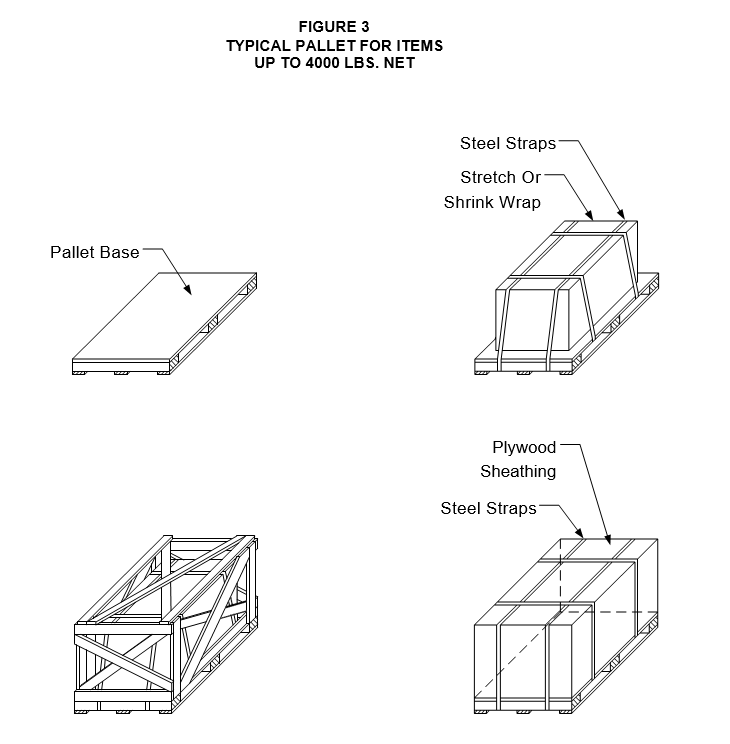
- Containerized and unitized packing procedures shall be used to the greatest extent possible.
- All crates, skids, and pallets shall be suitable for use with slings and fork lifts, and shall be suitable for rail, truck, barge, and ship transport.
- All crates, open or sheathed, and palletized items shall be capable of supporting a stacked load of a similar item during transit.
- Crates requiring waterproofing shall be lined with a waterproof material between the sheathing and the framing members, overlapped sections shall be sealed with a waterproof adhesive. The top cover shall have two layers of a waterproof material.
- When ventilation is required, floor boards may be spaced 3/8 inch apart or a series of suitable holes, appropriately spaced, may be drilled if the base is plywood.
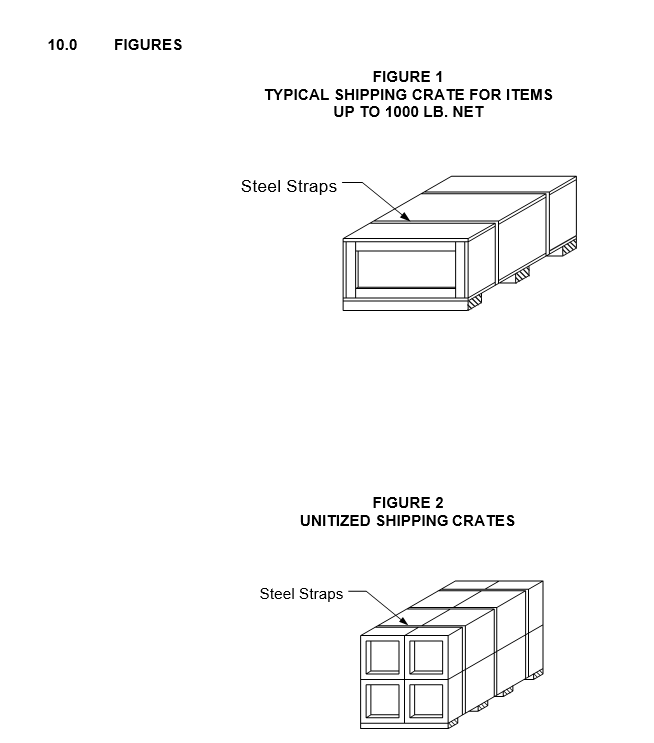
- All crates shall have a minimum of two steel straps on approximately 2 foot centers. Crates over 1000 lbs. shall have all faces strapped. Bundles shall have a minimum of three steel straps on no more than 5 foot centers.
- Shipping Crate
- A typical shipping crate, for items up to 1000 lb. net, is shown in Figure 1. Crates shall be designed for use with slings and fork lifts.
- Small shipping crates and items sufficiently protected shall be either unitized as in Figure 2, palletized as in Figure 4, or packed in larger shipping crates or shipping containers to facilitate handling.
- Pallets
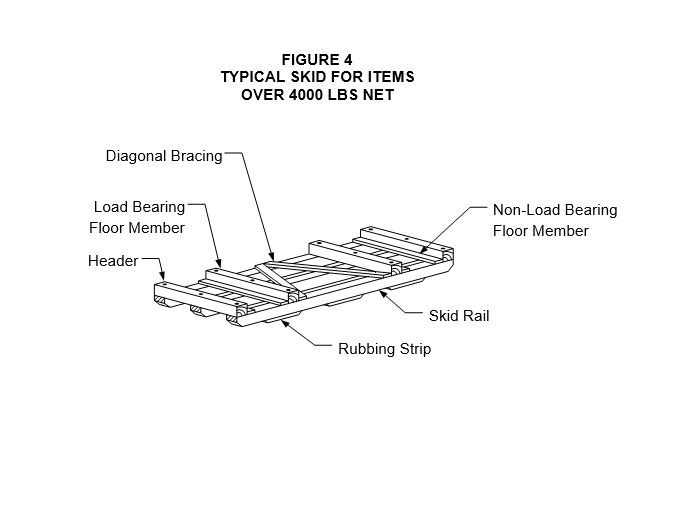
- Pallets shall be designed to be sufficiently rigid so as to prevent damage during handling and storage. The maximum pallet load shall be 4000 lb. The pallet size and shape shall suit the items being shipped.
- Palletized items shall be securely strapped and attached to the pallet base. Items may require further protection by the addition of stretch or shrink wrapping, open-sided, or fully sheathed crates. All bags shall be palletized and stretch and shrink wrapped. A typical pallet base with progressive degrees of protection is shown in Figure 3.
- Skids
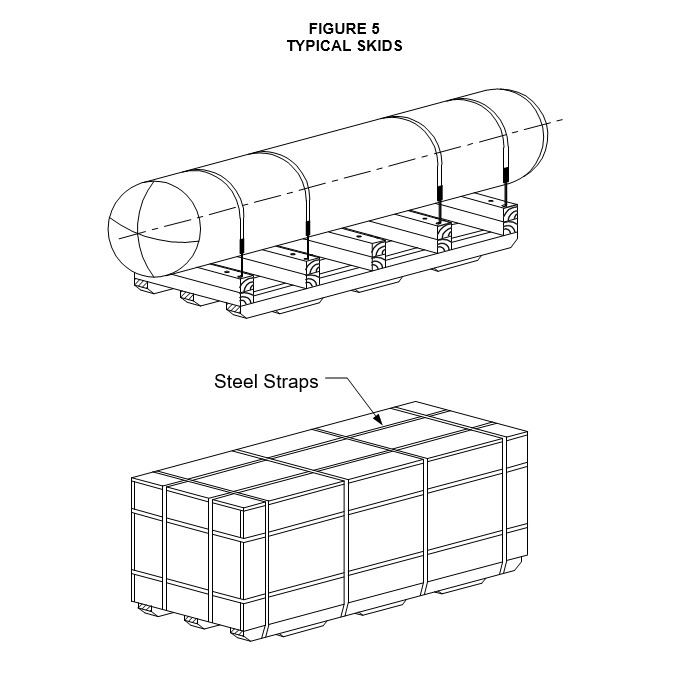
- Items exceeding 4000 lb. net shall be shipped on a skid assembly. A typical skid assembly is shown in Figure 4. Skids with progressive degrees of protection are shown in Figure 5.
- Skids shall be designed to be sufficiently rigid with lifting points arranged so as to prevent damage during handling.
- Skid rails, headers, and load beam members shall be bolted together. Bolts shall be counter sunk and have washers on both ends.
- Skid rails and headers shall be the same size.
- Plywood
- Plywood sheathing shall be a minimum 3/8 inch for crates up to 1000 lbs. and a minimum 1/2 inch for crates over 1000 lbs. Plywood shall be structural grade exterior plywood.
- Crates with plywood sheathing shall have each face reinforced by spanning the short direction with members spaced approximately on 24 inch centers.
- Flat crates (height one fourth the width) shall have diagonal bracing on the two large faces.
- Lumber
- Lumber shall be new, sound, and dried, with no fungus or decay. Lumber sheathing shall have a minimum nominal thickness of 1 inch.
- Crates with lumber sheathing and open sided crates shall have diagonal bracing on all faces.
MARKING
- Shipping Marks
- Shipping marks shall be applied to the top and two opposite sides of crates.
- Shipping marks for bundled material shall be applied to galvanized sheet metal tags attached to both ends of the bundle. Markings shall be stamped or stenciled with waterproof paint and shellacked over. The strapping of the bundle shall be inserted through the top and bottom of the tag. On small bundles the tags may be secured with tie wire.
- Lifting instructions, caution signs and spreader-bar lift locations to be exercised at transfer points shall be clearly noted. Fragile areas shall be marked "DO NOT LIFT HERE." Items that weigh 20,000 lbs. or more shall be marked with center of gravity and sling marks.
- Items with breakable lining material shall be clearly marked with specific and informative cautions to prevent damage due to rough or incorrect handling.
- Attachments to items which have been removed and packaged separately shall be clearly marked with the appropriate item number.
- Pictorial Marks
- The pictorial markings, shown in Figure 6, shall be stenciled directly on all packages as required to facilitate proper handling. Cautionary basic text may appear below the symbol in the national language of the country of origin and destination.
- Symbols should be black. However, if the color of the package is such that the marking does not show clearly, a panel of suitable contrasting color, preferably white, should be provided as a background.
- The number of identical markings is at the discretion of the Seller and should depend on the size and shape of the package. Pictorial markings should be placed above and to the left of the shipping mark.
- The symbols for "SLING HERE" and "CENTER OF GRAVITY" shall be placed in the correct position in order to indicate the intent of the symbol. The symbol for "THIS WAY UP" should be placed on the two top corners of a face of the package and may be repeated on the other vertical faces.
- The overall size of the symbols should be either 4, 6, or 8 inches depending on package size. Symbols in Figure 6 are shown in their recommended proportions.
9.0 TABLES
TABLE 1
PACKAGING AND PROTECTION OF SPECIAL EQUIPMENT
| ITEM | TYPE OF PACKAGE AND PROTECTION |
|---|---|
| Catalyst | Drums (5) |
| Chemicals | Bags Drums (3) |
| Electrical Equipment | Crate (1), (2), (4), (8) |
| Exchanger Tubes | Crate (2), (6) |
| Expansion Joints | (7) |
| Fans & Blowers | Crate (5) |
| Generators | Crate (5) |
| Hazardous Materials | (10) |
| Lube Oil Systems | Crate (5) |
| Instruments | Crate (1), (2), (4), (8) |
| Separators | Crate |
| Packing | Drums (5) |
| Panel Boards | Crate (5) |
| Purged Equipment | (9) |
| Transformers, Large Items | Crate |
| Turbines & Motors | Crate (5) |
| Weld Rod | (1) |
NOTES:
- Items shall be sleeved in polyethylene and heat sealed or packaged in waterproof, vapor barrier packages.
- Ends shall be protected and openings sealed to prevent ingress of moisture and foreign matter.
- Multi-ply plastic lined bags or watertight metal drums or semi-bulk containers. All packages/containers shall be palletized.
- Packages up to 65 lbs. and 4.5 ft3 shall be packed in waterproof triple wall cardboard cases. Packages exceeding 65 lbs or 4.5 ft3 shall be packed in waterproof crates Internally lined with waterproof paper.
- Item shall be packaged in waterproof containers. All drums shall be shipped on pallets.
- Tube bundles shall be crated with cribbing between each assembly. Outside of exchanger tubes shipped loose shall be coated with a corrosion inhibitor and the ends plugged and sealed.
- Expansion Joints shall be secured in a fixed position to prevent deflection of the joint during handling, transport and storage.
- Instruments and electrical items shall be packaged to prevent damage due to rough handling, condensation, weather, corrosion, and vibration. When fungus protection is required, such treatment shall not be applied to electrical contacts or current carrying metal surfaces. Large items such as transformers shall receive the Manufacturer's standard protection.
- Internal surfaces of purged equipment shall be thoroughly dried and free of moisture. All openings shall be sealed and capable of withstanding an internal purge pressure. Purged equipment shall display the warning:
PURGED OF AIR NOT TO BE OPENED WITHOUT THE CONSENT OF THE PURCHASER
A pressure gauge shall be mounted on equipment to monitor the status of the purge. The gauge shall be easily read and positioned to avoid damage. A block valve shall be placed between the gauge and the equipment so that if the gauge is damaged the purge will not be lost. Item shall be shipped with the block valve closed. A filling point with a shut-off valve shall be placed between the block valve and the equipment so that the purge can be re-established if it is lost.
- Hazardous materials shall be prepared for shipment, packed, marked, and documented in accordance with the applicable rules, regulations, and tariffs of all cognizant governmental and governing authorities. The Manufacturer shall designate the materials as hazardous and identify each material by its proper commodity name and its hazardous material class code.
TABLE 2
PACKAGING AND PROTECTION OF MATERIALS AND COMPONENTS FOR PRESSURE VESSELS AND TANKS
| ITEM | TYPE OF PACKAGE AND PROTECTION |
|---|---|
| Catalyst | Drums (3) (4) |
| Gaskets | Box (3) |
| Packing: Tower Polypropylene Steel Rings |
Crate (3) Fiber Drums (3) (4) Crate (3) |
| Refractory Material: Granular All Others |
Palletized Bags, Drums (2) Steel Drums (3) (4) |
| Separators | Crate |
| Weld Rods | (1) |
NOTES:
- Items shall be sleeved in polyethylene and heat sealed or packaged in waterproof, vapor barrier packages.
- Multi-ply watertight bags. Waterproof steel drums are acceptable. All bags and drums shall be shipped on pallets.
- Item shall be packaged in waterproof containers.
- Item shall be palletized.

© 2026 Inflection Point Engineering, LLC. All rights reserved. The content of this page — including calculation methods, reference data, written analysis, interactive tools, and source code — is the intellectual property of Inflection Point Engineering, LLC and is protected under applicable copyright, trademark, and trade secret laws. Unauthorized reproduction, redistribution, modification, or derivative use in whole or in part is prohibited without prior written consent.
Disclaimer. This material is provided for informational and educational purposes only and does not constitute professional engineering advice. Calculations, reference data, and methodologies are based on published standards and accepted engineering practice but are not a substitute for engineering judgment, site-specific analysis, or review by a licensed Professional Engineer. Inflection Point Engineering, LLC makes no warranties, express or implied, regarding the accuracy, completeness, or fitness for a particular purpose of any content presented here, and shall not be liable for any direct, indirect, incidental, or consequential damages arising from its use. Users assume all risk associated with applying this content to real-world design, operations, or decisions.
© 2026 Inflection Point Engineering, LLC. All rights reserved.