 Section 10 — Material Requirements
Cathodic Protection for Heat Exchangers "Anode" Installation
IPE Engineering Practice IPE-EP-10-3-5
Document number: IPE-EP-10-3-5 · Section: 10 — Material Requirements
SCOPE
- This Practice provides direction for the installation of cathodic protection to heat exchangers to reduce aqueous corrosion.
- Exchangers in cooling water and other aqueous service shall be cathodically protected except when routine oil fouling of the sacrificial anode is expected.
- Cathodic protection is compatible with and complementary to coating protection of the heat exchanger internals that is described in EP 10–3–4.
- An Asterisk (*) indicates that a decision by the Owner’s Engineer or Owner is required, or that additional information is furnished by the Purchaser.
- Any deviation to this Practice must be approved by the procedure described in EP 1–1–3.
2.0 REFERENCES
The latest edition of the following standards and publications are referred to herein.
STANDARDS AND PUBLICATIONS
DEFINITIONS
- Contractor – Company or business that agrees to furnish materials or perform specified services at a specified price and/or rate to the Owner.
- Owner – Refining Company.
- Owner’s Engineer – A Refining Company appointed engineer.
- Manufacturer – The recipient of a direct or indirect purchase order for materials and/or equipment. In this context, a direct order is one issued to a Manufacturer by a Contractor or the Owner. An indirect order is one issued to a Manufacturer by a vendor (recipient of a direct order) for materials, fabricated components, or subassemblies.
- Purchaser – The party placing a direct purchase order. The purchaser is the Owner’s designated representative.
- Purchase Order – The contractual document given to the Manufacturer to authorize a purchase.
CATHODIC PROTECTION SYSTEM DESCRIPTION
- The anode shall be magnesium for cooling water service other than salt water.
- For salt water service the anode material shall be Gavalum Ill.
- A standard magnesium anode size shall be stocked for general use. The recommended size is: Cathodic Protection Services (phone number 713–952–6322) anode No. 75S which is eight inches square by two inches thick or anode No. 33 RH from Harco Corp. (phone number 216– 725–6681) which is 10 inches diameter by one and one half inches thick.
- The anodes shall be supplied with a three quarters inch schedule forty steel pipe core cast into its center during manufacture.
- Normally one anode shall be mounted in the center of the partition of each waterside compartment of the channel and floating head cover. Anode–edges must be kept a minimum of 2 inches away from the tube ends. Anodes may be trimmed to fit smaller units.
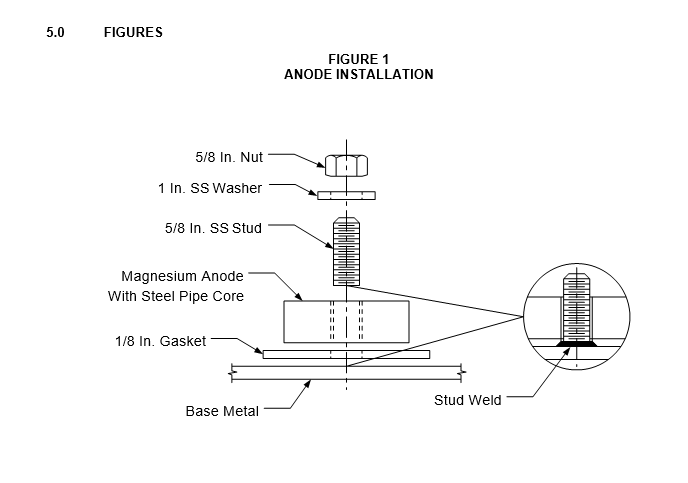
- 5/8 inch stainless steel studs shall be used to fasten the anode to the base metal. Each stud shall be firmly welded to the base metal and the anode securely bolted down.
- An insulating sheet of 1/8 inch thick rubber neoprene or polypropylene shall be installed under each anode. The insulating sheet shall be cut to extend 1/2 inch beyond all the edges of the anode.
- It is essential that the electrical contact be made from the base metal, through the stud, to the anode.
- Figure 1 displays the anode installation assembly.
© 2026 Inflection Point Engineering, LLC. All rights reserved. The content of this page — including calculation methods, reference data, written analysis, interactive tools, and source code — is the intellectual property of Inflection Point Engineering, LLC and is protected under applicable copyright, trademark, and trade secret laws. Unauthorized reproduction, redistribution, modification, or derivative use in whole or in part is prohibited without prior written consent.
Disclaimer. This material is provided for informational and educational purposes only and does not constitute professional engineering advice. Calculations, reference data, and methodologies are based on published standards and accepted engineering practice but are not a substitute for engineering judgment, site-specific analysis, or review by a licensed Professional Engineer. Inflection Point Engineering, LLC makes no warranties, express or implied, regarding the accuracy, completeness, or fitness for a particular purpose of any content presented here, and shall not be liable for any direct, indirect, incidental, or consequential damages arising from its use. Users assume all risk associated with applying this content to real-world design, operations, or decisions.
© 2026 Inflection Point Engineering, LLC. All rights reserved.