 Section 7 — Pressure Vessels
Rerating of Pressure Vessels
IPE Engineering Practice IPE-EP-7-3-1
Document number: IPE-EP-7-3-1 · Section: 7 — Pressure Vessels
SCOPE
- This Practice covers the requirements for rerating of existing pressure vessels. Pressure vessels can not be legally operated above the maximum allowable working pressure (MAWP) at the indicated design temperature stamped on the vessel’s nameplate and recorded on the latest revision of the Manufacturer’s Data Report. Where process or operating changes are contemplated which will exceed these allowable conditions, rerating of the vessel is required. In addition, rerating may be required to lower the MAWP of a pressure vessel because of degradation of the vessel shell material due to corrosion, pitting, or blistering.
- Any deviation from this Practice must be approved by the procedure described in EP 1–1–3.
- An asterisk (*) indicates that a decision by the Owner’s Engineer or Owner is required.
- A revision bar indicates all changes made to this Revision.
2.0 REFERENCE
The latest edition of the following standards and publications are referred to herein.
STANDARDS AND PUBLICATIONS
| Engineering Practices |
|---|
| EP 1–1–3 Deviations to Engineering Practices EP 7–1–1 Pressure Vessels EP 10–2–1 Material Requirements for Aggressive Environmental Services |
| API Standards |
| Std510 Pressure Vessel Inspection Code RP920 Prevention of Brittle Fracture of Pressure Vessels |
| ANSI Standards |
| ANSI/NB23 National Board Inspection Code |
| ASME Code |
| Sec VIIIPressure Vessels, Division 1 Sec VIIIPressure Vessels, Alternate Rules, Division 2 |
DEFINITIONS
- Alteration - Per the NBIC, an Alteration is any change in the item described on the original Manufacturer’s Data Report which affects the pressure containing capability of the pressure vessel. Non–physical changes such as an increase in the maximum allowable working pressure (internal or external) or design temperature of a pressure vessel shall be considered an alteration. A reduction in the minimum temperature such that additional mechanical tests are required shall also be considered an alteration. Per API 510, an Alteration is a physical change in any component which has design implications which affect the pressure containing capability of a pressure vessel beyond the scope of the items described in existing data reports. It is not intended that any comparable or duplicate replacement, the addition of any reinforced nozzle equal to or less than the size of existing reinforced nozzles, the addition of nozzles not requiring reinforcement, or rerating be considered an alteration.
- Aggressive Environmental Service (AES) - Process services which result in material degradation such as cracking, scaling, blistering, and severe pitting and/or corrosion. Examples of such services are hydrogen service, wet hydrogen sulfide, cyanides, caustic, amine, and hydrofluoric acid. AES process fluid are defined in EP 10–2–1.
- Authorized Inspector - Per the NBIC, an Authorized Inspector is an inspector who holds a valid National Board Commission and has qualified by written examination under the laws, rules and regulations of a jurisdiction of a state of the United States of America or a Province of Canada and is regularly employed as an Inspector by an Authorized Inspection Agency. Per API 510, an Authorized Inspector is an employee of Authorized Inspection Agency who is qualified and certified to perform inspection under API 510.
- Authorized Inspection Agency - An inspection organization as defined in the NBIC or API 510, as applicable.
- Inspection Code - ANSI/NB23 National Board Inspection Code (NBIC) published by The National Board of Boiler and Pressure Vessel Inspectors, or API 510 Pressure Vessel Inspection Code published by the American Petroleum Institute.
- Inspector - A Refining Company appointed engineer or inspector.
- Jurisdiction - A legally constituted government administration as defined in the NBIC or API 510, as applicable
- NBIC - National Board Inspection Code.
- Owner’s Engineer - A Refining Company appointed engineer.
- Repair - The work necessary to restore a vessel to a condition suitable for safe operation at the design conditions. If any restorative changes result in a change of design pressure and temperature, the requirements for Rerating shall also be satisifed.
- Rerate (Rerating) - Per the NBIC, a Rerate is the increase or decrease of the maximum allowable working pressure or temperature of a pressure vessel regardless of whether or not a physical change is carried out on the pressure vessel. Rerating in accordance with the NBIC shall be considered an Alteration. Per API 510, a Rerate is a change in either or both the temperature ratings or the maximum allowable working pressure rating of a vessel. Rerating in accordance with API 510 is not an Alteration unless physical modification of the vessel is required.
GENERAL
- Rerating of all Pressure Vessels shall be performed based on the requirements outlined in the applicable Inspection Code.
- Rerating a pressure vessel in accordance with the NBIC by increasing the maximum allowable working pressure (internal or external) or temperature, or decreasing the minimum temperature such that additional mechanical tests are required, shall be considered an Alteration. Rerating a pressure vessel in accordance with API 510 is not considered to be an Alteration.
- Where the proposed design conditions make it necessary to physically alter the pressure vessel (e.g. thicken pressure retaining parts), in addition to Rerating, Alterations shall be made in accordance with the applicable Inspection Code or State Laws.
- A vessel that is found to be in need of any work necessary to restore it to its original design conditions, must be Repaired as defined by the Inspection Code. If a decision is made not to restore the vessel to its original condition, the vessel design conditions including the corrosion allowance must be changed. For example, if a vessel is corroded past its original design corrosion allowance, Rerating is required in order to reduce the MAWP and modify the corrosion allowance if no repairs are to be made.
- When the decision has been made to Rerate a pressure vessel, the entire system, including all piping components, pumps and other equipment must be examined to ensure that the various parts of the system are also satisfactory for the proposed new design conditions.
- Rerating and reuse of equipment with C–1/2Mo material components shall be based on the criteria stipulated in EP 10–2–1.
RERATING PROCEDURES
- Review the inspection records of the vessel to determine the minimum thicknesses of all pressure containing and support components including the shell, heads, nozzles, and skirt. If in the opinion of the Inspector the inspection records are not current, a complete thickness survey of the vessel shall be completed using appropriate NDT techniques to determine minimum wall thicknesses of each vessel component.
- Evaluate the contemplated service and the existing condition of the vessel and determine if the vessel material is still adequate for continued use in that service. In cases where material degradation (cracking, blistering, pitting) has occurred in Aggressive Environmental Services or where new material selection criteria have been established, retirement of the vessel in lieu of Rerating may be necessary.
- Evaluate the contemplated service and verify that the existing corrosion allowance is appropriate or establish a new corrosion allowance for the intended service.
- (*)Revised calculations verifying the new service conditions shall be requested from the original Manufacturer. Where such calculations cannot be obtained from this source, they may be prepared by the Owner’s Engineer or any Code authorized organization having the appropriate code symbol stamp..
- All Reratings shall be established by computation using the appropriate formulas and design stress values in the latest edition of the ASME Code Section VIII, Division 1 or 2 as applicable, if all essential details are known to definitely comply with the latest edition of this code. Otherwise, Rerating shall be established in accordance with the requirements of the ASME Code edition to which the pressure vessel was built.
- (*)If a vessel constructed to the ASME Code, Section VIII, Division 2 is to be Rerated, a User Design Specification shall be prepared by the Owner’s Engineer in accordance with the requirements of this code. In addition, all differences between the original design conditions and proposed design conditions shall be clearly stated. These differences include changes in the design pressure, temperature, and the number of experienced and expected operational cycles.
- An assessment of the vessel’s ability to resist brittle fracture shall be made in accordance with the provisions of API 920. In addition, the vessel shall be assigned a minimum design metal temperature and associated pressure based on this assessment, see EP 7–1–1.
- For vessels Rerated per the NBIC, the following Procedures are required.
- A cover letter describing the proposed change and requesting approval for Rerating shall be forwarded for approval, to the jurisdiction or jurisdictions having authority at the installation location. In addition, this letter shall include; the vessel rerating calculations, all supporting information for the Rerating including a thickness survey report, the original Manufacturer’s Data Report, any R–1 forms indicating previous repairs or alterations made to the vessel, and any correspondence from the original Manufacturer related to the Rerate, if applicable.
- The Rerating shall be reviewed with, and must be acceptable to, the local jurisdictions and the Authorized Inspector.
- Upon jurisdictional approval, and upon completion of repairs and physical alterations, if required, the R–1 Form, Report of Alteration shall be completed. Paragraph R–502.1 of the NBIC gives the requirements as to who is responsible for completing the R–1 form.
- A pressure test as required for new construction shall be applied. Subject to the acceptance of the jurisdiction, an alternate test may be used. For example, an alternate test to a hydrotest may be necessary if the existing foundations were not designed to support the vessel full of water.
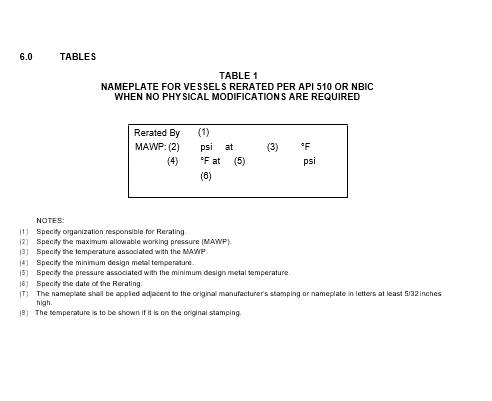
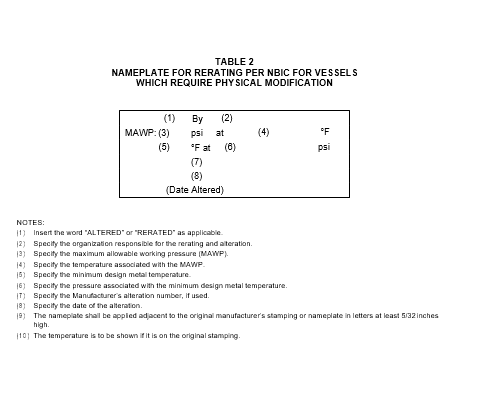
- Subject to the approval of the jurisdiction, the Authorized Inspector shall witness the transfer of the nameplate or a change in the stamping. In the Commonwealth of Pennsylvania, only an Authorized Inspector employed by the Commonwealth may handle the nameplate change and/ or restamping. The nameplate shall conform to:
- Table 1 for a Rerate in which physical modifications have not been made.
- Table 2 for a Rerate in which physical modifications have been made.
- A final Rerate report including: the original Manufacturers’ Data Report; all Partial Data Reports for replacement parts, if applicable; a completed R–1 Form; and the approval correspondence from the Jurisdiction shall be distributed by the Inspector to the following:
- Authorized Inspection Agency
- The Jurisdiction
- National Board
- Chemical Plant Inspection Department
- All Rerate calculations and other supporting information shall be maintained by the Chemical Plant Inspection Department.
- For vessels Rerated per API 510, the following procedures shall be followed:
- The Rerate shall be reviewed with, and must be acceptable to the Authorized Inspector.
- A pressure test is required unless one of the following two conditions is met:
- the pressure vessel has at some time been pressure tested in accordance with the new service conditions, or
- the vessel integrity is maintained by special NDE inspection techniques.
- The Authorized Inspector shall witness the transfer of the nameplate or a change in the stamping. The nameplate shall conform to Table 1.
- Documentation shall be per API 510. A copy of the completed documentation shall be maintained by the Plant Inspection Department.
© 2026 Inflection Point Engineering, LLC. All rights reserved. The content of this page — including calculation methods, reference data, written analysis, interactive tools, and source code — is the intellectual property of Inflection Point Engineering, LLC and is protected under applicable copyright, trademark, and trade secret laws. Unauthorized reproduction, redistribution, modification, or derivative use in whole or in part is prohibited without prior written consent.
Disclaimer. This material is provided for informational and educational purposes only and does not constitute professional engineering advice. Calculations, reference data, and methodologies are based on published standards and accepted engineering practice but are not a substitute for engineering judgment, site-specific analysis, or review by a licensed Professional Engineer. Inflection Point Engineering, LLC makes no warranties, express or implied, regarding the accuracy, completeness, or fitness for a particular purpose of any content presented here, and shall not be liable for any direct, indirect, incidental, or consequential damages arising from its use. Users assume all risk associated with applying this content to real-world design, operations, or decisions.
© 2026 Inflection Point Engineering, LLC. All rights reserved.