 Section 4 — Structures and Foundations
Construction, Rigging, Scaffolding and Requirements for Heavy Lifts
IPE Engineering Practice IPE-EP-4-9-1
Document number: IPE-EP-4-9-1 · Section: 4 — Structures and Foundations
SCOPE
- This Practice covers mandatory requirements for lifts of large enough weight to require lifting equipment. This Practice also covers rigging and scaffolding requirements for construction and lifting operations and temporary support of heavy loads, and requirements for temporary and permanent guylines.
- The requirements for permanent platforms for the support of equipment and personnel are given in EP 4-5-3.
- Any deviation to this Practice must be approved by the procedures described in EP 1-1-3.
- An asterisk (*) indicates that a decision or approval by the Owner's Engineer is required, or that additional information is furnished by the Purchaser.
- A revision bar indicates all changes made to this Revision.
- Documentation required in accordance with this Practice is given in Table 3.
2.0 REFERENCES
The latest edition of the following standards and publications are referred to herein.
STANDARDS AND PUBLICATIONS
| IPE Engineering Practices |
|---|
| EP 1-1-3 Deviations to IPE Engineering Practices EP 4-1-1 Design Criteria and Loads for Structures EP 4-2-1 Foundation Types and Selection Criteria EP 4-2-2 Earthwork EP 4-2-3 Reinforced Concrete Foundations EP 4-3-1 Concrete Design EP 4-5-1 Structural Steel EP 4-5-3 Auxiliary Structures for Operation and Maintenance |
| AISC Publications |
| Manual of Steel Construction, 9th Edition, Allowable Stress Design Manual of Steel Construction, 1st Edition, Load Resistance Factor Design |
| ASME/ANSI Standards |
| A10.5 Safety Requirements for Material Hoists 830.2 Overhead and Gantry Cranes 830.6 Derricks |
STANDARDS AND PUBLICATIONS (CONTINUED)
| ASTM Standards |
|---|
| A475 Zinc-Coated Steel Wire Strand 8668 Steel Forgings, Carbon and Alloy, for General Industrial Use F1145 Turnbuckles, Swaged Welded, Cast, Forged |
| National Forest Products Association |
| National Design Specification for Wood Construction Design Values for Wood Construction |
| OSHA Code of Federal Regulations |
| 29 CFR Part 1910 Occupational Safety and Health Standards |
| Publication |
| Rossnagel, W. E., Higgins, L. R., and MacDonald, J. A., "Handbook of Rigging for Construction and Industrial Operations," 4th Edition, McGraw-Hill, 1988. |
3.0
3.1
3.2
3.3
3.4
3.5
3.6
3.7
3.8
3.9
3.10
3.11
3.12
3.13 3.14
DEFINITIONS
Contractor - Company or business that agrees to furnish materials or perform specified services at a specified price and/or rate to the Owner.
Derrick - Piece of lifting equipment without an integral hoisting engine.
Factor of Safety - Ratio of the Minimum 8reaking Load over the Safe Working Load. Heavy Lifting - Lifts of large enough weight to require the use of lifting equipment.
Hitches - Sling arrangements used to lift loads. See Figure 1 for configurations. Lifting Equipment - A machine for moving or lifting plant equipment.
Lifting Gear - Items used in conjunction with lifting equipment including, but not limited to, fiber ropes, wire strand ropes, clamps, hitches, slings, shackles, blocks, rollers, and skids.
Lifting Point - Point on slings or lifting beams where the load shall be applied. Inspector - A Inflection Point Engineering, LLC appointed engineer or inspector.
Minimum 8reaking Load (M8L) -Minimum load at which the component or piece of equipment will break based on tests to failure which have been certified and guaranteed by the Manufacturer.
Mobile Crane - Piece of lifting equipment with an integral hoisting engine that is capable of moving to the work area under its own power.
Owner - Inflection Point Engineering, LLC. Owner's Engineer - A Inflection Point Engineering, LLC appointed engineer. Rigging - Handling of loads suspended from a crane, hoist or derrick.
- Rigging Machinery - Another name for Lifting Equipment.
- Safe Working Load (SWL) - The maximum allowable load that maybe applied to a component or system of lifting equipment and lifting gear.
GENERAL REQUIREMENTS
- (*)All lifting equipment and lifting gear, and lifting and rigging procedures shall comply with OSHA, the requirements of the state and local jurisdictions and the additional requirements of this Practice. In cases of conflict, the more stringent requirements, as specified by the Owner's Engineer, shall apply.
- (*)All lifting equipment and lifting gear shall be subjected to testing and inspection to determine safe working loads as specified in this Practice. Results of all tests and inspected shall be recorded and submitted to the Owner's Engineer.
- The Manufacturer of lifting equipment and lifting gear shall supply certification of compliance with the requirements of this Practice and those of recognized standards, including certification that the equipment or gear has been proof testing to the minimum overloads given in Table 1. Other information to be supplied to the Owner includes, but is not limited to, calculations that demonstrate the basis for the safe working load and loading points, and manuals of operation and maintenance.
- The safe working load and lifting point shall be permanently marked on lifting equipment and lifting gear, where appropriate.
- Environmental, safety, and utility requirements shall be considered in the specification of lifting equipment and lifting gear.
- Materials of construction shall be suitable for the expected operating conditions, including the consideration of sparking, where appropriate.
- (*)No modifications that affect the capacity or safe operation of lifting equipment or lifting gear shall be made without the approval of the Manufacturer and the Owner's Engineer.
HEAVY LIFT REQUIREMENTS
- Load Considerations
- Loads given in EP 4-1-1 shall be used in the design and specification of lifting equipment.
- The effects on moving loads and horizontal loads on rigging beams, crane runways and other structures shall be considered in the design and specification of lifting equipment. The methods given in the AISC Specification shall be used.
- The effect of load impact shall be considered in the design and specification of lifting equipment.
- The effects of wind on the stability of lifting equipment shall be taken into consideration.
- Rigging Considerations
- Safe working loads for lifting equipment shall be in accordance with appropriate OSHA tables. For equipment not listed by OSHA, safe working loads shall be specified by the Manufacturer.
- The center of gravity for all heavy equipment to be lifted shall be determined and marked on rigging drawings.
- Whenever possible, lifting points shall be directly above the center of gravity of the object to be lifted.
- Whenever a load is to be rotated 90° so as to rest on its side, the sling arrangement in Figure 1 shall be used.
- When a spreader beam or rig is used, the horizontal angle of a line through the center of gravity to the lower attachment points on the equipment shall be much less than the horizontal angle from the spreader or rig attachment points to the lifting point, see Figure 2.
- Site Considerations
- When founding equipment for a heavy lift on an un-developed site, a soils investigation shall be performed to determined allowable bearing pressure if the applied soil pressure will exceed the lower-bound sites-specific value given in EP 4-2-1. Soils investigation shall be performed in accordance with EP 4-2-1. Any earthwork required to bring the site to an acceptable condition for lifting shall be performed in accordance with EP 4-2-2.
- When supporting equipment for a heavy lift on an existing foundation or structure, an analysis of the additional loading due to the lift shall be performed. The conditions given under the heading "Erection" in Table 7 of EP 4-1-1 shall be considered.
- When locating equipment for a heavy lift, consideration shall be given to the safety of adjacent structures and operating units.
RIGGING MACHINERY
- General Considerations
- (*)Operation of all rigging machinery shall be in accordance with the Manufacturer's specifications and limitations. If Manufacturer's specifications and limitations are not available, operation of the machinery shall be based on specifications and limitations assigned by a qualified engineer and approved by the Owner's Engineer. These specifications and limitations shall be documented and recorded.
- Rated capacities, warnings of special hazards and instructions shall be conspicuously posted on all rigging machinery.
- Derricks
- Derricks shall be used only when the work is above the reach or the capacity of a mobile crane.
- All derricks shall be designed, constructed, installed, inspected, tested and maintained in accordance with ANSI/ASME 830.6.
- The use of guy or gin-pole derricks is prohibited.
- Mobile Cranes
- Wind and the effects of boom deformation and line elongation shall be considered when determining lifting position and crane stability.
- Tire-mounted cranes shall be stabilized by the use of outriggers. The crane should be raised such that the outriggers carry the full weight.
- Tracks of crawler cranes or outriggers on tire-mounted cranes shall be supported throughout the lifting process on bearing pads that are maintained level within 1%.
- Cranes left in position for long periods of time (weeks) shall be monitored and releveled as required to maintain the 1% tolerance.
- Overhead Cranes
- Overhead cranes shall be designed, constructed, installed, tested, inspected, operated and maintained in accordance with ANSI/ASME 830.2.
- Overhead cranes and their supporting structures shall be designed for all applicable loads specified in EP 4-1-1, including test loads, where appropriate. Dynamic loads resulting from braking and accelerating, both the hoist and travel, shall also be considered.
- Power shall be electric, pneumatic, hydraulic or manual. Power shall be supplied to the crane in a manner that avoids damage to the equipment and protects personnel.
- Rails shall be sufficiently level for smooth travel under all operating load conditions. The crane shall not move under the influence of gravity alone.
- (*)The Owner's Engineer shall specify tolerances for straightness and parallelism of rails.
- Supporting structures for crane rails shall be designed in accordance with EP 4-5-1. The crane Manufacturer shall be required to provide all necessary data for the design of supporting structures.
- Hoists
- (*)Hoists for lifting materials shall comply with ANSI A10.5. The designs for hoists shall be submitted to the Owner's Engineer for approval.
- Hoists shall be designed for all applicable loads in EP 4-1-1, including test loads, where appropriate. Special consideration shall be given to dynamic loads.
- Hoists may be either fixed point, suspended from trolleys on a runway beam, or hooked suspension-type, i.e. removable. Runway beams and trolleys shall be designed in accordance with Section 8.0.
- Hoist systems shall be used only for vertical lifting and horizontal travel along a beam runway, unless specifically designed for other modes of operation.
- Power for hoists shall be manual, electric of hydraulic.
- The lifting components of hoists shall be chain or wire strand rope.
- Hoists shall have overload protection devices, whether manual or power-driven. Power-driven hoists shall have an automatic brake capable of sustaining any load up to and including all test loads.
- Chain and wire strand rope hoists shall have collection boxes that can contain the entire length of rope or chain and which are fitted with protective guards.
- Winches
- The minimum breaking load for the wire strand rope shall be at least 3.5 times the safe working load for the winch in a pulling operation, and a minimum of 5.0 times the safe working load of the winch in a lifting operation.
- Winches shall be equipped with at least one brake capable of arresting and holding a minimum of 1.5 times the torque generated at the drum, including any dynamic effects.
- Winches shall be provided with controls to maintain steady lowering speeds, to provide emergency lowering capability, and to provide over-travel protection.
LIFTING GEAR
- Wire Strand Rope, Slings, Hitches and Blocks
- (*)Wire strand rope shall comply with ASTM A475, unless otherwise specified by the Owner's Engineer.
- (*)The wire strand rope specified by a Manufacturer of a piece of lifting equipment shall be used with that piece of equipment unless other alternatives are submitted to the Owner's Engineer for review and approval.
- (*)The safe working loads for wire strand ropes shall be in accordance with appropriate OSHA tables. However, in no instance shall the minimum breaking load for wire strand ropes used with cranes and hoists be less than 5.0 times the safe working load for equipment lifts or less than 10.0 times the safe working load for personnel lifts, unless otherwise specified by the Owner's Engineer.
- A proof test to 125% of the rated load shall be used on all lifting gear that is of special or custom design.
- Wire strand rope terminations, wedge and socket, shall be designed as follows:
- Wedge and socket terminations shall be proof tested to 40% of the minimum breaking load for the strongest rope to be used with the termination. After the test, dimensional checks and magnetic particle inspection shall be performed. Defective terminations shall be rejected.
- Wedge and socket terminations shall be marked with the rope diameter and service for which it is to be used. Parts of termination sets shall not be interchanged.
- Pins shall have plain round shanks with a threaded end fitted with a nut.
- Wire strand rope slings and their terminations shall be designed with a minimum factor of safety of 5.0.
- Synthetic fiber and steel-mesh slings shall have permanent terminations and shall not be used with wire strand rope grips.
- Synthetic fiber slings are often used when the object to be lifted can not be marred. If synthetic fiber slings are used, the material specified shall be as follows:
- Nylon for general purpose lifting not involving exposure to acids or bleaching agents and not exceeding 250°F. Nylon slings will stretch approximately 10% at their rated capacity.
- Polyester whenever acid, other that sulfuric acid, is present or when minimal stretching is required. Polyester shall not be used in alkaline conditions, or above 250°F. Polyester slings will stretch approximately 3% at their rated capacity.
- Polypropylene whenever alkaline conditions exist, but not exceeding 180°F. Polypropylene slings will stretch approximately 10% at their rated capacity.
- The safe working load for synthetic fiber or steel-mesh slings shall be clearly marked.
- On multiple leg slings, the safe working load at different angles shall be indicated.
- Hitch types are illustrated in Figure 3. The following are brief descriptions of the types of hitches and their limitations:
- Vertical hitches may be used at the full rated capacity. However, no load rotation shall be tolerated with this type of rigging.
- 8ridle hitches may be used to lift objects that have the necessary attachments. This system provides excellent stability when the hook is over the center of gravity and the load is equally dived among the legs. Legs angles must be determined accurately to ensure individual legs are not overloaded.
- Chokers are used to hold irregular or unbalanced loads. Rated capacities shall be reduced by 25% as compared to vertical hitches.
- 8asket hitches are used in pairs to provide balance and even load distribution.
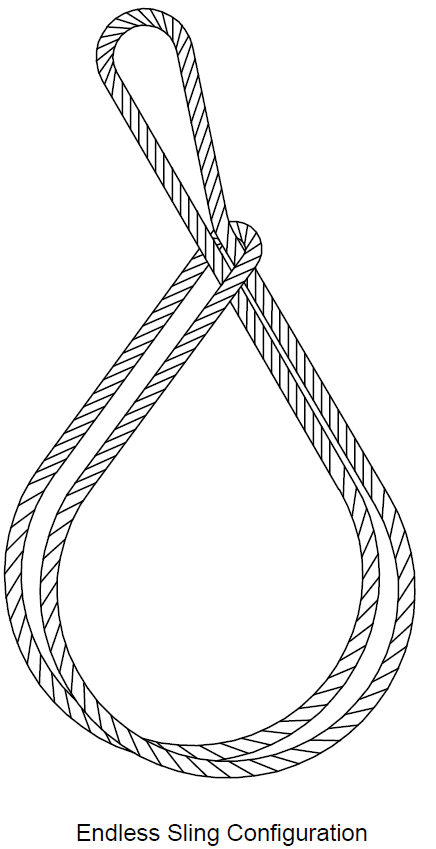
- An endless slings is a wire strand rope formed into a continuous loop, used as shown in Figure 4.
- Sling angles shall be greater than 45° from the horizontal.
- Safe working loads for the various hitch configurations shall be determined based on Table 2. When selecting the actual sling or hitch, refer to the Manufacturers' data and recommendations.
- (*)The Owner's Engineer shall approve the use of chain slings. Chain slings used in choker fashion shall have their rated capacity reduced by 25%. Chain slings shall be padded when bearing on sharp edges.
- (*)All block fittings shall be made of forged alloy steel per ASTM A668, unless otherwise specified by the Owner's Engineer.
- The exterior surfaces of hook blocks shall be painted so as to be readily visible.
- End Attachments
- The safe working load for all attachments shall be clearly marked.
- (*)Permanent terminations shall be used with wire strand rope end attachments in all lifting applications. The Owner's Engineer shall approve the use of grip terminations for light load situations such as hold back lines.
- (*)Shackles used in lifting operations shall be forged steel in accordance with ASTM A668, unless otherwise specified by the Owner's Engineer. Pins shall have plain round shanks through the shackle with a threaded end fitted with a nut. The threaded end shall be drilled to accept a cotter pin.
- (*)Eyebolts used in lifting operations shall be forged alloy steel in accordance with ASTM A668, unless otherwise specified by the Owner's Engineer.
- (*)Hooks used in lifting operations shall be forged alloy steel in accordance with ASTM A668, unless otherwise specified by the Owner's Engineer.
- Hooks used with lifting equipment shall be provided with a device to prevent the displacement of a sling or load during lifting.
8.0 PERMANENT STRUCTURES FOR LIFTING EQUIPMENT
- Permanent structures for lifting equipment, such as crane rails and trolley runways, shall be designed in accordance with EP 4-2-3 and EP 4-3-1 or EP 4-5-1, where appropriate. The applicable maximum safe working loads from this Practice and the additional load criteria from EP 4-1-1 and the AISC Specification shall be used.
- Crane rails shall not be attached to structures by welding.
- Auxiliary structures associated with lifting equipment shall be designed in accordance with EP 4-5-3.
SCAFFOLDING, GUYLINES AND TEMPORARY STRUCTURES
- Scaffolding for Lifting and Construction Operations
- Scaffolding for lifting and construction operations shall be designed, constructed and maintained in accordance with OSHA requirements.
- The scaffolding shall bear on a foundation that is sized such that the load is over a sufficient area to prevent settlement.
- Vertical scaffolding members shall be maintained plumb at all times.
- (*)The design of specialized scaffolding, including but not limited to swinging, suspended, cantilevered and outrigger scaffolding, shall be designed by an experience scaffolding engineer and submitted to the Owner's Engineer for approval.
- Guylines (for Lifting Operations and Permanent Structures)
- (*)Wire strand rope used as guylines shall comply with ASTM A668, unless otherwise specified by the Owner's Engineer. Forged alloy steel turnbuckles shall comply with ASTM F1145.
- End attachments used with guylines shall comply with Paragraph 7.2 and the additional requirements of this Section.
- (*)The use of guylines on permanent structures, such as stacks, is outside of the scope of this Practice and shall be approved by the Owner's Engineer.
- The minimum breaking load for wire strand rope used in static guylines shall be at least 4.0 times the safe working load for the rope.
- (*)Static wire strand ropes shall be galvanized. Wire strand ropes used in dynamic applications shall be galvanized and lubricated, unless otherwise specified by the Owner's Engineer.
- Instrumentation to monitor tension in guylines shall be installed and the tensile load monitored during erection to ensure that the tension is within design guidelines.
- Temporary Wood Structures for Lifting and Construction Operations
- (*)Wood may be used for bracing or temporary support of lifting or construction loads and personnel if approved by the Owner's Engineer. Wood shall not be used in areas with operating plant equipment that pose a fire safety concern.
- Wood structures used for bracing or temporary support of lifting or construction loads and personnel shall be designed based on loads given in EP 4-1-1.
- Allowable stresses for wood components shall be in accordance with the National Forest Products Association's Design Values for Wood Construction. The grade of wood used in scaffolding shall be in accordance with OSHA requirements.
- Analysis of wood structural components shall be in accordance with the National Forest Products Association's National Design Specification for Wood Construction.
- Wood used for bracing and temporary supports shall be free from decay and shall be at optimum moisture content.
- Temporary Metal Structures for Lifting and Construction Operations
- Aluminum and steel structural shapes may be used in scaffolding, bracing or temporary structures for the support of lifting or construction loads and personnel. For the design of permanent steel structures for maintenance see EP 4-5-3.
- Steel structures shall be designed in accordance with EP 4-5-1 and the additional requirements of this Practice.
- (*)Design procedures and allowable stresses for aluminum structural components shall be submitted to the Owner's Engineer for approval.
- Other Structural Materials
- (*)Other materials such as plastics and composites shall not be used as structural components in scaffolding, bracing or temporary structures for the support of lifting or construction loads and personnel without the prior approval of the Owner's Engineer.
- (*)Design procedures and allowable stresses for components made from other structural materials shall be submitted to the Owner's Engineer for approval.
10.0 INSPECTION AND MAINTENANCE OF LIFTING EQUIPMENT AND LIFTING GEAR
- (*)All lifting equipment and lifting gear shall be thoroughly inspected prior to initial use. Additionally, periodic inspections shall be performed as required by this Practice. Results of all inspections shall be recorded and submitted to the Owner's Engineer.
- Wire strand rope and attachments shall be inspected before initial use. Wire strand rope in use shall be visually inspected at least weekly. Wire strand rope that has been out of service longer than one month shall be thoroughly inspected before being returned to service. Refer to the Rossnagel reference (See Section 2.0) for diagnosis of wire strand rope problems and appropriate maintenance procedures.
- Slings and their attachments, overhead cranes and hoists, mobile cranes, and derricks shall be inspected and maintained in accordance with OSHA regulations.
- Scaffolding shall be visually inspected before initial use and weekly, thereafter, to see that it remains in compliance with statutory regulations. More frequent inspections shall be necessary if adverse weather conditions or if other unusual circumstances that may affect the behavior of the scaffolding have occurred.
- Guylines shall be visually inspected and tension readings taken 6 months after erection, and at least annually thereafter.
11.0 TABLES
TABLE 1
PROOF LOADS FOR LIFTING EQUIPMENT AND GEAR
| Equipment | Safe Working Load (SWL) | Proof Test Load |
|---|---|---|
| Cranes and Winches | less than 20 tons 20 to 50 tons over 50 tons |
1.25 x SWL SWL + 5 tons 1.10 x SWL |
| Single-Sheave Pulley 8locks | all | 4.0 x SWL |
| Multiple-Sheave Pulley 8locks | less than 20 tons 20 to 40 tons over 40 tons |
2.0 x SWL SWL + 20 tons 1.5 x SWL |
| Hand-Operated Chain 8locks | all | 1.5 x SWL |
| Chain or Wire Rope Hoists | all | 1.25 x SWL |
| Wire Strand Rope | all | sample(s) tested to destruction |
| Wire Strand Rope Terminations | all | 0.4 x min. breaking load for strongest rope to be used |
| Other Gear | all | 2.0 x SWL |
TABLE 2
SAFE WORKING LOAD FOR SLINGS AND HITCHES
| Type of Sling or Hitch | Safe Working Load |
|---|---|
| Vertical | SWLV=M8L/5.0 (For Equipment) SWLV=M8L/10.0 (For Personnel) |
| 8ridle (2 to 4 Leg) | SWL8r=SWLV (2H/L) (1) |
| Choker | SWLC=SWLV (0.75) |
| 8asket | SWL8a=SWLV (4.0) (Double Vertical Leg) SWL8a=SWLV (4H/L) (Double Inclined Leg) |
| Endless | SWLE=2 (Value for appropriate configuration above) |
NOTES:
H=Headroom between load and hook, and L=Length of sling legs
TABLE 3 DOCUMENTATION REQUIREMENTS FOR CONSTRUCTION RIGGING, SCAFFOLDING AND HEAVY LIFTING REQUIREMENTS PER EP 4-9-1
| Item | Description | Format | As-Built |
|---|---|---|---|
| 1 | Results of all inspection and testing. | Text | N/A |
| 2 | Certification of compliance with this Practice. | Text | N/A |
| 3 | Manufacturer's or assigned engineer's specifications and limitations on Rigging Machinery. | Text | N/A |
| 4 | Alternatives for Manufacturer's recommended wire strand rope. | Text | N/A |
| 5 | Design drawings and specifications for specialized scaffolding. | See EP 2-5-2 | Yes |
| 6 | Design procedures and allowable stresses for aluminum structures. | Text | Yes |
| 7 | Design procedures and allowable stresses for non- metallic structures. | Text | N/A |
| 8 | Results of inspections of lifting equipment. | Text | N/A |
FIGURES
FIGURE 1 ROTATING LOAD
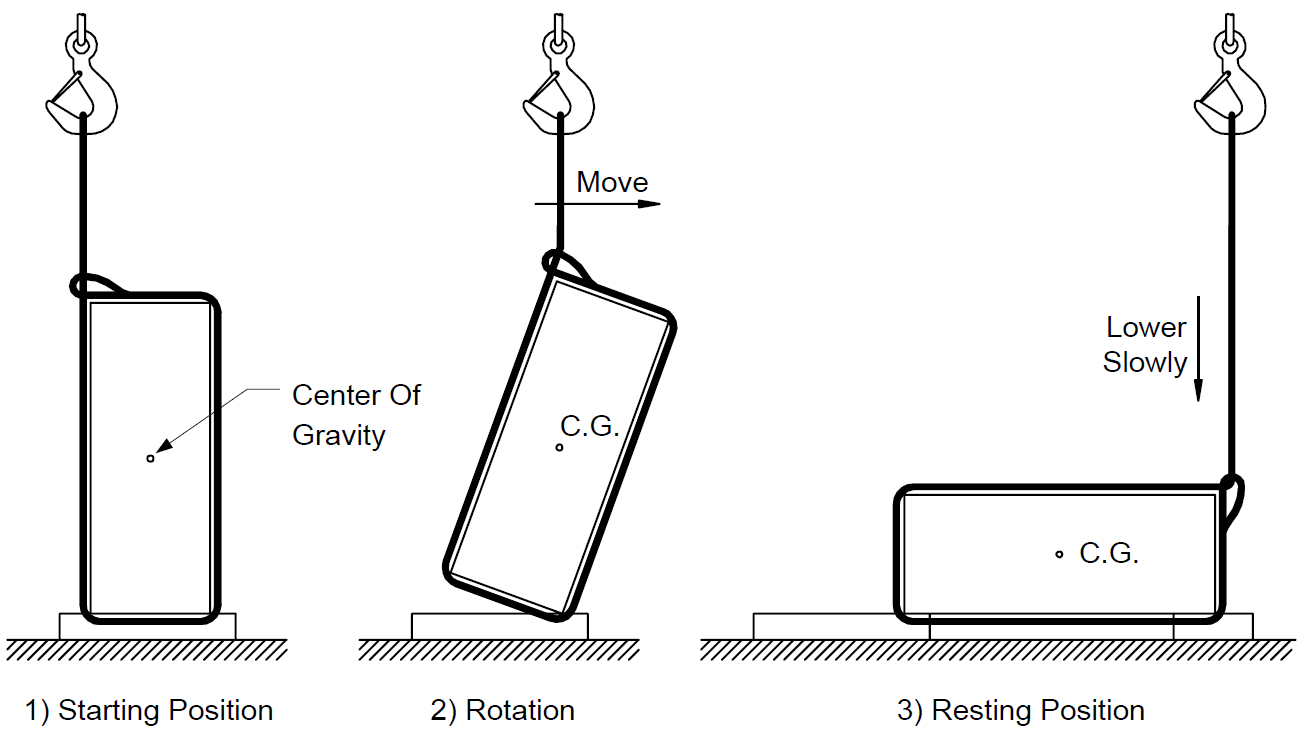
FIGURE 2
SPREADER BEAM/LOAD ARRANGEMENT
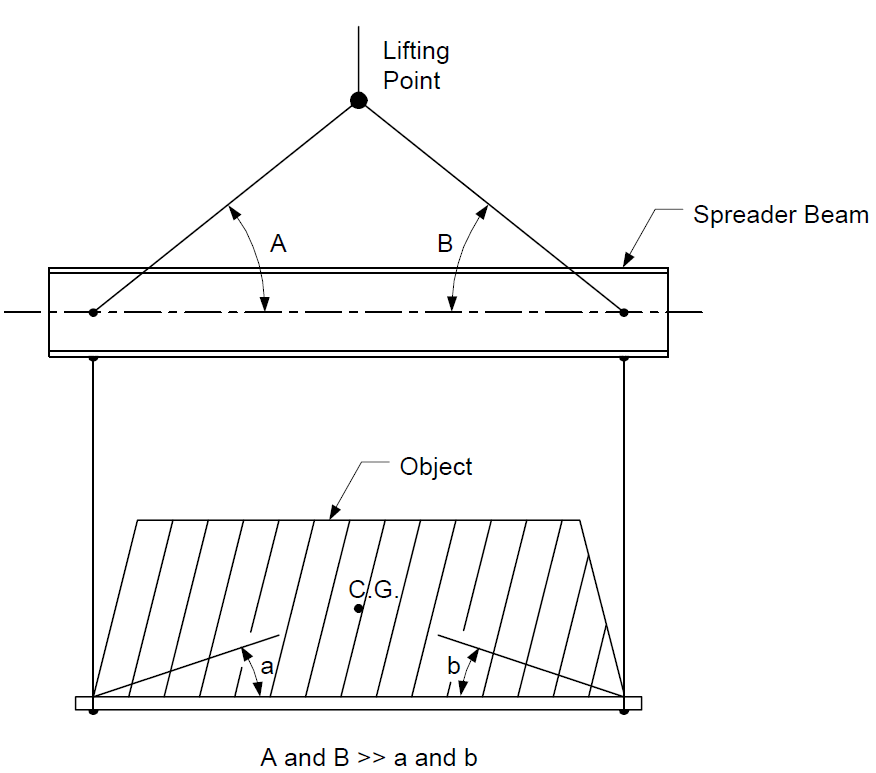
FIGURE 3 TYPES OF HITCHES
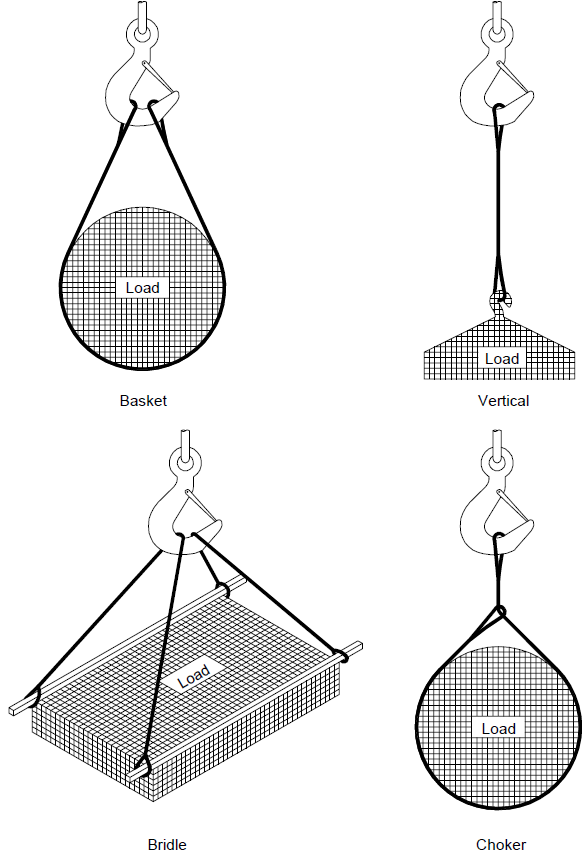
FIGURE 4 ENDLESS SLING
© 2026 Inflection Point Engineering, LLC. All rights reserved. The content of this page — including calculation methods, reference data, written analysis, interactive tools, and source code — is the intellectual property of Inflection Point Engineering, LLC and is protected under applicable copyright, trademark, and trade secret laws. Unauthorized reproduction, redistribution, modification, or derivative use in whole or in part is prohibited without prior written consent.
Disclaimer. This material is provided for informational and educational purposes only and does not constitute professional engineering advice. Calculations, reference data, and methodologies are based on published standards and accepted engineering practice but are not a substitute for engineering judgment, site-specific analysis, or review by a licensed Professional Engineer. Inflection Point Engineering, LLC makes no warranties, express or implied, regarding the accuracy, completeness, or fitness for a particular purpose of any content presented here, and shall not be liable for any direct, indirect, incidental, or consequential damages arising from its use. Users assume all risk associated with applying this content to real-world design, operations, or decisions.
© 2026 Inflection Point Engineering, LLC. All rights reserved.