 Section 4 — Structures and Foundations
Roadways and Paving
IPE Engineering Practice IPE-EP-4-4-1
Document number: IPE-EP-4-4-1 · Section: 4 — Structures and Foundations
SCOPE
- This Practice covers the requirements for the design, construction and repair of plant paving and roadways.
- Any deviation from this Practice must be approved by the procedure described in EP 1-1-3.
- An asterisk (*) indicates that a decision or approval by the Owner or the Owner's Engineer is required, or that additional information is furnished by the Purchaser.
- A revision bar indicates all changes made to this Revision.
- Documentation required for roadway and pavement construction in accordance with this Practice is given in Table 1.
2.0 REFERENCES
The latest edition of the following publications are referred to herein.
STANDARDS AND PUBLICATIONS
| IPE Engineering Practices |
|---|
| EP 1-1-3 Deviations to IPE Engineering Practices S&L EP 3-1-1 P Philosophy EP 4-1-1 Design Criteria and Loads for Structures EP 4-2-1 Foundation Types and Selection Criteria EP 4-2-2 Earthwork EP 4-3-1 Concrete Design |
| ACI Standard |
| 318 Building Code Requirements for Reinforced Concrete |
| APWA |
| Standard Specifications for Road, Bridge and Municipal Construction |
| ASTM Standards |
| A185 Specification for Steel Welded Wire, Fabric, Plain, for Concrete Reinforcement A615 Deformed and Plain Billet - Steel Bars for Concrete Reinforcement C94 Ready Mix Concrete D1557 Moisture-Unit Weight Relations of Soils, and Soil Aggregate Mixtures Using 10-lb. Rammer and 18-in. Drop. |
3.0
3.1
3.2
3.3
3.4
3.5
3.6
3.7
3.8
4.0
4.1
4.2
4.3
4.4
4.5
4.6
4.7
5.0
5.1
DEFINITIONS
Base Course - Intermediate foundation material for roadways. Base Course usually consists of stone or mineral aggregate and is placed on top of the subgrade.
Contractor - Company or business that agrees to furnish materials or perform specified services at a specified price and/or rate to the Owner.
Inspector - A Inflection Point Engineering, LLC appointed engineer or inspector. Owner - Inflection Point Engineering, LLC .
Owner's Engineer - A Inflection Point Engineering, LLC appointed engineer.
Prime Coat Material - Liquid asphalt applied to the surface of placed and compacted base course material in preparation for receiving the final surface course.
Subgrade - Existing soil after excavation. Soil conditions on which Base Course is to be applied. Surface Course - Final hot-mix asphalt concrete surface.
MATERIALS OF CONSTRUCTION
Subgrade Repair Material shall conform to APWA gravel base compacted into a hard, dense mass in accordance with EP 4-2-2.
Base Course shall be stone or mineral aggregate, conforming APWA gravel base. Aggregate base shall be Class 2, 1-1/2 inches maximum mineral aggregate.
Surface Course shall be Type B with 1/2 inch maximum coarse graded aggregate and shall conform to APWA Construction and Material Specifications.
Prime Coat Material shall be liquid asphalt, Grade RC-70 conforming to APWA Construction and Material Specifications.
Tack Coat Material shall be emulsified asphalt, Type MS-2 or SS-2 conforming to the APWA Construction and Material Specifications.
(*)Parking Bumpers shall be precast concrete, extra duty type, 6 feet. Bumpers shall be 3000 psi compressive strength concrete weighing approximately 265 lb each, gray or white as selected by Owner's Engineer. Bumpers shall have two (2) 1-inch diameter holes for anchoring pins and shall be reinforced with two (2) longitudinal #4 deformed bars, ASTM A615, Grade 60. Anchoring pins shall be #6 deformed bars, 3-feet long or equal.
(*)Traffic Marking Paint shall be Glidden 'Traffic Zone Paint" or Sherwin-Williams 'Pro-Mar" Series B36. The Owner's Engineer shall select the color.
PAVING AND ROADWORK DESIGN
Except as otherwise noted, concrete design shall be in accordance with ACI 318.
(*)Traffic Conditions
The road and pavement design shall conform to the maximum equipment wheel loads and traffic volumes specified by the Owner's Engineer. The requirements of this Practice shall be followed, unless otherwise specified. Drawings and specifications required for the design shall be submitted to the Owner's Engineer.
- Subgrade Soils
The thickness design shall take into account the quality of the subgrade soils. Appropriate tests shall be made to determine the conditions of in situ subgrade soils, see EP 4-2-1.
- Road Crowns
Roads shall be crowned (1 to 2 percent for concrete pavement and 2 to 4 percent for asphalt pavement) to provide adequate drainage.
- Grades and Drainage
Area paving for process units shall be sloped to drain within the pavement limits, but away from equipment or pipe racks.
- Area paving at loading racks shall be sloped to drain away from the rack. The area on which tank truck wheels rest shall have a maximum transverse slope of 0.1 inch per foot.
- Paving elevations and slopes shall preclude the flooding of control houses, electrical switchgear and other major fire-critical equipment during periods of maximum firewater use. Burning hydrocarbons may be present on the surface of impounded firewater. Care shall be taken to control the depth and location of such accumulations. Normal surface drainage shall be away from fire-critical equipment.
- If it is impractical to design sewer systems to handle maximum possible firewater rates, provisions shall be made to handle peaks by overflow into peripheral ditches, gutters, undeveloped areas, etc., without accumulations that would endanger fire-critical equipment.
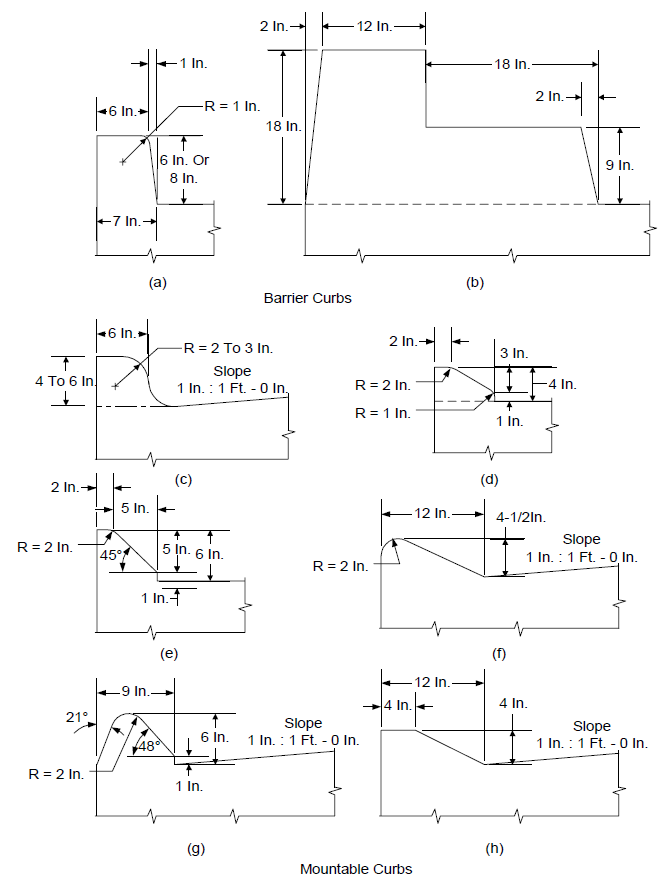
- (*)Slopes for paved curb areas shall be per Figure 1, unless otherwise specified by the Owner's Engineer.
- Additional Requirements for Concrete Paving
- Expansion joints, drains, and trenches shall be as follows:
- Expansion joints subdividing pavement slabs shall be placed at high points of the slab in order to prevent infiltration of water below the slab and possible uneven settlement.
- Drains shall be provided in the slab adjacent to all equipment requiring drains, such as pumps, drums, condenser boxes, etc. Catch basins shall be provided in each drainage area. Catch basins shall not be located under equipment, pipe racks, stairways and ladders.
- (*)Trenches for drainage or piping shall not be used in paved areas unless approved by Owner.
- Slabs and supporting sub-base around operating equipment shall be designed to support the maximum wheel load expected from mobile handling equipment. Special compaction of the sub- base may be required.
- Pavement slabs around operating equipment shall be per Paragraph 7.3 of this Practice. Slabs greater than six inches thick shall be designed for the applied loads.
- Reinforcing steel shall be provided to resist forces produced when slab cools, contracts and slides along the ground surface.
- Pavement slabs shall be separated from pipelines projecting through the slab by two thicknesses of 60-pound, asphalt-impregnated felt, or a 1/2-inch thick pre-molded asphalt expansion joint.
- (*)Unless otherwise specified by the Owner's Engineer, at the point where items such as pipelines project through the slab, the surface of the slab shall be sloped upward toward the pipe line approximately one inch with a slope of one inch in six inches.
- Spill wall curbs shall be provided around the periphery of pressure storage vessel areas and around furnaces which may handle liquids. Arrangement shall be as follows:
- Where furnaces are grouped, intermediate curbs shall be installed in addition to the peripheral curbs to isolate each furnace, preventing the flow of liquid to adjacent equipment in case of tube or header failure.
- In the case of grouped pressure vessels, no intermediate curbs shall be installed. The peripheral curb is installed to prevent liquid spills from adjacent equipment from flowing under the vessels and subjecting them to fire risk.
- Each enclosure shall be equipped with a separate sealed catch basin.
- Tops of curbs shall be level except where control of overflow is desired.
- The height of curbs above slabs shall be 12 inches maximum at slab low points and 5-1/2 inches minimum at of slab high points.
- Curbs are not required, except where used as spill containment around certain pump slabs covered with water spray systems, furnaces and storage areas.
- Curbs shall be omitted from offsite slabs except for storage areas and the following:
- For retaining walls if the slab is below grade.
- For spill containment in unusually dirty or leak-prone services such as around asphalt pumps, etc.
- Curbs for offsite slabs shall be similar to those for onsite slabs.
- Sidewalks shall be a minimum of 4-inch thick reinforced concrete.
- Sidewalks shall slope 1/4 inch per foot transversely with the low side draining towards a street or ditch.
- Sidewalks shall have transverse dummy joints every eight feet. If the walk is wider than eight feet, longitudinal dummy joints shall also be made on eight-foot centers maximum.
- Expansion joints shall be provided every 60 feet.
SUBGRADE PREPARATION- ROADWAYS
Subgrade preparation shall consist of clearing, grubbing, excavation, embankment, dressing shaping, wetting, compaction, and stabilizing, as required. Such preparations shall be made to the full width of the road bed or plant yard in accordance with the grade, lines and cross sections shown on the drawing or plans, see EP 4-2-2 for further requirements for earthwork.
- Clearing and Grubbing
- (*)The entire right of way or plant site shall be cleared of obstructions, except such trees and brush as may be designated by the Owner's Engineer for preservation.
- Area required for embankment construction, roadways, channels, structural excavations for borrow sites, and material sources shall be cleared and grubbed.
- Areas required for roadways, channels, or structural excavations shall have all stumps, roots, etc. (except for designated trees and brush) removed to a depth of one foot below the finished surface of the required cross section.
- (*)All cleared and grubbed material shall be disposed of in a manner satisfactory to the Owner's Engineer.
- Excavation
Excavation shall consist of excavating and grading the roadway or the plant site within the limits of grade stakes (including slope rounding and 'V" ditches or gutters paralleling the roadway or plant site). Also the disposal of excavated material and the formation of embankments, subgrade, shoulders, slopes, berms, and dikes is included as part of excavation operations.
- (*)All suitable material removed from excavation shall be used as far as practical in the formation of the embankments, subgrade, base courses, shoulders, dikes, berms, and at such other places as shall be directed by Owner.
- Material suitable for top soil base course, mineral aggregate, shoulders, or other special purposes, encountered in excavation, shall be reserved, as per Owner requests, until it can be placed in its proper position.
- (*)Embankment Construction
Embankment shall consist of fills from acceptable materials excavated to the lines, grades, and cross sections shown on the construction plans, or as otherwise approved by the Owner's Engineer.
- Prior to placing any embankment, all clearing and grubbing shall have been completed. (See Paragraph 6.1 of this Practice)
- All materials placed in embankments shall contain no material that will prevent satisfactory compaction. Where the ground surface on which embankments are to be placed is in a loose un-compacted condition, the ground surface shall be compacted to the required density as shown on the plans.
- Embankments shall be constructed in layers the full width of the roadway or plant site. The maximum thickness of each layer should not exceed what can be effectively compacted with a 10-ton roller.
- (*)Embankments constructed in layers of the depths specified shall be compacted by rolling with a roller weighing not less than 10 tons, or as required by the Owner's Engineer. Each layer shall be sprinkled with water when so required, or if excess moisture is present, each layer shall be manipulated so as to dry out the excess moisture. The water shall be uniformly incorporated with the embankment material in an amount sufficient to assure the required density after rolling.
- (*)Unless otherwise specified by the Owner's Engineer, embankments and other surfaces to be paved shall be compacted to the values given in EP 4-2-2, Section 5.0. Asphalt roadway subgrade shall be compacted as specified in this Practice.
- (*)Embankments around all culvert pipes are to be placed in layers not more than 6 inches in depth, before compaction. Placement shall be in such a manner that on each side of the pipe there will be a berm of thoroughly compacted or undisturbed material at least as wide as the outside diameter of the pipe. Each layer, if dry, shall be moistened and then compacted to a density satisfactory to the Owner's Engineer. Special care shall be taken in compacting the fill under the haunches of the pipe. Around corrugated or other metal pipe, this method should be continued to 6 inches above the top of the pipe.
- Stabilization
Stabilizing shall consist of a foundation course for surface courses or additional foundation courses, and shall be composed of materials constructed in conformity with the typical sections shown on the construction plans.
- (*)The material type and source shall be approved by the Owner.
- (*)Subgrade material shall be uniformly and thoroughly mixed by blading or other Owner approved methods before compaction.
- Prior to compaction, the mixed material shall be windrowed. It shall then be bladed to position for compaction by sprinkling and rolling in thin successive layers.
- Succeeding courses shall follow the design indicated by the construction plans.
- The subgrade shall not be prepared during freezing weather, when frozen, or when it is unsuitable due to excessive moisture.
- (*)The finished subgrade shall be maintained so that it will remain dense, stable, properly drained, and free from ruts and holes until the base course is placed, or as otherwise directed by the Owner's Engineer.
- (*)Inspection of the subgrade shall be required before the sub-base and/or base material is installed.
CONSTRUCTION REQUIREMENTS
- Asphalt Roadways
- (*)Subgrade shall be compacted to 95% maximum density as measured by the test procedure in ASTM D1557, Method D, for a depth of 12 inches, unless otherwise specified by the Owner's Engineer.
- The Prime Coat shall be spread on all aggregate base course surfaces at a rate of 0.25 gallons per square yard of surface area.
- The final surface course shall be placed and compacted to a total thickness as shown on the construction plans.
- The Tack Coat (Binder) shall be applied to all vertical surfaces that the new asphalt concrete paving contacts. The application rate shall be between 0.10 and 0.25 gallons per square yard of contact surface.
- Asphalt Roadway Shoulders
Shoulders shall be constructed as shown on the construction drawings.
- One coat of liquid asphalt, Grade RC-70, shall be applied at a rate of 0.50 gallons per square yard to the aggregate base. A minimum 48-hour curing period shall be allowed.
- One coat of asphalt emulsion, Grade CRS-1, shall be applied at a rate of 0.50 gallons per square yard.
- The asphalt emulsion shall be followed immediately with an application of chips at a rate of 10 pounds per square yard. Chips are 1/4 inch #10 screened rock.
- The procedures in paragraphs 7.2.2 and 7.2.3 of this Practice shall be repeated for a second coat of oil and chips.
- The final coat of chips shall be broomed smooth.
- Concrete Paving
- Mass concrete shall be delivered ready mixed in accordance with ASTM C94.
- Reinforcing bars shall be deformed steel bars in accordance with ASTM A615 Grade 60.
- Reinforcement wire fabric shall be carbon steel in accordance with ASTM A185.
- A 4-inch thick concrete slab reinforced with a 6-inch x 6-inch welded wire fabric mesh (No. 6 gage x No. 6 gage) placed at mid-depth shall be used in all process unit areas not subject to regular maintenance loads or other heavy loads. The slab shall be provided with a broom finish.
- A 6-inch thick concrete slab with a 6-inch x 6-inch welded wire fabric mesh (No. 4 gage x No. 4 gage) placed at mid-depth shall be used in areas regularly subject to regular maintenance loads or other heavy loads. The slab shall be provided with a broom finish.
- Paving areas which sustain constant concentrated equipment loadings (piping assembly support, etc.) shall be properly thickened and reinforced in the loaded area to ensure proper load transfer to the subgrade. These slabs shall be provided with a wood float finish.
- Floors of lavatories and control rooms, areas receiving resilient floor tile, and floors subject to wear and dusting from mobile handling equipment shall have a mechanical float finish or a steel trowel finish. All other floors shall be wood float finished.
- Slabs on superstructures shall have a wood float finish.
- Paving shall be separated from all foundations piers projecting above grade and from building floors by an environmentally compatible filler and a two component polysulfide sealer.
- Asphalt Curbs
- Bituminous curbs (as required) shall consist of surface course material placed to a height of 6 inches in accordance with APWA Construction and Material Specifications.
- Completed curbs shall be protected from traffic or other disturbance until adequate stability is obtained, but in no case less than 12 hours.
- Cast-In-Place Concrete Curbs
- Cast-in-place concrete curbs shall be constructed in accordance with the state's Construction and Materials Specifications per EP 4-1-1.
- Curbs shall be 6 inches above finished pavement and shall match existing curbs, if appropriate.
- Existing concrete curbs damaged by new construction shall be repaired per Paragraph 8.0 of this Practice. All required excavation and backfill shall be provided for concrete curbs. Acceptable curb shapes are shown in Figure 1.
PAVING REPAIRS
- Repairs shall include work on both the subgrade and Base Course.
- Where new paving meets existing, edges of existing paving shall be cut and trimmed as straight, vertical and square as possible.
- Existing surfaces shall be primed before placing new materials.
- (*)The junction of new and existing paving shall be flush and smooth. All repairs shall be as approved by the Owner.
- Chuck holes shall be repaired with materials matching the existing pavement by the following procedures:
- (*)The chuck hole shall be cleaned thoroughly by sweeping or jets of compressed air. If compressed air is used, personnel protective equipment such as dust masks and goggles must be worn as directed by the Owner's Engineer.
- The chuck hole shall be shaped to provide a square shoulder in the direction of traffic against which the patch can be placed. The sides of the hole shall be vertical.
- The chuck hole shall be filled with approved material, in layers and compacted as it is placed. The completed patch shall be crowned approximately 1/8 to 1/4 inch above the level of adjacent pavement.
- Long Cracks wider than 1/8 inch shall be cleaned by removing foreign and loose material with a jet of compressed air. See Paragraph 8.2.1 for required safety precautions.
- All spalled areas shall be removed.
- (*)Special crack-filling asphalt, approved by the Owner's Engineer, shall be poured or squeezed into the crack until it is full.
- Alligator Cracks caused by base failure shall be repaired by removing the entire failed area, including an additional 1-foot in all directions beyond the perimeter of the cracked area.
- The sides or the repair shall be vertical and squared in the direction of traffic to provide a good surface for adherence.
- (*)After priming the old surfaces containing the repair, the hole shall be filled and compacted using materials similar to those approved by the Owner's Engineer for new construction.
QUALITY CONTROL
- Smoothness
The surface of the completed work shall not contain irregularities in excess of 1/4 inch, when tested with a 10-foot straight edge.
- Sampling and Testing
- (*)If requested by the Owner, the contractor shall furnish representative samples of the materials to be used in the work for test and analysis. Tests shall be performed by a third party testing laboratory and the results shall be submitted to the Owner's Engineer.
- Sampling and testing shall be in accordance with the latest revisions of the American Association of State Highway and Transportation Officials (AASHTO) or the American Society for Testing and Materials (ASTM) standard procedures for sampling and testing the materials being used.
- Field inspection and testing required to verify compliance with this Practice shall be performed, as specified by the Owner's Engineer. Results shall be recorded on EP 4-4-1C.
10.0 TABLES
TABLE 1
DOCUMENTATION REQUIREMENTS FOR ROADWAYS AND PAVING per EP 4-4-1
| Item | Description | Format | As-Built |
|---|---|---|---|
| 1 | Drawings and specifications. | See EP 2-5-2 | Yes |
| 2 | Results of laboratory testing of paving materials. | Text | N/A |
| 3 | Field inspection and testing results. | Text | N/A |
11.0 FIGURES
FIGURE 1 TYPICAL CURB DETAILS
© 2026 Inflection Point Engineering, LLC. All rights reserved. The content of this page — including calculation methods, reference data, written analysis, interactive tools, and source code — is the intellectual property of Inflection Point Engineering, LLC and is protected under applicable copyright, trademark, and trade secret laws. Unauthorized reproduction, redistribution, modification, or derivative use in whole or in part is prohibited without prior written consent.
Disclaimer. This material is provided for informational and educational purposes only and does not constitute professional engineering advice. Calculations, reference data, and methodologies are based on published standards and accepted engineering practice but are not a substitute for engineering judgment, site-specific analysis, or review by a licensed Professional Engineer. Inflection Point Engineering, LLC makes no warranties, express or implied, regarding the accuracy, completeness, or fitness for a particular purpose of any content presented here, and shall not be liable for any direct, indirect, incidental, or consequential damages arising from its use. Users assume all risk associated with applying this content to real-world design, operations, or decisions.
© 2026 Inflection Point Engineering, LLC. All rights reserved.