 Section 4 — Structures and Foundations
Foundation Types and Selection Criteria
IPE Engineering Practice IPE-EP-4-2-1
Document number: IPE-EP-4-2-1 · Section: 4 — Structures and Foundations
SCOPE
- This Practice contains general requirements for the design and selection of common types of foundations.
- This Practice does not include design guidelines for pile or drilled caisson foundations. Piles and drilled caissons are covered in EP 4–2–4 and EP 4–2–6, respectively.
- Any deviations to this Practice must be approved by the procedures described in EP 1–1–3.
- An asterisk (*) indicates that a decision or approval by the Owner or the Owner’s Engineer is required, or that additional information is furnished by the Purchaser.
- A revision bar indicates all changes made to this Revision.
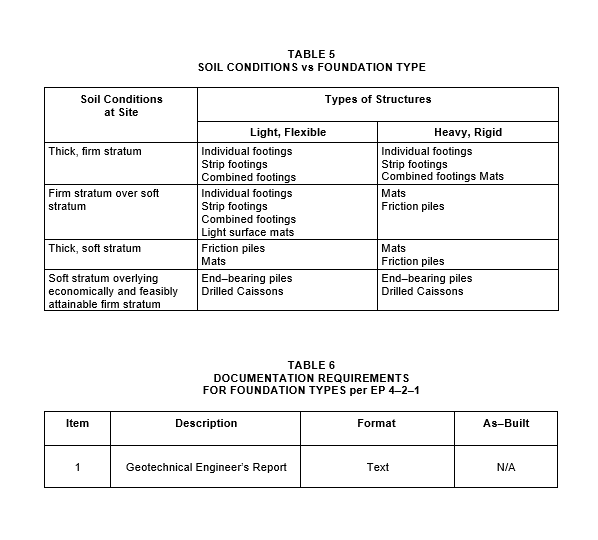
- Documentation required for foundation selection in accordance with this Practice is given in Table 6.
2.0 REFERENCES
The latest edition of the following standards and publications are referred to herein.
STANDARDS AND PUBLICATIONS
| Engineering Practices |
|---|
| EP 1–1–3 Deviations to Engineering Practices EP 4–2–2 Earthwork EP 4–2–4 Pile Foundations EP 4–2–6 Drilled Caisson Foundations |
| NAVFAC (U.S. Navy) Design Manuals |
| DM-7.01 Soil Mechanics DM-7.02 Foundations and Earth Structures |
| ASTM Standards |
| D1586 Penetration Test and Split–Barrel Sampling of Soils D1587 Thin–Walled Tube Sampling of Soils D2166 Unconfined Compressive Strength of Cohesive Soils |
DEFINITIONS
- Contractor - Company or business that agrees to furnish materials or perform specified services at a specified price and/or rate to the Owner.
- Deep Foundation - Foundation that must be placed considerably below the lowest part of the superstructure that it supports.
- Foundation - Member which provides support for the structure and its loads.
- Geotechnical Engineer - A Company engineer or designated representative appointed to carry out soil testing, foundation engineering and/or field inspection.
- Inspector - A Refining Company appointed engineer or inspector.
- Owner - Refining Company.
- Owner’s Engineer - A Refining Company appointed engineer.
- Pile - Structural member of timber, concrete, and/or steel, used to transmit surface loads to lower levels in the soil mass.
- Shallow Foundation - Foundation that is placed immediately beneath the lowest part of the superstructure that it supports.
- Standard Penetration Resistance - Number of blows required to drive a standard sampling device for a distance of 12 inches into the soil. This test shall be performed in accordance with ASTM D1586.
- Ultimate Bearing Capacity - The maximum load per unit of area that the soil can support without failure.
- Unconfined Compressive Strength - Load per unit area at which an unconfined cylindrical soil sample will fail in a simple compression test. This test shall be performed in accordance with ASTM D 2166.
SOIL DESIGN DATA
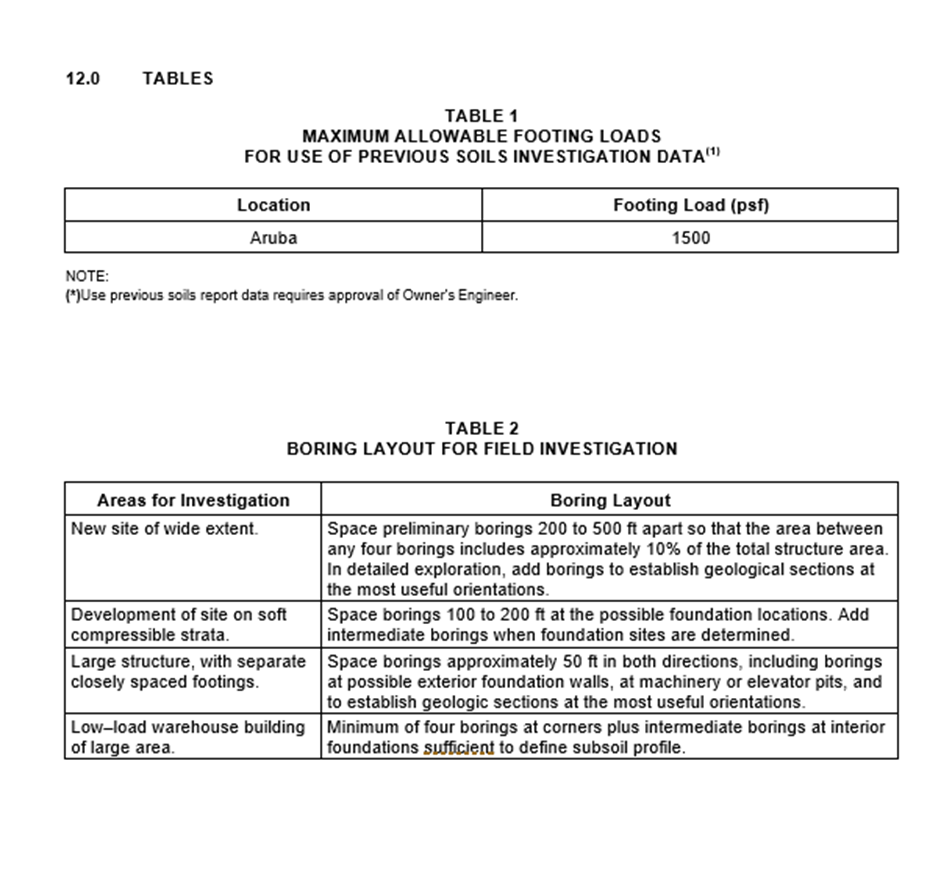
- (*)For projects where anticipated static footing loads are reasonably small (see Table 1) and sufficient data on soil–bearing capacity of the job site exist because of prior adjacent construction, these data shall be used to establish soil–bearing capacity in the project specifications, unless otherwise specified by the Owner’s Engineer.
- (*)For projects where major process units are involved or where large footing loads are anticipated, the foundation design conditions shall be based on the results of a field investigation preformed by a Geotechnical Engineer and approved by the Owner.
- The Owner’s Engineer shall review the Geotechnical Engineer’s report. Data included shall be adequate to allow appraisal of the Geotechnical Engineer’s recommendations. This shall include some or all of the following:
- Boring profiles
- Laboratory test data
- Soil loading test data
- Special soil characteristics
- Water table elevation
- Recommendations for surface and subsurface drainage
- Recommendations for foundation depths
- Suitability of soils for backfill
- Estimated ultimate soil–bearing capacity (static, and if applicable, dynamic)
- Recommended allowable design bearing capacity for different foundations
- Design criteria for dynamic loads
- Lateral resistance of soil
- Special conditions to be taken into account
- Whether piling or unusual foundation design appear advisable.
- The Geotechnical Engineer’s recommendations shall include anticipated and permissible settlements for allowable bearing capacities specified for various types of structures.
FIELD INVESTIGATION
- Table 2 shall be followed, where applicable, to establish the boring layout for the field investigation.
- Extend borings to a depth where vertical stress decreases to 10% of bearing pressure. Generally all borings shall extend no less than 30 feet below lowest part of foundation unless rock is encountered at shallower depth.
- If bedrock is encountered, two borings shall be extended 5 feet into sound, un-weathered rock.
- Field identification of all samples shall be made and recorded using the Unified Soil Classification System. Samples shall be individually packed in airtight containers, sealed, and labeled.
- (*)Sampling in cohesionless soils shall be limited to split–barrel sampling and standard penetration tests in accordance with ASTM D1586. Sampling shall not exceed 5-foot intervals, unless otherwise specified by the Owner’s Engineer. Samples shall also be taken at every apparent change of stratum.
- In cohesive soils, thin–walled (undisturbed) samples shall be taken in accordance with ASTM D1587. Samples shall be taken at 5-foot intervals, or at every apparent change of soil type.
- (*)Elevation of the groundwater table shall be measured and recorded. It shall be referenced to the established datum immediately after boring, then later when the water level has reached equilibrium with the surrounding groundwater. In an area affected by the tide or heavy rainfalls, observation wells shall be required to determine groundwater fluctuations over a period of time, as specified by the Owner’s Engineer. In tidal zones, the tide level shall be recorded at the same time as the groundwater measurement.
LABORATORY WORK
- The purpose of laboratory work is to establish the physical properties of soils from the representative samples taken in the field. The extent of testing depends on the nature of the soil and the detail required in the engineering design. However, the range of tests includes, but is not limited to:
- Visual identification
- Moisture content
- Grain size distribution (sieve and/or hydrometer analysis)
- Atterberg (liquid and plastic) limits
- Shear strength parameters.
- For compressible soils, consolidation tests shall be performed for predicting settlement magnitude and rate.
- (*)The Owner shall approve the type and number of laboratory tests to be performed.
FOUNDATION TYPES
- Foundations are classified as shallow and deep foundations.
- Shallow foundations are further divided into the following types:
- Spread footings: footings that support single columns. In soils, regardless of the allowable bearing pressure they shall never be less than 12 inches in width to avoid the possibility of punching into the soil. Their sides shall be of equal, or nearly equal dimensions. These footings are the simplest and least costly of foundations.
- Combined footings: footings that support a line of two or more columns. A combined footing may have either a rectangular or trapezoidal shape, or be a series of pads connected by narrow rigid beams called a strap footing.
- Continuous or strip footings: footings extended a substantial length in one direction to support a wall.
- Mat foundations (rafts): large concrete slab extended a substantial length in both directions, used to support numerous columns and/or equipment pedestals. A mat foundation is often used under a compressor shelter or a similar structure.
FOUNDATION REQUIREMENTS
- The foundation is an essential part of the structure and therefore it must satisfy certain stability requirements. As a minimum these requirements shall be:
- The foundation shall be safe against failure of the supporting soil.
- The foundation shall not undergo excessive settlement. Total and differential settlements must be limited in order not to cause structural distress, excessive tilting of the superstructure, or affect the serviceability requirements of the superstructure or attached equipment.
- The foundation shall be deep enough with respect to the depth of frost penetration and depth of seasonal volume changes in the soil to prevent excessive movement resulting from these influences.
- The foundation shall be deep enough to exclude the possibility of erosion and undermining of the supporting soil by water and wind currents.
- The foundation shall be adequately placed with respect to adjacent structures, existing or anticipated, to minimize the possibility of mutual damage by construction operations or by transmission of additional loads to the supporting soils.
- The ultimate bearing capacity of shallow foundations shall be selected based on application of the accepted principles of soil mechanics. Design procedures such as those given in NAVFAC DM–7.02 are considered acceptable and shall be followed.
- If shallow foundations are found to be unsuitable, for bearing capacity or settlement reasons, then the feasibility of ground improvement or a deep foundation shall be evaluated in terms of relative economics.
- (*)Unless otherwise approved by the Owner, the ultimate bearing capacity of the soil shall be divided by a safety factor of 3.0 to obtain the allowable bearing capacity. The factor of safety shall safeguard against:
- Natural variations in the shear strength of the soil.
- Uncertainties in the accuracy or reliability of theoretical or empirical methods for calculating bearing capacities.
- Excessive settlement.
SETTLEMENT OF FOUNDATIONS
- Settlement of the foundation is usually the most important consideration in assessing allowable bearing pressures.
- The differential settlement between one part of a structure and another is of greater significance to the stability of the superstructure than the magnitude of the total settlement. However, total settlement may be a significant factor if the superstructure supports piping or equipment connected to piping or equipment on adjacent superstructures.
- Foundation settlement shall be estimated based on application of the accepted principles of soil mechanics. Settlement analysis procedures, such as those given in the NAVFAC DM–7.01, are considered acceptable and shall be followed.
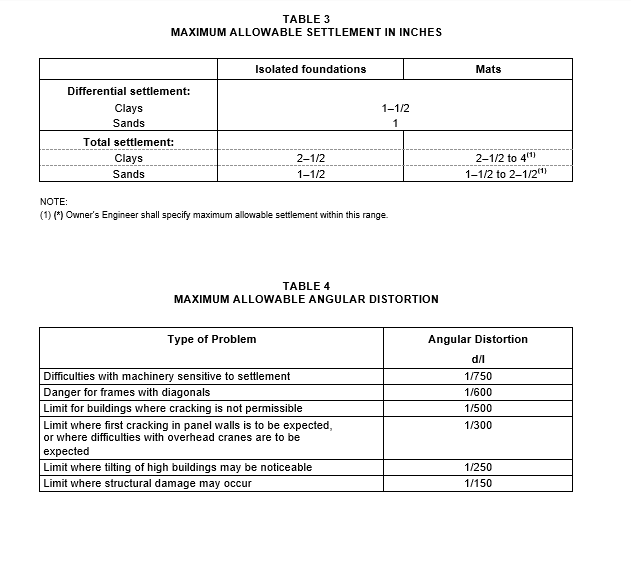
- The allowable total and differential settlement for foundation design shall consider the soil type under the foundation and shall be limited to the values given in Table 3.
- The type of problem expected from settlement can be related to the angular distortion, defined as the settlement difference between two points (d) divided by the horizontal distance (I): between the two points.
- The correlation (see Table 4) between structural problems and maximum allowable angular distortion shall be considered in the design of foundations.
FOUNDATION SELECTION
- The foundation type shall be selected based on the type of the structure, on the allowable soil pressure, and on the sensitivity of the structure to total and differential settlement.
- Foundation types shall be selected on the basis of a detailed soil investigation. However for preliminary planning, the selection guidelines given in Table 5 shall be followed.
- When spread footings would occupy more than 30% of the structure’s overall area, or when allowable differential settlement criteria cannot be satisfied, continuous footings shall be used.
- A mat foundation shall be used if the sum of individual footing areas would exceed 50% of the structure’s overall area.
- A mat foundation shall be used when there is a wide variation in loading between adjacent columns, which would lead to large differential settlements if individual footings were used.
- Piles or drilled caissons shall be used where thick deposits of weak compressible soil exist and other ground improvement methods prove more costly or are not otherwise feasible.
GROUND IMPROVEMENT
- (*)Where ground improvement is necessary to increase bearing capacity and reduce settlements, a method of ground improvement, given below, shall be considered. The Owner’s Engineer shall approve the method of ground improvement.
- Excavation and Backfill: This method is generally economical where relatively shallow, weak soils are present above the water table. It consists of excavating the weak soil, carefully backfilling with better soils in controlled lift thickness, and compacting the soil with the appropriate compaction equipment.
- Preloading (Surcharge): This method consists of banking soil to a height above the surrounding grade such that the load on the intended foundation site is equal to, or greater than the proposed structure design load. This technique is mainly applicable to saturated compressible clays. The soil is applied in layers at a rate that permits the weak soils to consolidate so that failures do not occur during the banking operation. The preload is left in place for sufficient time to achieve the degree of consolidation that will result in acceptable settlement and bearing capacity during structure operation. This method may prove the most economical, depending on availability and haul distance of the preload material and the time available for consolidation.
- Dynamic Consolidation: This method consists of repeatedly tamping the ground with a heavy weight. The tamper with a mass up to 20 metric tons is dropped from heights ranging from 20 to 80 feet onto a grid spacing so that the site is adequately compacted. Dynamic consolidation is only applicable to vacant sites, where no damage will result to existing structures. Most saturated soils can be substantially improved by this method, with improvement increasing with decrease in silt or clay content. Saturated clays may undergo almost no improvement.
- Vibroflotation: In vibroflotation, a probe is jetted to the bottom of the stratum that is to be densified. As it is being removed, the prove vibrates. The combination of vibration and saturation creates a quick condition around the probe, and the sand is densified. Vibroflotation is mainly applicable in deep deposits of medium–to–coarse sands, where less than 15 percent silt (passing the No. 200 sieve) is present.
11.2 For additional requirements for excavation and backfill, refer to EP 4–2–2.
© 2026 Inflection Point Engineering, LLC. All rights reserved. The content of this page — including calculation methods, reference data, written analysis, interactive tools, and source code — is the intellectual property of Inflection Point Engineering, LLC and is protected under applicable copyright, trademark, and trade secret laws. Unauthorized reproduction, redistribution, modification, or derivative use in whole or in part is prohibited without prior written consent.
Disclaimer. This material is provided for informational and educational purposes only and does not constitute professional engineering advice. Calculations, reference data, and methodologies are based on published standards and accepted engineering practice but are not a substitute for engineering judgment, site-specific analysis, or review by a licensed Professional Engineer. Inflection Point Engineering, LLC makes no warranties, express or implied, regarding the accuracy, completeness, or fitness for a particular purpose of any content presented here, and shall not be liable for any direct, indirect, incidental, or consequential damages arising from its use. Users assume all risk associated with applying this content to real-world design, operations, or decisions.
© 2026 Inflection Point Engineering, LLC. All rights reserved.