 Section 4 — Structures and Foundations
Design Criteria and Loads for Structures
IPE Engineering Practice IPE-EP-4-1-1
Document number: IPE-EP-4-1-1 · Section: 4 — Structures and Foundations
TABLE 7 LOAD CASE COMBINATIONS AND DESIGN CRITERIA FOR STRUCTURAL ELEMENTS (CONTINUED) 25
TABLE 8 UNIFORMLY DISTRIBUTED PIPING DEAD LOADS FOR OPEN FRAME STRUCTURES 24 TABLE 9 DESIGN FORCES FOR FLARE PIPING SYSTEMS 26
TABLE 10 COEFFICIENTS OF STATIC FRICTION 27
TABLE 11 ASCE 7 WIND LOADING DESIGN PARAMETERS (1) 27
TABLE 12 ASCE 7 SEISMIC LOAD COEFFICIENTS 28
TABLE 13 DOCUMENTATION REQUIREMENTS FOR DESIGN CRITERIA AND LOADS FOR STRUCTURES PER EP 4-1-1 29
SCOPE
- This Practice covers design criteria, minimum design loads and load case combination requirements, deflection limits, and foundation loads for new structures and equipment. Existing structures and equipment may be analyzed using the loads in this Practice or loads from the original design code, with the load combinations in this Practice.
- The latest version of ASCE 7 shall be used with all construction except as noted in paragraph 1.1.2
- Additions and alterations to existing structures designed in accordance with editions of ASCE 7, issued prior to the latest edition, may be designed in accordance with the provisions of that prior edition when approved by the Owner's Engineer.
- Any deviation from this Practice must be approved by the procedure described in EP 1-1-3.
- An asterisk (*) indicates that a decision by the Owner or the Owner's Engineer is required or that additional information is furnished by the Purchaser.
- A revision bar indicates all changes made to this Revision.
- Documentation required in accordance with this Practice is given in Table 14.
2.0 REFERENCES
The latest edition of the following standards and publications are referred to herein.
STANDARDS AND PUBLICATIONS
| IPE Engineering Practices |
|---|
| EP 1-1-3 Deviations to IPE Engineering Practices |
| EP 4-1-2 Requirements for Blast Resistant Buildings and |
| EP 4-2-3 Structures Reinforced Concrete Foundations |
| EP 4-2-8 Support Structures and Foundations for Heavy Machinery |
| EP 4-3-1 Concrete Design |
| EP 4-5-1 Structural Steel |
| EP 4-5-3 Auxiliary Structures for Operation and Maintenance |
| EP 4-6-1 General Requirements for Buildings |
| EP 4-7-1 Steel Stacks |
| EP 5-1-3 Piping Stress Analysis and Supports |
| EP 7-1-1 Pressure Vessels |
| EP 9-1-1 Atmospheric Storage Tanks |
| EP 9-2-1 Low Pressure Storage Tanks |
| ACI Publications |
| 318 Building Code Requirements for Reinforced Concrete 530 Building Code Requirements for Masonry Structures |
STANDARDS AND PUBLICATIONS (CONT.)
| AISC Publication |
|---|
| Manual of Steel Construction, Allowable Stress Design Manual of Steel Construction, Load and Resistance Factor Design |
| API |
| RP 579 Fitness-for-Service Std 620 Design and Construction of Large, Welded, Low-Pressure Storage Tanks Std 650 Welded Steel Tanks for Oil Storage |
| ASCE |
| 7 Minimum Design Loads for Buildings and Other Structures "Wind Loads and Anchor Bolt Design for Petrochemical Facilities" |
| ASME Codes and Standards |
| Sec. VIII Pressure Vessels Code, Divisions 1 Sec. VIII Pressure Vessels Code, Alternative Rules, Division 2 B31.3 Process Piping STS-1 Steel Stacks |
| Building Codes |
| ICBO Uniform Building Code International Building Code |
| OSHA |
| Rules and Regulations |
| Publication |
| Bednar, H. H., "Pressure Vessel Design Handbook", Van Nostrand Reinhold, 1981. Deghetto, K., and Long, W., "Dynamic Stability Design of Stacks and Towers", Transactions of the ASME, November, 1966. |
DEFINITIONS
- Contractor - Company or business that agrees to furnish materials or perform specified services at a specified price and/or rate to the Owner.
- Inspector - A Inflection Point Engineering, LLC appointed engineer or inspector.
- Manufacturer - The recipient of a direct or indirect purchase order for materials and/or equipment. In this context, a direct order is one issued to a manufacturer by a contractor or the Owner. An indirect order is one issued to a manufacturer by a vendor (recipient of a direct order) for materials, fabricated components, or subassemblies.
- Owner - Inflection Point Engineering, LLC .
- Owner's Engineer - A Inflection Point Engineering, LLC appointed engineer.
STRUCTURAL DESIGN CRITERIA
- The design criteria for structures shall be in accordance with the standards and publications in Table 1, and the requirements of this Practice.
- Minimum design loads, load combinations, deflection limits and foundation loads shall be in accordance with the requirements of this Practice.
- In addition to the requirements of this Practice, all applicable state and local building codes and regulations shall apply. In case of a conflict between the requirements of this Practice and these codes and regulations, the more stringent requirements shall apply. It should be noted that in the spring of 2000, the first edition of the International Building Code (IBC) has been published. It is expected that juridictions will eventually replace existing model codes with the IBC.
DEAD LOADS
- Dead loads consist of the weight of the structure and all materials permanently fastened thereto or supported thereby, including fireproofing, piping, empty equipment, piping attached to equipment, and insulation.
- In estimating dead loads for purposes of design, the actual weight of materials and constructions shall be used. Alternatively, in the absence of definite information, assumed weights may be used to determine dead loads provided that before completion of the final design, all assumed dead loads are reviewed and compared to actual values. Based on this review, structural member sizes shall be increased where necessary.
- The minimum design dead loads and minimum densities for design loads of materials of construction shall be in accordance with Tables C3-1 and C3-2 of ASCE 7 (Tables C1 and C2 of ASCE 7-93), respectively. Alternatively, these loads can be established from published information provided by the Manufacturer.
- The actual weight of fixed equipment such as pressure vessels, heat exchangers, and pumps shall be used to establish the dead loads for design purposes. Consideration shall be given to hydrotest loads, where appropriate.
- The members of open frame structures, other than pipeways, shall be designed for the estimated uniformly distributed piping loads shown in Table 8. In addition, all piping larger than NPS 12 and heavy duty pipe and/or fittings shall be considered as concentrated loads. Before completion of the final design, all uniform loading shall be reviewed and compared to the actual pipe loading for the area under consideration, and structural member sizes shall be modified where necessary.
LIVE LOADS
- General
- Live loads are those loads produced by the use and occupancy of the building or structure, and do not include environmental loads such as wind loads, earthquake loads, snow loads, or rain loads. In addition, this category of load does not include dead loads, fluid loads, loads due to thermal, friction, or settlement effects, and blast loads.
- In general, live loads include the following:
- Personnel, portable machinery, tools and equipment.
- Material to be temporarily stored during maintenance, such as exchanger parts, pipe and fittings, valves.
- Material normally stored during operation such as tools, maintenance equipment, catalyst and chemicals.
- Except as specified in Table 2, minimum live loading and reductions in live loads shall be as specified in ASCE 7.
- Impact Loads
- The minimum impact loads for built in handling facilities shall be in accordance with Table 3. More stringent loads than those shown in this table shall be used if specified by the equipment manufacturer.
- (*)The minimum wheel impact loads in Table 4 shall be used unless otherwise specified by the Owner.
- Vibration
- Where the amplitudes and frequencies of equipment vibrations are known, they shall be documented and included in the design of all structural members. Where they are anticipated but their magnitudes are unknown, they shall be assessed from Manufacturer's data and other sources, and provided for in the design.
- Where vibration induced by equipment or operation is specified or anticipated, supporting members shall be designed to prevent fatigue failure in accordance with AISC specifications or or ACI code.
- The natural frequency of a member or structure supporting equipment subject to vibration shall not be within the range of 0.70 to 1.40 times the exciting frequency unless damping is taken into consideration and amplitudes are limited to permissible values, and/or vibration isolation is provided.
- (*)The Owner or Contractor shall indicate where special consideration must be given to vibration or deflection of supporting members to avoid misalignment or malfunction of machinery and equipment.
- Where it is anticipated that vibrations will be transmitted through columns and other portions of a building or structure to the foundations, they shall be considered in the foundation design.
- Maintenance Loads
- Structures and foundations supporting heat exchangers subject to bundle pulling shall be designed for a longitudinal force applied at the centroid of the tube bundle. This force shall be equal to 150 percent of the bundle weight. The shear force due to bundle pulling shall be assumed to be transmitted solely through the fixed shell support.
- Davits (exclusive of manhole davits) shall be designed for the weight of the heaviest piece of equipment that they may be required to lift, plus the weight of rigging equipment, plus impact load, but not less than a minimum equipment load of 1,000 pounds. The design shall be based on the use of a single sheave pulley block with a tugger line in the most critical direction. All davits shall be legibly marked with the maximum permissible lifted load.
- Roof Live Loads
- Roof live loads shall be established in accordance with ASCE 7.
- The minimum roof live load to be used for design shall be 20 psf, distributed on the roof horizontal projection.
FLUID LOADS
- Static Loads
- Fluid loads shall include pressures and weight of the contained fluid. . A minimum of 13 psf shall be used at each main pipe rack (mpr) level and 9psf at each miscellaneous pipe rack (pr) and "T" support level.
- The pressure and weight of the test fluid shall be used for the test condition load case. The most stringent combination of pressure and weight of the production fluid shall be used for all other load cases.
- Transient Loads
- (*)The following fluid transient loads shall be evaluated when designing structures, piping systems, pressure vessels, and associated equipment. These loads shall be considered as live loads when establishing permissible design stresses and load factors for structural design, see Section 14.0. The analysis methods used to establish design loads resulting from fluid transients shall be submitted to the Owner for review and approval.
- Forces associated with pressure relief systems during a safety valve release event.
- Forces due to pulsation effects from positive displacement pumps and compressors.
- Forces resulting from slug or other two-phase flow regimes.
- Forces associated with hydraulic transients resulting from quick valve closure or pump startup (water hammer).
- Forces associated with surging action of fluidized solids in process equipment or piping.
- Flare system piping and support structures shall be designed to resist the forward, lateral, and upward dynamic forces developed at bends as a result of high-velocity vapors and condensed liquids, as well as to accommodate sudden thermal expansion or contraction. Unless otherwise determined from a transient fluid analysis, the design values for forces to be restrained shall be in accordance with Table 9.
THERMAL, FRICTION, AND SETTLEMENT LOADS
- Loads in this category are self-straining forces and effects arising from contraction or expansion that is the result of temperature changes, shrinkage, moisture changes, creep in component materials, movement due to differential settlement or combinations of these effects. In addition, loads due to friction are included in this category.
- Thermal forces resulting from complete or partial anchoring of piping and equipment, and expansion and contraction of a structure shall be included in the design of structural members.
- Friction forces resulting from sliding or rolling equipment and piping shall be included in the design of structural members. The friction force shall be computed as the product of the vertical force normal to the direction of movement or sliding and the friction factors stipulated below.
- (*)Coefficients of static friction shall be used to determine forces at sliding surfaces. Values for the static friction coefficient are given in Table 10. The use of values other than those given in Table 10 is subject to the approval of the Owner's Engineer.
RAIN LOADS
- Rain loads shall be established in accordance with the requirements of ASCE 7.
WIND LOADS
- General
- (*)Wind loads acting on structures, piping, and equipment (excluding atmospheric storage tanks), shall be determined from Method 2 (Analytical Method) of ASCE 7 and the following provisions set forth in this Practice. The use of Method 1 (Simplified Method) of ASCE 7 shall require Owner's Engineer approval and is limited to structures of regular shape as defined in ASCE 7. Wind loading and design requirements for atmospheric storage tanks are covered in EP 9-1-1.
- (*)All wind loading calculations and related designs are subject to the approval of the Owner.
- (*)The design basis of ASCE 7 does not include allowances for crosswind or torsional loading, vortex shedding, or instability due to galloping or flutter. The effects of these influences shall be examined by the contractor and, if required, designs to ensure structural reliability with these wind effects shall be submitted to the Owner for approval.
- (*)Unless otherwise specified by the Owner's Engineer, the wind loads derived from this paragraph need only be applied in a single direction. However, this direction should represent a conservative estimate of the wind load effects on the structural system. In order to ensure that open structures, which are rectangular in plan and elevation are designed for the most adverse wind effects on the structure and the foundation, design in accordance with the recommendations given in ASCE publication "Wind Loads and Anchor Bolt Design for Petrochemical Facilities
- (*)The Basic Design Wind Speed, Exposure Category, and Importance Factor shall be determined from Table 11. These parameters for locations not listed in the table shall be subject to the approval of the Owner.
- The Gust Response Factor shall be determined as follows:
- Structures shall be considered dynamically wind sensitive structures if their height to least horizontal dimension ratio is greater than 5 or their structural natural frequency is less than 1 Hertz (for example tall buildings, vertical pressure vessels, and stacks),
- For flexible or dynamically wind sensitive structures the gust effect factor for main wind-force resisting systems of flexible structures (Gf) shall be used and shall be calculated by the procedures in Paragraph 6.5.8.2 of ASCE 7 or by a rational analysis that incorporates the dynamic properties of the main wind-force resisting system.
- For all other structures being evaluated in accordance with ASCE 7, the rigid structure gust effect factor shall be determined from the simplified method given in ASCE 7, Paragraph 6.5.8.1.
- Except as indicated, no allowance shall be taken for shielding effects of other buildings, structures or equipment. Procedures to account for shielding of rows of pipes on a structure are covered in the piping-specific section of this paragraph.
- (*)For design of structures on ocean promontories, mountains, in gorges, or at other locations subject to unusual exposures, where wind records or experience indicate that the design wind speeds in ASCE 7 are inadequate, the design wind speed will be specified by the Owner.
- (*)Wind loading on platforms, ladders, piping, or other appurtenances attached to a structure or equipment shall be included in total wind loads on the structure. An approximate method may be used to account for appurtenances. However, the use of approximate methods not in accordance with this Practice shall be approved by the Owner's Engineer.
- Supplemental Requirements for Piping
- (*)Exposure Category C shall be used for piping systems. Exceptions to this requirement include, but are not limited to, piping covered by the following paragraph, FCCU overhead and other vessel overhead lines, furnace decoking lines, marine dock lines, and similarly exposed piping systems. The Exposure Category for these exceptions shall be determined by the Owner's Engineer.
- (*)For piping systems located in sheltered areas, such as piping in racks or in between vessels or furnaces, Exposure Category B may be used, if approved by the Owner's Engineer.
- The force coefficient to be used in the determination of wind forces (Cf) shall be determined according to Table 6-10 of ASCE 7.
- The design wind forces acting on piping shall be determined using the procedure in Paragraph
6.5.13 of ASCE 7 using the column marked "Open buildings and other structures". The projected area normal to the wind, Af, shall be based on the largest pipe diameter including insulation and jacketing. Note that for piping analysis the wind force is expressed as a force per unit length.
- (*)Methods to account for wind forces on multiple pipes on support beams shall be approved by the Owner's Engineer.
- Supplemental Requirements for Equipment
- The supplemental requirements of this Section apply to pressure vessels, low pressure storage tanks, and steel stacks. Wind design for atmospheric storage tanks is covered in EP 9-1-1.
- The wind load on equipment shall be determined by one of the three methods listed below:
- Wind loads shall be based on an equivalent diameter determined in accordance with Paragraph
11.3.3. The force coefficient shall be 0.6 if the height to diameter ratio is less than 7.0, and 0.7 if the height to diameter ratio equals 25.0. For height to diameter ratios greater than 7.0 and less than 25.0, the force coefficient shall be determined by interpolation. This method shall be limited to equipment with circular platforms whose width does not exceed 4 feet.
- Wind loads shall be determined using the actual equipment diameter with protruding elements, such as platforms and caged ladders, treated as surface roughness. The force coefficient shall be determined from Table 6-10 of ASCE 7 based on a roughness category calculated using the width of the largest protruding element and the actual equipment diameter.
- Wind loads for piping, platforms, ladders and other appurtenances shall be determined separately from those of the associated equipment and shall be applied to the equipment at the nominal height of their occurrence. The force coefficient for open lattice appurtenances, such as caged ladders and platforms, shall be taken as 1.8. The force coefficient for the equipment, attached piping and any other cylindrical appurtenances shall be based on height to diameter ratio in accordance with paragraph 11.3.2.1. Wind loads for appurtenances and the equipment shall be based on actual project area (or diameter).
- The equivalent wind diameter shall be determined from one of the following formula if the equipment has attached platforms and/or ladders whose width does not exceed 4 feet:
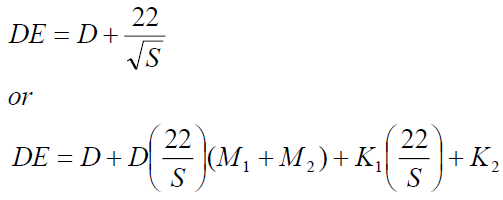
where
DE Equivalent Outside Diameter (ft)
D Outside Diameter of Equipement including Insulation (ft) S Average platform spacing (ft)
M1 Platform Factor, 0 for no platforms, 0.04 with platforms M 2 Piping ping Factor, 0 for no piping, 0.16 with piping
K1 Platform Factor, 0 for no platforms,1.59 with platforms
K 2 Ladder Factor, 0 for no ladders,1.89 0.1(S - 22) with ladders
- If the equipment has only attached piping (no attached platforms and/or ladders), the equivalent wind diameter shall be:
DE 1.5D for D 3 feet 1.4D for 3 D 5 feet 1.3D for 5 D 7 feet 1.2D for D 7 feet
- (*)The use of alternative equations for equivalent wind diameter, including the factors given by Bednar (see paragraph 2.0), shall be approved by the Owner's Engineer. It should be noted that the factors in the Bednar reference may not be suitable for vessels with platforms and caged ladders that are consistent with EP 4-5-3 details.
- (*)Unless otherwise approved by the Owner's Engineer, a single method of calculation of equivalent diameter shall be applied consistently over the entire height of the equipment.
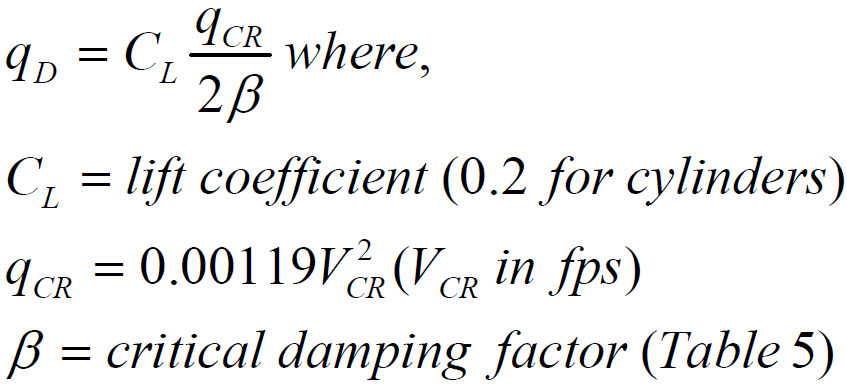
- When using the rational analysis method to determine the Gust Response Factor, the value of the structural damping coefficient, Beta (β,) shall be determined from Table 5 for vertical pressure vessels or Table 6 for Steel Stacks.
- Wind Induced Vibration
- (*)Smooth vessels, towers and stacks qualify as wind sensitive structures if their height to least horizontal dimension ratio is greater than 5 or they have a structural natural frequency less than 1 Hertz. If the critical velocity is determined to be between 30 and 70 mph, the structures shall be analyzed for the effects of vortex shedding. Alternatively, vortex shedding shall be inhibited by external strakes, spoilers or other means approved by the Owner.
- (*)The effects of wind induced vibration from vortex shedding shall be evaluated by the methods proposed by Deghetto and Long, see Paragraph 2.0, and the additional requirements of this Practice. Alternative evaluation methods may be used if approved by the Owner.
- Vortex shedding can be avoided by suitable design, which would raise the calculated critical wind velocity to a value higher than the maximum velocity of any sustained wind expected at the site. Where sustained wind resonance is unavoidable, the designer shall demonstrate by calculation that all criteria for safe, sustained operation and erection of affected structures are met.
- Calculations for predicted critical wind velocity shall be based on a Strouhal number of 0.2.
- (*)The structural natural frequency shall be computed by a method that takes into account mass and stiffness of components distributed through the structure. In addition, the effects of support structure stiffness (for example, the roof components for a heater-supported stack) shall be included in the determination of the natural frequency. The use of methods other than the Raleigh method or other numerical methods, including finite element methods, shall be approved by the Owner's Engineer.
- The design for wind-induced vibration from vortex shedding, including dynamic lift effects, shall be based on a fatigue life of at least 100 hours of vibration, but not less than the expected duration of the first mode of the resonant wind over a 10-year period. The minimum stress concentration factor for butt-weld joints shall be 2.0 and for other joints shall be 3.0. Fatigue cycles shall be determined from the appropriate figure in ASME Boiler and Pressure Vessel Code, Section VIII, Division 2. Alternatively, fatigue design curves for welded structures in Appendix F of API 579 may be used.
- The dynamic design wind pressure, qD , (psf) shall be determined as follows:
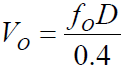
- Ovaling vibration effects shall be considered in the design of all wind-sensitive structures. The frequency of the lowest mode of ovaling vibration, fO (Hz) is:
f0 678.5 D2
where,
t thickness of structure at height under consideration (in.)
D outside diameter at height under consideration ( ft.)
Resonance occurs if the frequency of the lowest mode of ovaling vibration is twice the vortex shedding frequency, or the critical velocity for ovaling is, VO (ft./sec):
- The maximum single displacement amplitude at the top, including that caused by movement of the base, shall be 0.2% of the height for stayed towers and 0.5% of the height for all other structures.
EARTHQUAKE LOADS
- Design for earthquakes shall be based on ASCE 7 Section 9.0 including the requirements for "Nonbuilding Structures" where applicable.
- (*)Mapped maximum considered earthquake, seismic performance categories and soil profile types to be used with ASCE 7 shall be determined from Table 12. The Owner's Engineer shall specify or approve values for these parameters for locations not listed in this table. The seismic performance category shall be based on an ASCE 7-95 occupancy classification of Category III.
- (*)Proposed analysis procedures, static or dynamic, to be used for the design of structures and equipment are subject to the approval of the Owner.
- (*)Unless otherwise specified by the Owner, dynamic (modal) seismic analyses shall be performed for the following:
- Towers, stacks, flares and process vessels over 50 feet in height.
- Towers, stacks, flares and process vessels under 50 feet in height whose mass and stiffness distribution are not well approximated by a cantilever that has a single displacement shape.
- All piping with an ASME/ANSI Class 600 and greater components.
- (*)Where specified by the Owner's Engineer, soil-structure interaction shall be taken into consideration. The methods in ASCE 7 Section 9.0 shall be used in such analyses.
BLAST LOADS
- Blast loads and design criteria for blast-resistant structures shall be in accordance with EP 4-1- 2.
- (*)Except as noted below, the Owner shall stipulate the need for a blast-resistant structural design on a case-by case basis by. All on-site control houses shall be designed for resistance to blast loads, unless otherwise specified by the Owner.
SOIL, HYDROSTATIC PRESSURE AND FLOOD LOADS
- (*)Unless otherwise specified by the Owner's Engineer, hydrostatic and hydrodynamic loads on buried structures and foundations shall be in accordance with ASCE 7 Section 5.
- Buried structures shall also be designed to resist potential lateral loads from surcharges from fixed or moving loads.
- Structures and foundations shall be designed for flood loads in accordance with ASCE 7 Section 5.0 at sites considered flood hazard zones (areas) on a map approved by the authority having jurisdiction for the designated flood zone.
LOAD CASE COMBINATION AND DESIGN CRITERIA
- (*)The combination of loads and forces shown in Table 7 shall be used to design structural elements (such as columns, beams, slabs bracing, anchor bolts, and foundations) in
accordance with the AISC Specification or ACI code, and to check the stability of structures against overturning. The consideration of a load case in ASCE 7 not specifically addresses in Table 7 shall be approved by the Owner's Engineer. These may include, but are not limited to, load cases involving flood and/or hydrostatic (or hydrodynamic) loads.
- Load combinations and design criteria for equipment are specified in the applicable IPE
Engineering Practices listed in Table 1.
DEFLECTION LIMITS
- The deflection limits for structural elements shall be in accordance with the applicable standard and the requirements of this Practice.
- Structural elements whose span length is L shall be designed to meet the following deflection limits when subject to the normal operating load cases specified in Table 7.
- Deflection shall not exceed 0.05 inches for elements supporting rotating equipment or piping connected to rotating equipment, regardless of the span.
- Deflection shall not exceed L/240, for horizontal framing members, excluding crane runway girders.
- Deflection shall not exceed L/800 for crane runway girders.
- Deflection shall not exceed L/240 for floor plate and grating.
- Deflection shall not exceed L/360 for floor systems for computer and instrumentation centers.
- Deflections of structural elements and horizontal sway of structures supporting equipment shall be investigated to ensure that these deflections do not overstress the equipment or connected piping.
- Horizontal sway of structures shall be investigated to ensure that adjacent structures or structures and adjacent equipment do not overstress the equipment or connected piping.
- Deflection limits for equipment are specified in the applicable IPE Engineering Practices listed in Table 1.
FOUNDATION LOADS
- Foundation loads shall be based on the load combinations defined in Table 7.
- Additional requirements for support structures and foundations for heavy rotating equipment are covered in EP 4-2-8.
17.0 TABLES
TABLE 1
DESIGN CRITERIA FOR STRUCTURES
| Structural System | Applicable Industry Standard | Applicable IPE Engineering Practice |
|---|---|---|
| Reinforced Concrete: Foundations |
ACI 318 | EP 4-2-3 |
| Support Structures and Foundations for Heavy Machinery | ACI 318 | EP 4-2-8 |
| Structural Steel: Buildings and Pipe Supports | AISC Manual of Steel Construction | EP 4-5-1, EP 4-6-1 |
| Structural Steel: Platforms and Walkways | AISC Manual of Steel Construction | EP 4-5-1, EP 4-5-3 |
| Reinforced Concrete: Buildings and Pipe Supports | ACI 318 | EP 4-3-1, EP 4-6-1 |
| Reinforced Masonry Structures | ACI 530 | EP 4-6-1 |
| Steel Stacks | ASME STS-1 | EP 4-7-1 |
| Piping Systems | ASME B31.3 | EP 5-1-3 |
| Pressure Vessels | ASME Code, Section VIII | EP 7-1-1 |
| Low-Pressure Storage Tanks (API-620) | API Std 620 | EP 9-2-1 |
| Atmospheric Storage Tanks (API-650) | API Std 650 | EP 9-1-1 |
TABLE 2
MINIMUM LIVE LOADING REQUIREMENTS FOR DESIGN OF STRUCTURAL FRAMING
| Structural Component | Minimum Live Load |
|---|---|
| Walkways and Floor Plate or Grating(1) | 75 psf(2) |
| Platform Framing(1) | 75 psf(2) or a concentrated load of 2,000 lb. applied over an area of 2-1/2 sq. ft., or the actual equipment weight, whichever is greater (Located so as to produce the maximum load effects in structural members) |
| Warehouse, Storage Areas, Loading Platforms, and Slab on Grade | 250 psf or wheel loading, including impact, of material-handling equipment expected to be operated in the area, whichever is greater |
| Ladders | A moving concentrated load of 500 lb. |
| Stairs | A moving concentrated load of 1,000 lb or 50 psf on the horizontal projection applied vertically, whichever is more severe |
| Guard Railing and Posts for Platforms and Stairway | Shall meet OSHA requirements, Section 1910.23e |
NOTES:
- The minimum live loading on areas that may be subjected to heavy equipment and material loads during periodic maintenance operations shall be increased 50 percent over the loading listed in this table.
- A higher live load may be required by the local jurisdiction.
TABLE 3
MINIMUM DESIGN IMPACT LOADS
| Handling Facility | Load Application | Impact Load |
|---|---|---|
| Traveling Crane Runway | Vertical on the supports Longitudinal on the supports Lateral on the supports |
*25% of the lifted load 10% of the maximum wheel loads applied at the top of the runway 20% of the sum of the lifted load and the weight (mass) of the crane trolley applied at the top of the runway, one half on each side, and considered as acting in either direction normal to the runway |
| Trolley Beams | Vertical on trolley beams Longitudinal on trolley beams |
25% of the lifted load 10% of the wheel loads |
| Davits | Vertical on the davit Lateral on the davit |
25% of the lifted load 20% of the weight (mass) of the moving equipment |
| Elevators | Vertical on the supports | 100% of rated capacity |
* Must be verified to see if this agrees with the requirements of ASCE 7 (ref sect.4.10)
TABLE 4
MINIMUM WHEEL IMPACT LOADS
| Vehicle Type | Impact Load |
|---|---|
| Vehicles with Pneumatic Tires | 30% of Equipment Weight |
| Vehicles with Solid Tires | 50% of Equipment Weight |
TABLE 5
VALUE OF THE STRUCTURAL DAMPING COEFFICIENT (BETA) FOR VERTICAL PRESSURE VESSELS
| Description | Beta () |
|---|---|
| Empty steel vessel without internals | 0.0048 |
| Empty steel vessel with trays spaced more than 5 feet | 0.0051 |
| Empty steel vessel with trays spaced more than 3 feet but less than or equal to 5 feet | 0.0056 |
| Empty steel vessel with trays spaced less than or equal to 3 feet | 0.0064 |
| Steel vessel with trays spaced more than 5 feet but less than or equal to 8 feet and with operating liquid in trays | 0.0116 |
| Steel vessel with trays spaced less than or equal to 5 feet and with operating liquid in trays | 0.0127 |
| Vessel full of liquid | 0.018 |
TABLE 6
VALUE OF THE STRUCTURAL DAMPING COEFFICIENT (BETA) FOR STACKS
| Stack Configuration | Beta () |
|---|---|
| Stacks Supported At Grade: | 0.004 0.001 0.002 0.002 0.003 0.008 |
| Minimum Value-All welded, unlined stack, with a shallow | 0.004 0.001 0.002 0.002 0.003 0.008 |
| foundation on rock or firm soil | 0.004 0.001 0.002 0.002 0.003 0.008 |
| Additional Damping, added to a minimum value, due to: | 0.004 0.001 0.002 0.002 0.003 0.008 |
| Foundation (piled or shallow)on soft soil | 0.004 0.001 0.002 0.002 0.003 0.008 |
| Stack lining, at least 2 inches thick | 0.004 0.001 0.002 0.002 0.003 0.008 |
| Stack with at least 5 bolted, unwelded, flanges | 0.004 0.001 0.002 0.002 0.003 0.008 |
| Ducts entering top 60% of slack height from at | 0.004 0.001 0.002 0.002 0.003 0.008 |
| least two direction between 60 and 120 apart | 0.004 0.001 0.002 0.002 0.003 0.008 |
| Maximum Value, including above additions | 0.004 0.001 0.002 0.002 0.003 0.008 |
| Stacks on Elevated Supports: Minimum Value-All welded, unlined stack, on bare steel support structure Additional Damping, added to minimum value, due to: Refractory lining added to steel support Stack lining, at least 2 inches thick (1) Stack with at least 5 bolted, unwelded, flanges (1) Maximum Value, including above additions |
0.003 |
| Stacks on Elevated Supports: Minimum Value-All welded, unlined stack, on bare steel support structure Additional Damping, added to minimum value, due to: Refractory lining added to steel support Stack lining, at least 2 inches thick (1) Stack with at least 5 bolted, unwelded, flanges (1) Maximum Value, including above additions |
0.002 |
| Stacks on Elevated Supports: Minimum Value-All welded, unlined stack, on bare steel support structure Additional Damping, added to minimum value, due to: Refractory lining added to steel support Stack lining, at least 2 inches thick (1) Stack with at least 5 bolted, unwelded, flanges (1) Maximum Value, including above additions |
0.001 - 0.002 |
| Stacks on Elevated Supports: Minimum Value-All welded, unlined stack, on bare steel support structure Additional Damping, added to minimum value, due to: Refractory lining added to steel support Stack lining, at least 2 inches thick (1) Stack with at least 5 bolted, unwelded, flanges (1) Maximum Value, including above additions |
0.001 - 0.003 |
| Stacks on Elevated Supports: Minimum Value-All welded, unlined stack, on bare steel support structure Additional Damping, added to minimum value, due to: Refractory lining added to steel support Stack lining, at least 2 inches thick (1) Stack with at least 5 bolted, unwelded, flanges (1) Maximum Value, including above additions |
0.008 |
| All Cases: | |
| Maximum Value, with addition of at least 3 guy wires | |
| temporarily attached to top one-third of stack during erection | 0.012 |
| Maximum Value, with addition of damping pads (2) | 0.020 |
NOTES:
- Values chosen depend on relative stiffnesses of stack and support, the higher value being used exclusively for a relatively flexible stack on a stiff support.
- The design of damping pads shall be approved by the Owner, see EP 4-7-1.
TABLE 7
LOAD CASE COMBINATIONS AND DESIGN CRITERIA FOR STRUCTURAL ELEMENTS
| Loading Condition | Design Loads and Forces (1) (All loads and forces are additive) |
Design Stresses and Load Factors (3) (Structural steel and reinforced concrete) |
|---|---|---|
| Erection | Dead load of structure less: fireproofing and piping. Dead load of equipment, less: all loose internals, insulation and platforms supported from the equipment. Temporary loads and forces caused by erection. Full wind or earthquake, whichever is greater. |
AISC Specification or ACI 318 |
| Testing or Flushing Equipment Plus Reduced Occasional | Dead load of structure, plus fire- proofing. Dead load of equipment, including: all internals, insulation, and platforms supported from the equip- ment. Dead load of piping, plus insulation. Applicable live loads excluding vibration, surge, maintenance and roof live loads. Fluid load (water) for testing or flushing equipment and piping unless pneumatic test is specified. Wind load for a wind speed of 35 mph. |
AISC Specification, or ACI 318 plus the following provisions for structures supporting equipment subject to water test, wherein all or a majority of the fluid load is water applied for a relatively short time. t Allowable Stress Design(AISC). Basic allow-able stresses may be increased 20% when wind loading is excluded t Strength Design (ACI). All load factors may be multiplied by 0.83 when wind loading is excluded, and 0.75 when wind loading is included. t Load and Resistance Design (AISC). For all loads, use a load factor of 1.4 when wind loading is excluded, and 1.3 when wind loading is included. |
TABLE 7
LOAD CASE COMBINATIONS AND DESIGN CRITERIA FOR STRUCTURAL ELEMENTS (CONTINUED)
| Loading Condition | Design Loads and Forces (1) (All loads and forces are additive) |
Design Stresses and Load Factors (3) (Structural steel and reinforced concrete) |
|---|---|---|
| Normal Operation | Dead load of structure, plus fire- proofing. Dead load of equipment, including: all internals, insulation, and platforms supported from the equipment. Dead load of piping, plus insulation Applicable live loads excluding roof live loads and surge loads (2) Fluid load during normal operation. Thermal, friction, and settlement loads. Roof live load or rain load, whichever is greater. |
AISC Specification or ACI 318 |
TABLE 7
LOAD CASE COMBINATIONS AND DESIGN CRITERIA FOR STRUCTURAL ELEMENTS (CONTINUED)
| Loading Condition | Design Loads and Forces (1) (All loads and forces are additive) |
Design Stresses and Load Factors (3) (Structural steel and reinforced concrete) |
|---|---|---|
| Normal Operation plus Occasional | Dead load of structure, plus fire- proofing. Dead load of equipment, including: all internals, insulation, and platforms supported from the equipment. Dead load of piping, plus insulation. Applicable live loads excluding roof live loads (2). |
AISC Specification or ACI 318 plus the following provisions when surge load is combined with wind or earthquake loads (4): t Allowable Stress Design(AISC). Basic allow-able stresses may be increased in accordance with ASCE 7. |
| 3. Normal surge forces. | t Strength Design (ACI). All load factors may be multiplied by 0.75, but net load factors shall not be reduced below 1.0. |
|
| 4. Fluid load during normal operation | ||
| 5. Thermal, friction, and settlement loads. | t Load and Resistance Design (AISC). Use a load factor of 1.15 on all loads.. |
|
| 6. Roof live load, snow load or rain load, whichever is greater. | ||
| 7. Full wind or earthquake, whichever is greater. |
TABLE 7
LOAD CASE COMBINATIONS AND DESIGN CRITERIA FOR STRUCTURAL ELEMENTS (CONTINUED)
| Loading Condition | Design Loads and Forces (1) (All loads and forces are additive) |
Design Stresses and Load Factors (3) (Structural steel and reinforced concrete) |
|---|---|---|
| Abnormal Operation or Startup plus Reduced Occasional |
1. Dead load of structure plus fire- proofing. Dead load of equipment, including: all internals, insulation, and platforms supported form the equipment. Dead load of piping, plus insulation. | AISC Specification or ACI 318 plus the following provisions when surge load is combined with wind loads (4): t Ulitmate Stress Design (AISC). The basic allowable stresses may be increased 50%, but not above the yield point of the material. t Ultimate Strength Design (ACI). All load factors may be multiplied by 0.75, but net load factors shall not be reduced below 1.0. t Load and Resistance Factor Design (AISC). Use a load factor of 1.15 on all loads. |
| 2. Applicable live loads excluding roof live loads and surge loads (2). | AISC Specification or ACI 318 plus the following provisions when surge load is combined with wind loads (4): t Ulitmate Stress Design (AISC). The basic allowable stresses may be increased 50%, but not above the yield point of the material. t Ultimate Strength Design (ACI). All load factors may be multiplied by 0.75, but net load factors shall not be reduced below 1.0. t Load and Resistance Factor Design (AISC). Use a load factor of 1.15 on all loads. |
|
| 3. Abnormal surge forces. | AISC Specification or ACI 318 plus the following provisions when surge load is combined with wind loads (4): t Ulitmate Stress Design (AISC). The basic allowable stresses may be increased 50%, but not above the yield point of the material. t Ultimate Strength Design (ACI). All load factors may be multiplied by 0.75, but net load factors shall not be reduced below 1.0. t Load and Resistance Factor Design (AISC). Use a load factor of 1.15 on all loads. |
|
| 4. Fluid load during normal operation, startup or upset, whichever is greatest. | AISC Specification or ACI 318 plus the following provisions when surge load is combined with wind loads (4): t Ulitmate Stress Design (AISC). The basic allowable stresses may be increased 50%, but not above the yield point of the material. t Ultimate Strength Design (ACI). All load factors may be multiplied by 0.75, but net load factors shall not be reduced below 1.0. t Load and Resistance Factor Design (AISC). Use a load factor of 1.15 on all loads. |
|
| 5. Thermal, friction, and settlement loads. | AISC Specification or ACI 318 plus the following provisions when surge load is combined with wind loads (4): t Ulitmate Stress Design (AISC). The basic allowable stresses may be increased 50%, but not above the yield point of the material. t Ultimate Strength Design (ACI). All load factors may be multiplied by 0.75, but net load factors shall not be reduced below 1.0. t Load and Resistance Factor Design (AISC). Use a load factor of 1.15 on all loads. |
|
| 6. Roof live load, snow load or rain load, whichever is greater. | AISC Specification or ACI 318 plus the following provisions when surge load is combined with wind loads (4): t Ulitmate Stress Design (AISC). The basic allowable stresses may be increased 50%, but not above the yield point of the material. t Ultimate Strength Design (ACI). All load factors may be multiplied by 0.75, but net load factors shall not be reduced below 1.0. t Load and Resistance Factor Design (AISC). Use a load factor of 1.15 on all loads. |
|
| 7. Wind load for a wind speed of 35 mph. | AISC Specification or ACI 318 plus the following provisions when surge load is combined with wind loads (4): t Ulitmate Stress Design (AISC). The basic allowable stresses may be increased 50%, but not above the yield point of the material. t Ultimate Strength Design (ACI). All load factors may be multiplied by 0.75, but net load factors shall not be reduced below 1.0. t Load and Resistance Factor Design (AISC). Use a load factor of 1.15 on all loads. |
NOTES:
- Loads in each category shall be as defined in this Practice.
- Live loads shall not be included in this load case when their exclusion results in a more conservation design.
- When provisions noted with the symbol (t) apply, they supersede and are not additive with respect to increased allowable stresses or decreased load factors specified by ACI & AISC for wind and earthquake loading.
- For steel structures subjected to surge vibration, members and connections shall be checked for combinations exclusive of wind or earthquake per the provisions of Appendix B of the AISC Specification for stress variations exceeding 2,000,000 cycles.
TABLE 8
UNIFORMLY DISTRIBUTED PIPING DEAD LOADS FOR OPEN FRAME STRUCTURES
| Estimated Piping Arrangement | Uniform Dead Load (PSF) |
|---|---|
| Extensive piping is anticipated; generally the lower two levels of tower structures |
20 |
| Levels supporting a lesser amount of piping than above | 10 |
| Levels supporting possible future piping | 0 |
TABLE 9
DESIGN FORCES FOR FLARE PIPING SYSTEMS
| NPS (inch) | Force (lbs) |
|---|---|
| 4 | 1,500 |
| 6 | 3,000 |
| 8 | 5,000 |
| 10 | 8,000 |
| 12 | 12,000 |
| 14 | 14,000 |
| 16 | 20,000 |
| 18 | 24,000 |
| 20 and above | 30,000 |
TABLE 10 COEFFICIENTS OF STATIC FRICTION
| Surfaces | Friction Coefficient |
|---|---|
| Teflon on Teflon | 0.10(1) |
| Steel on Steel | 0.40(2) |
| Steel on Concrete | 0.45 |
NOTES:
(*)Slide plates (Teflon and other) are available with friction coefficients as low as 0.03. However, the value in the table shall be used unless slide plate designs warrant the use of a different value, in which case Owner's Engineer approval is required.
(*)The typical range for steel on steel is 0.2 to 0.6, depending on surface condition. "Clean mill scale" surface conditions produce a value of about 0.34. The value in the table shall be used unless surface conditions warrant the use of a different value, in which case Owner's Engineer approval is required.
TABLE 11
ASCE 7 WIND LOADING DESIGN PARAMETERS
| Location | Basic Design Wind Speed (mph) | Exposure Category | Importance Factor |
|---|---|---|---|
| Location | ASCE 7- | ASCE 7- | ASCE 7- |
| Aruba | 90.0 | D(2) | Tab 1-1 Tab6-1 ASCE 7 |
NOTE:
- It may be necessary to give special consideration to terrain, particularly ocean promontories.
- For structures and equipment farther than 1500 feet and 10 times the height of the structure or equipment from the shoreline, the Exposure Category shall be reduced to C. This does not apply to piping systems. Piping System Exposure Category requirements are given in paragraph 11.2.
TABLE 12
ASCE 7 SEISMIC LOAD COEFFICIENTS
| Location | SS, Mapped Maximum Considered Earthquake, Short Period (5% Damped) (1) |
S1, Mapped Maximum Considered Earthquake, 1 second-Period (5% Damped) (1) | Soil Profile (Site Class) (2)) |
|---|---|---|---|
| Location | ASCE 7-98 | ASCE 7-98 | ASCE 7-98 |
| In-Land (On Coral) | 5.0 | 2.0 | C |
| Coastline (On Fill) |
5.0 | 2.0 | E |
NOTES:
- Given as a spectral response acceleration. Units = %g.
- Soil Profile Type F requires site-specific soils evaluation.
TABLE 13 DOCUMENTATION REQUIREMENTS
FOR DESIGN CRITERIA AND LOADS FOR STRUCTURES PER EP 4-1-1
| Item | Description | Format | As-Built |
|---|---|---|---|
| 1 | Manufacturer's documentation of dead loads, impact loads and vibrations. | Text | N/A |
© 2026 Inflection Point Engineering, LLC. All rights reserved. The content of this page — including calculation methods, reference data, written analysis, interactive tools, and source code — is the intellectual property of Inflection Point Engineering, LLC and is protected under applicable copyright, trademark, and trade secret laws. Unauthorized reproduction, redistribution, modification, or derivative use in whole or in part is prohibited without prior written consent.
Disclaimer. This material is provided for informational and educational purposes only and does not constitute professional engineering advice. Calculations, reference data, and methodologies are based on published standards and accepted engineering practice but are not a substitute for engineering judgment, site-specific analysis, or review by a licensed Professional Engineer. Inflection Point Engineering, LLC makes no warranties, express or implied, regarding the accuracy, completeness, or fitness for a particular purpose of any content presented here, and shall not be liable for any direct, indirect, incidental, or consequential damages arising from its use. Users assume all risk associated with applying this content to real-world design, operations, or decisions.
© 2026 Inflection Point Engineering, LLC. All rights reserved.