 Section 3 — Process Safety & Loss Prevention
Pressure Relieving System
IPE Engineering Practice IPE-EP-3-7-1
Document number: IPE-EP-3-7-1 · Section: 3 — Process Safety & Loss Prevention
SCOPE
- This Practice governs the general requirements for the protection of pressured systems against overpressure. The Practice applies to refineries, steam generating plants and auxiliary equipment, storage installations and vacuum systems.
- Requirements for the design, inspection and testing of pressure relief valves and rupture disk devices shall be in accordance with EP 5–3–14 and EP 5–3–15, respectively.
- Pressure limiting instrumentation shall be in accordance with EP 3–7–4.
- Selection, sizing and design of relief disposal systems shall be in accordance with EP 3–7–2.
- Any deviation to this Practice shall be in accordance with the procedure given in EP 1–1–3.
- An asterisk (*) indicates that a decision by the Owner of the Owner’s Engineer is required or that additional information is furnished by the Purchaser.
- A Revision Bar indicates all changes made to this Revision.
2.0 REFERENCES
The latest edition of the following standards and publications are referred to herein.
STANDARDS & PUBLICATIONS
| IPE Engineering Practices | IPE Engineering Practices |
|---|---|
| EP 1–1–3 | Deviations to IPE Engineering Practices |
| EP 3–7–2 | Relief Disposal Systems |
| EP 3–7–3 | Register of Pressure Relieving Systems |
| EP 3–7–4 | Use of Protective Instrumentation in Pressure Relieving Systems |
| EP 5–1–1 | General Piping Design |
| EP 5–3–14 | Pressure Relief Valves |
| EP 5–3–15 | Rupture Disk Devices |
| EP 5–6–2 | Piping for Rotating Equipment |
| EP 5–6–4 | Piping for Pressure Relief Systems |
| EP 5–6–8 | Steam Tracing |
| EP 7–1–1 | Pressure Vessels |
| EP 11–2–1 | Fireproofing |
| EP 13–1–1 | Power System Design Practices |
| EP 13–12–1 | Electrical Tracing |
STANDARDS & PUBLICATIONS (CONT.)
| API Publications |
|---|
| RP520 Part I Sizing, Selection and Installation of Pressure–Relieving Devices in Refineries Part I – Sizing and Selection RP520 Part II Sizing, Selection and Installation of Pressure–Relieving Devices in Refineries Part II – Installation RP521 Guide for Pressure–Relieving and Depressuring Systems Std526 Flanged Steel Pressure–Relief Valves Std2000 Venting Atmospheric and Low–Pressure Storage Tanks. (Nonrefrigerated and Refrigerated) Std 2510 Design and Construction of Liquefied Petroleum Gas (LPG) Installations |
| ASME Codes |
| Sec VIII Pressure Vessels, Division 1 Sec VIII Pressure Vessels, Alternative Rules, Division 2 B31.3 Chemical Plant and Petroleum Refinery Piping |
DEFINITIONS
- Accumulation – The pressure increase over the maximum allowable working pressure of a vessel during discharge through the pressure relief valve. Expressed as a percentage of the maximum allowable working pressure or in pounds per square inch.
- Atmospheric Discharge – The release of vapors and gases from pressure relieving and depressuring devices to the atmosphere.
- Back Pressure – The pressure that exists at the outlet of the pressure relieving device because of pressure in the discharge system (see also “Built–up back pressure” and “Superimposed back pressure).
- Balanced Pressure Relief Valve – A pressure relief valve that incorporates means for minimizing the effect of back pressure on the performance characteristics, such as, opening pressure, closing pressure, lift, and relieving capacity.
- Blowdown – The difference between the set pressure and the reseating pressure of a pressure relief valve and is expressed as a percentage of the set pressure or in pounds per square inch.
- Built–up Back Pressure – The pressure in the discharge header that develops as a result of flow after the pressure relief valve opens.
- Burst Pressure – The static differential pressure at which a rupture disk device functions.
- Closed–Bonnet Pressure Relief Valve – A pressure relief valve whose spring is totally encased in a metal housing. This housing protects the spring from corrosive agents in the environment and is a means of collecting leakage around the stem or disk guide.
- Closed Disposal System – A disposal system that is capable of containing pressures different from atmospheric pressure without leakage.
- Cold Differential Test Pressure – Measured in psig, is the inlet static pressure at which the pressure relief valve is adjusted to open on the test stand. This pressure includes the corrections for service conditions of back pressure or temperature or both.
- Contractor – Company or business that agrees to furnish materials or perform specified services at a specified price and/or rate to the Owner.
- Conventional Pressure Relief Valve – A closed–bonnet Pressure Relief valve whose bonnet is usually vented to the discharge side of the valve.
- Design Pressure – The pressure used in the design of a vessel to determine the minimum permissible thickness or other physical characteristics of the different parts of the vessel.
- Flare – A means of safe disposal of waste gases by combustion.
- Hazard Quantification – A mathematical method that combines the expected frequency of occurrence of an undesired event and the magnitude of the consequences of that event.
- High Reliability Trip System - High reliability trip systems are those systems which are used in place of relief systems, or are used to reduce their size. They are normally composed of multiple detectors and shut–down valves with signal voting systems. They require a full reliability analysis and regular testing under strict supervision.
- Let–Down Station – A let–down station is a flow restriction where the upstream operating pressure is greater than the downstream design pressure. It normally consists of an arrangement of control valves, valves, and/or orifices plates. Less obvious situations include reverse flow through pumps or non–return valves, utility connections to processes, drains to closed drain systems, and heat exchanger tube failures.
- Lift – The actual travel of the disk away from the closed position when the valve is relieving.
- Liquid Relief - Liquid entering a flare or other closed relief disposal system through a pressure relief valve or rupture disc, either on its own or in association with gas or vapor relief streams.
- Maximum Allowable Accumulated Pressure – Measured in psig, is the sum of maximum allowable working pressure and the allowable accumulation pressure.
- Maximum Allowable Working Pressure – Measured in psig, is the maximum gauge pressure permissible at the top of a completed vessel in its operating position for a designated temperature. The design pressure may be used in place of the maximum allowable working pressure in cases in which calculations are not made to determine the value of the latter.
- Open–Bonnet Pressure Relief Valve – A pressure relief valve whose spring is directly exposed to the atmosphere through the bonnet or yoke.
- Open Disposal System – A disposal system that discharges directly from the pressure relieving device to the atmosphere with no containment other than a short tail pipe.
- Operating Pressure – The pressure, measured in psig, to which the vessel is usually subjected in service.
- Overpressure – Measured in psig, is the pressure increase over the set pressure of the primary pressure relieving device. Overpressure is termed accumulation when the pressure relieving device is set at the vessel’s maximum allowable working pressure. NOTE: When the set pressure of the first (primary) pressure relief valve to open is less than the vessel’s maximum allowable working pressure, the overpressure may be greater than the set pressure per the ASME Code, Section VIII, Division 1, paragraph UG–25.
- Owner – Inflection Point Engineering, LLC.
- Owner’s Engineer – A Inflection Point Engineering, LLC appointed engineer.
- Pilot Operated Pressure Relief Valve – A valve that has the major flow device combined with and controlled by a self–actuated auxiliary pressure relief valve.
- Pressure Relief Valves – A generic term applied to relief valves, safety valves and safety relief valves.
- Pressure Relieving System – An arrangement of the pressure relieving device, piping, and a means of disposal intended for the safe relief, conveyance, and disposal of fluids in a vapor, liquid, or mixed phase.
- Protective Instrumentation – Instrumentation provided to prevent losses of all kinds, particularly in process upsets or emergencies, as distinct from instrumentation provided for normal control.
- Purchaser – The party placing a direct purchase order. The purchaser is the Owner’s designated representative.
- Reliability Analysis – A mathematical technique for assessing in probability terms the performance of a component or system.
- Relief Valve – An automatic pressure relief device actuated by the static pressure upstream of the valve, which opens in proportion to the increase in pressure over the opening pressure. A relief valve is used primarily for liquid service.
- Relieving Conditions – Used to indicate the inlet pressure and temperature of a pressure relieving device at a specific overpressure. The relieving pressure is equal to the valve set pressure (or rupture disk burst pressure) plus the overpressure.
- Rupture Disk Device – A device that is actuated by static differential pressure and is designed to function by the bursting of a pressure retaining disk.
- Safety Relief Valve – Normally used in gas and vapor service or in liquid service, is an automatic pressure relief device suitable for use as either a safety or a relief valve, depending on the application.
- Safety Valve – Normally used in gas and vapor service or in steam and air service, is an automatic pressure relieving device actuated by the static pressure upstream of the valve and characterized by rapid full opening or pop action.
- Set Pressure – Measured in psig, is the inlet pressure at which the pressure relief device is adjusted to open under service conditions. In a safety or safety relief valve in gas, vapor, or steam service, the set pressure is the inlet pressure at which the valve pops under service conditions. In a relief or safety relief valve in liquid service, the set pressure is the inlet pressure at which the valve starts to discharge under service conditions.
- Superimposed Back Pressure – The static pressure that exists at the outlet of a pressure relief device at the time the device is required to operate.
SUMMARY OF PRESSURE RELIEF DESIGN PROCEDURE
The essential steps in the design of pressure relieving systems are summarized in this Section. Details of each step are given in other Sections of this Practice or other Practices as specified below.
- Consideration and Listing of All Sources of Overpressure
All contingencies that may result in the overpressuring of equipment are considered, including external fire exposure of equipment, utility failures, equipment failures and malfunctions, abnormal processing conditions, thermal expansion, startup and shutdown, and operator error. Section 6.0 gives guidance as to the sources of overpressure that must be considered.
- Split the Plant Into Easily Handled Segments
Using the P&ID’s (or PFD’s if not prepared) the plant or unit should be divided into related operational segments. Each segment should be small enough for the designer to track the impact of an upset, but large enough so that the impacts are contained within the segments being reviewed.
- Develop the Summary of Relief Loads Table
For each item of equipment in the segments, the overpressure cases to be considered should be used to identify the required individual relief loads. Section 7.0 provides guidance in determining relieving rates. The Summary of Relief Loads as described in EP 3–7–3 should be assembled during this step.
- Select and Size Individual Relief Devices
After the Summary of Relief Loads has been assembled, individual pressure relief devices are selected and sized. Sections 23.0 and 24.0 give guidance on the selection and sizing of pressure relief devices. Appendix D of API RP 520 Part 1 covers the requirements for sizing pressure relief devices when the relief is a flashing two–phase flow.
- Select and Size the Disposal Systems
From the Summary of Relief Loads, common failure cases such as utility failures or the fire case are evaluated and the maximum relief requirement for each lead, lateral, subheader and main header of the common relief system can be determined. EP 3–7–2 gives guidance on the sizing and selection of the relief disposal system.
- Analyze the Results and Iterate if the Design is not Feasible or Practical
Once the pressure relief devices and disposal systems have been sized, there may be obvious mechanical design problems, such as excessively large header piping. If they exist, then the individual relief contributions should be examined in detail. Changes to the design, Section 28.0 of this Practice, should be explored to reduce individual relief loads where possible.
- Develop the Register of Pressure Relieving Systems
The final step in relief system design is to fully summarize and document the important details of the relief system per Section 29.0 of this Practice. EP 3–7–3 gives the requirements for the Register of Pressure Relieving Systems.
GENERAL DESIGN CONSIDERATIONS
- This Practice discusses the principal causes of overpressure in Plant equipment and describes design procedures for minimizing the effects of these causes. Overpressure is the result of an imbalance or disruption of the normal flows of material and energy that cause material or energy, or both, to build up in some part of the system. Analysis of the causes and magnitudes of overpressure is therefore a special and complex study of material and energy balances in a process system.
- Although efforts have been made to cover all major circumstances, the designer is cautioned not to consider the conditions described as the only causes of overpressure. Any circumstance that reasonably constitutes a hazard under the prevailing conditions for a system should be considered in the design.
- (*) The probability of two or more entirely unrelated failures occurring at the same time is unlikely and need not normally be considered in design, except where the consequences are particularly serious. In such cases the hazards shall be quantified by the Owner’s Engineer. Hazard and Operability studies (HAZOP) and other formal Hazard Analysis techniques are recommended. Proposed design measures for limiting the hazard shall be subject to approval by the Owner’s Engineer.
- It is important that a differentiation be made between two unrelated simultaneous failures, and a single failure that puts a demand upon a protective system which may itself already be in an unrevealed failure state. The latter does not represent a multiple failure case, and shall be considered in the design of the relief system. For example, should an air failure also cause a control valve in a cooling circuit to close, then both the air failure and the loss of cooling are considered as part of the same failure.
- It is the intent to provide a safe and reliable relief system, with appropriate relief capacity, pressure relief devices, alarms, and shutdown capabilities to automatically prevent overpressure beyond safe limits for all credible upset scenarios that may occur. In some circumstances, such as liquid relief for normally non–filled systems, operator intervention might be appropriate action for the mitigation of a relief scenario. For Operator intervention to be a consideration in the pressure relief system design, it must be formally reviewed and approved on a case–by–case basis as defined in Section 8.0 of this Practice.
- Since vessel design takes into account both temperature and pressure, the possibility that departures from the normally expected operating temperature range may occur during emergencies has to be recognized. In these circumstances, the allowable stress of construction materials may be so much reduced that failure occurs at pressures below the set pressure of the pressure relief device.
- Overheating either due to process control failure or fire, or auto–refrigeration from the presence of light hydrocarbons are typical examples. These may require provision of temperature– limiting systems per EP 3–7–4 or emergency depressurizing systems per Section 10.0 in addition to the pressure relieving systems.
- Vessels and equipment connected together in a system may be considered as one unit and the pressure relief valve system designed for the complete unit. In such cases, any block valves in the immediate piping must be locked or car–sealed open so that no vessel can be isolated from the pressure relief devices while connected to its source of pressure.
- The basis for overpressure protection described in this Refining Practice is the ASME Boiler and Pressure Vessel Codes, the ANSI B31.3 Code for Process Piping and the API Standards and Recommended Practices for Pressure Relieving Systems. Compliance with these Codes and Standards is a requirement, or is recognized as the equivalent of a requirement in many locations. Where more stringent codes apply, the local requirements must be met. Therefore, local codes must be checked to determine their requirements.
CAUSES OF OVERPRESSURE
- General
- All anticipated emergency conditions leading to possible overpressure shall be taken into account during the design of pressure relieving systems. The causes of overpressure to be considered shall include, but not necessarily be limited to, those items listed in Sections 2 and 3 of API RP521.
- Additional guidance on the causes of overpressure is given in this Section.
- Operator Error
Operator error is considered as a potential cause of overpressure, although contingencies of operator error are generally not considered. The following are examples of operator error items which are generally not included:
- failure to remove blinds
- vacuum due to blocking in of a steamed vessel during unit turnaround
- bypassing of emergency devices
- operating with a closed block valve under a pressure relief valve
- gross misalignment of process flow during startup
- inadvertent opening or closing of a locked or car sealed block valve.
- Utility Failure
- Failure of the utility supplies (e.g., electric power, cooling water, steam, instrument air or instrument power, or fuel) to plant facilities will in many instances result in emergency conditions with potential for overpressuring equipment.
- Interruptions of utility supply are considered only on a single contingency basis, corresponding to a failure of a single component of the generation or distribution system of one utility. Consideration must, however, be given to the direct effect of one utility on another. If a supply failure in one utility system, as a result of a single contingency, results in a complete or partial loss of another inter–related utility, then the dual failure must be considered. For example, in a plant where electricity is generated by steam turbine generators, loss of steam production may cause direct loss of power.
- Failures are considered on a local basis, such as loss of utility supply to one equipment item, and on a general basis, such as loss of supply to all consuming equipment in the process unit.
- Evaluation of the effects of overpressure attributable to the loss of a particular utility supply must include the chain of developments that could occur and the reaction time involved.
- Emergency Conditions in Integrated Plants
In integrated plants, a process upset in one unit may have an effect on other units (e.g., loss of flow of a pumparound which is used as a source of heat for reboiling other towers). All possibilities such as these must be carefully considered and the potential for resulting overpressure evaluated.
- Internal Equipment Blockage
Contingencies such as collapsed reactor bed vessel internals (e.g., fixed–bed reactor grids, coked catalyst beds, accumulation of catalyst fines, plugging of screens and strainers, lines blocked with coke, etc.), should be considered to identify any overpressure situations that could result.
- Reverse Flow
(*) Overpressure as a result of reverse flow from a high–pressure system shall be considered. No credit shall be taken for the presence of a non–return valve or steam trap in a line unless a hazard quantification shows that the non–return valve, or trap, and the system have an acceptable failure rate. The acceptable failure rate will be specified by the Owner’s Engineer.
- Startup, Shutdown and Alternate Operations
Not only design steady–state conditions, but also startup, shutdown, washout, regeneration, alternate feed stocks, blocked operations and other possible conditions must be evaluated for overpressure protection.
- Increased Plant Capacity
When increases in plant capacity are considered, the entire pressure relieving system should be reevaluated in accordance with plant Management of Change procedures. For example, a unit operating at 120% of design capacity may require additional pressure relieving capacity.
- Closed Outlets on Vessels
- The inadvertent closure of an isolation or control valve on the outlet of a pressure vessel while the plant is on–stream may expose the vessel to a pressure that exceeds the vessel’s maximum allowable working pressure.
- The closed outlet overpressure case can be eliminated if the isolation valve is car–sealed or chain–locked open, and strict management procedures are in place to prevent the unpermitted closure of this valve.
- The closing of the isolation valve must be logged in and out, and the consequences of closing the valve clearly communicated to the operator at the time of closing.
- Periodic inspection shall be made to insure that locked or car–sealed open, isolation valves are in their proper position. Table 9 of EP 3–7–3 can be used for this purpose.
DETERMINATION OF INDIVIDUAL RELIEVING RATES
- General
- This section provides guidance for determining relieving rates of individual pressure relief devices. Sizing of pressure relief devices shall be in accordance with Section 24.0 of this Practice.
- Guidance for determining the relief loads associated with relief disposal systems and the sizing of relief disposal systems is given in EP 3–7–2.
- Calculation of the quantity and properties of any vapor or liquid to be discharged under relief conditions shall be completed on the basis of a knowledge of the complete operating system, including process conditions, instrumentation, and utility systems. Reference should be made to API RP521 Section 3 for guidance on general principles, but calculation must be specific to the system under consideration.
- In particular the following conditions shall be considered (Paragraph references within parentheses are in accordance with API RP521):
- Changes in feedstock or other process conditions.
- The effect of a very large capacity source such as a wellhead or long pipeline.
- Properties of process fluids under relief conditions (paragraph 3.3). For example, blockages may occur due to freezing or hydrate formation.
- Effect of closed outlets (paragraph 3.5).
- Failure of automatic controls (paragraph 3.10). The possible failure of instrument systems shall be taken into consideration, including all trip systems. Modern instrument systems may rely on distributed shared loop systems. When this is the case, the possibility of simultaneous failure of more than one control loop shall be considered.
- Utility failure (paragraph 3.6). Note that the designer shall not assume partial cooling water failure (paragraph 2.3.6) unless it can be shown that all cooling water exchangers continue to receive water when part of the cooling water pumping capacity is lost. Note that partial utility failure can be worse than total utility failure.
- Runaway chemical reaction (paragraph 3.13).
- External fire (paragraph 3.15).
- (*) If there is any change in the design conditions that could result in an additional cause of overpressure, calculations for the revised conditions shall be carried out by the Contractor, and submitted for approval by the Owner’s Engineer, to ensure that the Owner’s requirements for overpressure protection are fully met. In the case of a modification to a relief system, they shall be in accordance with plant Management of Change procedures.
- It shall be recognized that a change in a control system design or philosophy could necessitate a corresponding change in the design of an overpressure protection system. The following are examples of this situation.
- Replacing a system of a single control loop integrity by a shared control loop system.
- Optimization linking control loops in a manner not considered in the original design.
- Changing control valve trim size, or the removal or repositioning of limit stops.
- Changes in protective instrumentation systems.
- Utility Failure
In situations where fluid flow stops due to failure of its utility supply, but is in parallel with equipment having a different energy source, credit may be taken for the unaffected and functioning equipment to the extent that operation is maintained and the operating equipment will not trip out due to overloading.
- External Fires
- Pressure relief devices shall be provided for the fire relief condition on all vessels and equipment that can be subjected to a sustained external fire. Calculation methods shall be in accordance with API 520 Parts I and II, API 521 and the additional requirements given in this Practice.
- In calculating fire loads from individual vessels, vapor is assumed to be generated by fire exposure and heat transfer to contained liquids at operating conditions. For determining pressure relief valve capacity for several interconnected vessels, each vessel should be calculated separately, rather than determining the heat input on the basis of the summation of the total wetted surfaces of all vessels. Vapors generated by normal process heat input are not considered.
- No credit is taken for any escape path for fire load vapors other than through the pressure relief valve (which may be a common relief valve for more than one connected vessel), nor is credit allowed for reduction in the fire load by the continued functioning of condensers or coolers.
- In order to determine the total vapor capacity to be relieved when several vessels are exposed to a single fire, a processing area is considered as being divided into a number of single fire zones. EP 3–7–2 gives requirements for establishing fire zones and for determining relief loads for relief disposal systems based on the fire case.
- When a fire occurs, it is assumed that all fluid flow to and from the fire zone has been stopped. Therefore, flow loads such as control valve failure or incoming feed streams are not additive to the fire load. Credit is not generally given to flow out through normal channels, since they could also be blocked during the fire emergency.
- Pressure relief devices shall be provided for the fire relief conditions on all equipment that can be subjected to an external fire. A pressure relief device is usually not required for protection against fire on any vessel which normally contains little or no liquid, since failure of the shell from overheating would occur even if a pressure relief device were provided. In these cases, consideration should be given to the use of emergency depressuring systems as described in Section 10.0 of this Practice.
- For liquid filled systems, the initial relieving rates correspond to hydraulic expansion. However, this rate is valid for a limited time, after which the vapor generation will become the determining contributor in the sizing of the pressure relief device. If it can be shown that an effective fire fighting response can be made before the liquid reaches its boiling point, then the pressure relief device need only be sized for the hydraulic expansion case.
OPERATOR INTERVENTION CONSIDERATIONS
- Occasionally, a clear case can be made that a relief incident could be mitigated if an operator intervened to cut feed, reduce heat input, etc. Any design incorporating Operator intervention shall be formally evaluated on a case–by–case basis to ensure it is safe and operable under subject conditions. Per API RP521, 4th Edition, Section 3.4: “The decision to take credit for operator response in determining maximum relieving conditions requires consideration of those who are responsible for operation and an understanding of the consequences of an incorrect action. A commonly accepted time range for the response is between 10 minutes and 30 minutes, depending on the complexity of the plant. The effectiveness of this response depends on the process dynamics.”
- Operator intervention, to prevent an incident from resulting in a relief case, may be considered only if all of the following conditions are met:
- The design and operation of the subject system complies with all pertinent sections of the ASME Code, OSHA Standards, API, as well as Local, State and Federal Rules and Regulations.
- At least two stand–alone, independent alarms are provided to clearly identify the potential conditions. Additionally:
- Instrumentation, not involved in the initiating incident, will clearly advise the Operator of the incident.
- Each alarm is easily recognizable by the Operator, both visibly and audibly, during all plant operations.
- Procedures are established to routinely verify that the alarms, and associated devices, are functional and reliable. The devices will be included on the Critical Instrumentation List.
- Relief will not occur for at least 10 to 30 minutes after the second alarm condition.
- The Operator must be able to promptly correct the relief-causing incident or cut off sources of overpressure before the 10 to 30 minute interval has elapsed.
- Where Operator intervention is expected, such alarm indication and specific action required must be clearly identified in the Unit Operating Procedures and training program.
- The required response must be simple, direct and performed from one location. Credit should never be taken for multiple actions, sequences or actions taken at two or more locations. If there is any question about the ability of the Operator to properly interpret an incident and make a prompt and effective response, then no credit should be taken for Operator intervention.
- The relief analysis shall clearly identify the specific consequences of no operator intervention, including calculating the actual time required to reach overflow and/or overpressure conditions beyond the second alarm indication.
- A process hazards analysis (PHA) review is required for any pressure
relief system design that incorporates Operator intervention. The proposed design, operating philosophy and PHA will also require the approval of the Operations Supervisor and the Owner's Engineer.
- When credit for Operator intervention is taken in accordance with this Section, it shall be documented in the Register of Pressure Relieving Systems (or equal), in accordance with EP 3–7–3.
RELIEF DESIGN FOR LET–DOWN STATIONS
- This Section governs the general requirements for the protection of downstream facilities from the effects of break–through of high pressure fluids at a let–down station. Examples include the low liquid level control valves on high pressure gas/liquid separators, and steam pressure reducing/desuperheating stations.
- In considering process systems where fluids pass through a let–down station, as defined above, from a high pressure system to a low pressure system, the low pressure system must be fully protected from overpressure. Relief devices should be sized to take into account the fluid conditions and all undesirable circumstances in the operation of the let–down station.
- Design for Gas Breakthrough
The circumstances should include all valves across the let–down station being open and gas breakthrough in liquid systems. Any bypass valves across the station should be assumed to be fully open and not simply to have the equivalent opening to normal process operation. This latter requirement may require smaller bypass valves or restriction orifices (in the case of existing plants) to be installed consistent with normal process flows. A detailed description of how to design for gas breakthrough is given in paragraph 9.16 of this Practice.
- Design for Liquid Overfill
- In addition to the gas breakthrough case, the opening of the letdown valve from the normal, liquid containing, operating situation could displace the high pressure vessel liquid inventory into the low pressure vessel. If this occurrence could cause overfilling of the low pressure vessel, when starting from normal operating levels, then full liquid relief capacity will also need to be provided from the low pressure vessel. This can take either of the following forms:
- Full liquid relief capacity shall be provided, together with suitable means of disposing and holding a sufficient quantity of liquid.
- A high reliability trip shall be provided to stop further liquid inflow a sufficient time before the equipment space is filled.
- In addition, normal process trips to reduce the frequency of demand on these ultimate safety systems are a sensible precaution.
- Operating Conditions
The designer shall consider the full range of operating conditions from purging, through prestart–up and start–up procedures to shut–down, regeneration and gas freeing. If there is a range of operating conditions, then the extreme case must be used in the calculation. The calculation of gas flow where gas breakthrough is possible should be based on gas at the normal operating conditions and properties, unless it is known that there are situations, for example at startup, where more arduous conditions are possible.
- Control Valve Sizing
In designing the relief system, the size of the let–down valves is one of the limiting factors. It is vital that the installed valve size is reflected in the relief calculations and that the basis is clearly defined. Since the control valve trim size and the size of any orifice plate in the bypass are central to the relief case, this data should be listed with the pressure relief valve data as part of the relief system and should not be changed without appropriate resizing calculations in accordance with EP 3–7–3. In new plant design, control valve definition often comes late in the program. Relief valve checks must be made after control valve selection.
- Credit for Normal Outlets
The HAZOP approach, is needed to specify the operating scenarios under which relief conditions including gas breakthrough could occur. Among these conditions there normally will be one scenario, for example at start–up, where the normal outlets in downstream equipment will be blocked, preventing any credit being allowed for the flow through these outlets.
- Credit for Operator Intervention
In the design of relief systems on let–down stations in either vapor or liquid relieving situations, no credit shall be taken for operator intervention on the process plot.
- Credit for Instrumentation
Where conventional design leads to an impractical or grossly uneconomic solution, for example offshore or pipelines, then a high reliability protective instrumentation system may be considered as an alternative to providing liquid relief. Consideration should be given to minimizing the frequency and extent of the operation of relief valves. Any instrumentation (which is not high reliability) used for this purpose shall not contribute to a reduction in the design capacity of the relief system.
- Design for Multiple Jeopardy
Relief design philosophy has considered, and still considers that it is unrealistic to design systems for simultaneous occurrence of two unrelated emergency conditions. The application of the thought processes included in the HAZOP approach often identifies that conditions which might otherwise be considered as separate have, in fact, a common cause. Such identification requires these conditions to be included in the design.
- Bypass Sizes and Restrictors
- Where existing units need to be modified to meet the requirements of this Practice, the options available for change are:
- To remove the bypass
- To install smaller bypass valves
- To add restriction orifices
- To lock the bypass valves closed
- The options listed above are in descending order of acceptability.
- All restriction devices shall be placed on a Preventative Maintenance program that monitors wear to ensure that downstream overpressure protection is not compromised.
- Temperature Effects
Since there can be appreciable temperature effects when hydrocarbon gases are reduced in pressure, the significance of these temperature changes need to be considered in both pressure relief valve sizing and the suitability of the materials of construction.
- Interconnecting Pipework
Normally in design, pipework lengths and valve sizes are such that the flow is determined by pressure drop through the valve rather than through the piping. However, this is not necessarily so in all retrofit cases and checks should be made. Where credit is to be taken for the influence of piping pressure drops, the relevant data needs to be recorded in the Register of Pressure Relieving Systems as described in EP 3–7–3.
- Documentation: For Let–Down Stations the Register shall include as a minimum:
- A list of all the relief valves with their size, type, set pressure and design capacity. In addition, the relief summary table (see EP 3–7–3) should be completed for new plants and provided for existing plants on a selected basis.
- A list specifying the data pertinent to a let–down station. This should include the size, type and fully open flow coefficient of the limiting valves or orifices in every route between the high and low pressure systems.
- High reliability trip system data. For each system it should include a schematic with every component specified together with the testing frequency and a reference to the study report which defines the system’s reliability.
- Where credit is to be taken for the pressure drop in interconnecting pipework to reduce the gas flow for the gas breakthrough situation, then the pipe lengths, diameters and fittings shall be included.
- All modifications to let–down stations shall be reviewed in accordance with the plant by a Management of Change Procedure.
- How To Design For Gas Breakthrough
- To calculate the amount of gas breakthrough from a high pressure system to a low pressure system with the let–down valve fully open, the high pressure system should be assumed to be at its normal operating pressure and temperature and with its normal molecular weight gas. These values should be modified if there is a known condition; for example, circulation during startups, where distinctly different values prevail. Particular effort should be made to ensure that all possible operating conditions have been considered.
- The Cg (the valve sizing coefficient for gas) of the actual let–down valve(s) and any bypass valves in their fully open position should be determined (Control valves have different loss/flow coefficients for gas or liquid flow and since the valve will have been installed and sized for liquid, it may be necessary to contact the Manufacturer for the information). With this data the Manufacturer’s equation for gas flow can be used to calculate the volume flow between the high pressure system operating pressure and the low pressure system relieving pressure.
- In addition to the gas breakthrough case, thought needs to be given to the effect of displacement of large quantities of liquid from the high pressure system and piping into the low pressure system. If the low pressure system gas space is not large enough to accommodate this liquid then the pressure relief valves and relief lines need to be sized to accept this liquid.
- It should be noted that where manual bypasses are installed around the let–down valve they are often much larger than the control valve. Therefore, the gas flow by this route could be several times greater than through the control valve alone, requiring a corresponding increase in relief capacity. The gas flow should be calculated on the basis of all control valves and the bypass valve being open simultaneously. Since it is unlikely that such a large extra flow capacity is needed operationally, it is sensible to reduce the flow possible through the bypass by removing the valve, modifying the valve size or installing a restriction orifice. Having determined the quantity of material which can be presented to the low pressure system, it is first necessary to check the capability of the existing or intended pressure relief valve to cope with the flow. In many existing cases it will be found that the pressure relief valve(s) is not sized for this case.
- If a larger pressure relief valve is needed, a check must also be made to determine if the relief valve inlet and outlet piping is adequately sized.
- This relief case may not be concurrent with other relief flows. In this case, pressure drop calculations only need to consider the one case. It is a Code requirement that the size of the relief line is not smaller than the pressure relief valve discharge flange. If other systems may relieve concurrently into the same downstream pipework as a result of a common cause failure, for example, upon utility failure, then the resultant total relief load must be taken into consideration.
- Typically for refinery process plants, the low pressure system will have a design pressure of at least 100 psig for a conventional pressure relief valve or 45 psig for a balanced bellows pressure relief valve.
- It is worth noting that the discharge lines should slope continuously to the Knock Out Drum to prevent liquid accumulations which would increase the pressure drop significantly. If liquid can accumulate on the discharge side of a pressure relief valve it will increase the pressure at which the valve will lift, perhaps endangering the vessel.
- The answer to the choice of disposal route for the relief (to flare or blowdown) must depend on the most practical individual solution. Since the gas breakthrough case may not be coincident with other relief flows, there will normally be adequate flare capacity. Thus it would be the first choice for consideration. In newer units there will normally be a large enough line feeding the flare close enough to the low pressure system to make the cost of this route relatively low.
EMERGENCY DEPRESSURING
- Means for emergency depressuring may be necessary in certain conditions. These include:
- Potentially uncontrollable reaction conditions where rapid depressuring systems will be more effective than normal pressure relief devices, in other words, pressure relief valves and rupture discs.
- Uncontrolled temperature rises that could lead to possible equipment failure at or below the equipment design pressure.
- Fire conditions, where the equipment is uncooled by process liquid contact, again leading to failure at or below the equipment design pressure.
- Units operating at a pressure above 1000 psig.
- Specific requirements that are identified in a Process Hazards Analysis.
- (*) For paragraphs 10.1.1 and 10.1.2 of this Practice, instrumentation shall be provided to sense potentially hazardous conditions, and initiate the necessary corrective action. Failure modes of the instrumentation shall be considered, and a formal Failure Modes and Effects Analysis report shall be prepared. Information on Failure Mode and Effects Analysis shall be provided by the Owner’s Engineer.
- In calculating the capacity of a depressuring system, it shall be assumed that during a fire there is no feed to or product from a system, and that all normal heat inputs have ceased.
- (*) The auto–refrigeration effect of depressuring shall be considered in accordance with EP 5– 1–1 and EP 7–1–1. Calculation procedures for estimating the temperature of vessels and pipework are subject to the approval of the Owner’s Engineer.
- The ability of existing or proposed flare disposal systems to accommodate depressuring loads shall be checked before continuing the design of the system. The designer shall also consider coincident relief loads on a common flare disposal system. EP 3–7–2 gives the requirements for the design of relief disposal systems.
THERMAL RELIEF
- Thermal relief is not normally required in short isolatable sections of piping within battery limits. However, liquid lines that can be blocked–in during normal operation while subject to heat input from external sources shall have thermal relief valves if the increase in fluid pressure will increase pressures beyond those permitted by the relevant piping design code. Section 19.0 gives additional information related to thermal relief of process piping.
- Thermal relief shall be provided on equipment where fluid can be trapped between inlet and outlet valves and where sufficient heat can be supplied to the fluid to increase the pressure above the equipment design pressure. Such equipment shall include fired heaters, heat exchangers, vessels, pumps and compressors. Additional information for thermal relief protection of various pieces of equipment are given in Sections 15.0 through 22.0 of this Practice.
- Thermal relief is not required to protect blocked–in piping or equipment where the isolation block valves are sealed or locked open during operation, closed only under permit and managed in accordance with paragraph 6.9 of this Practice.
- Where relief is to the process, the thermal relief valves shall discharge to a location that is always capable of absorbing the relieved material. The location of other valves and their possible positions at the time of discharge of the thermal relief valve shall be taken into account.
- The sizing of the thermal relief shall assume that:
- The fluid is initially at the most severe operating conditions.
- The ratio of gas, vapor and liquid is the most severe of the predicted design conditions over the life of the plant for the assumed flow, pressure and temperature.
- Pumps and compressors on the process fluid continue to operate unless there is an automatic shut–down initiated by the blocking–in, for example, on low flow. Relief devices on pumps and compressors and kick–back systems will operate. Non–return valves will be effective in stopping the flow.
- Heat input will continue at the design operating rate. Where temperature sensors are located so that the blocking of the process flow will give a low temperature at the sensor, then the heat input will be the maximum possible. This will be based on the maximum flow of fuel to fired heaters or of heating medium to the other equipment. Control valves on heater fuel or heating fluids will be assumed to be fully open.
- Where thermal relief valves discharge into a closed system the effects of back–pressure shall be considered.
VACUUM RELIEF
- The possible need for vacuum relief on all vessels and systems shall be considered. Suitable protection may be provided by vacuum–breaking systems, inert (non–condensable) blanketing systems, etc. The basis of protection shall be included in the documentation required by Section 29.0.
- As an alternative to providing vacuum relief, pressured equipment may be designed for full vacuum conditions.
COLD SERVICE
- Where auto–refrigeration or freezing of released vapors may occur, for example, from low temperature storage of methane to butane hydrocarbons, fluorocarbons or other low boiling materials, the pressure relief device and downstream disposal system shall be constructed of materials suitable for the minimum temperature encountered.
- Any non–flammable, non–toxic liquefied gas, for example, CO2, capable of forming solid particles on discharge, shall be vented directly to atmosphere with no piping downstream of the pressure relief device, except as required to ensure personnel safety.
- Where the discharging process fluid may result in ice formation such as to prevent the reclosing of a valve, the valve shall be heated and insulated as necessary per EP 5–6–8 and EP 13–12– 1.
CREDIT FOR PROTECTIVE INSTRUMENTATION SYSTEMS
- (*) Pressure relief devices shall be provided for protection of individual equipment items or sections of process plants, taking no credit for any provision of protective instrumentation systems, except in special circumstances which will be subject to approval by the Owner’s Engineer. Examples of such circumstances are:
- Where there is no practical location to which relief can be discharged.
- For protection against internal explosion.
- For protection against uncontrolled chemical reaction.
- Highly toxic, non–flammable material.
- When credit is taken for protective instrumentation systems, they shall be Category 1 in accordance with EP 3–7–4 and included in the Register of Pressure Relieving Systems (see EP 3–7–3).
- Protective instrumentation used in lieu of pressure relief capacity shall be in accordance with the additional requirements of Code Case 2211 of the ASME Code.
- Guidance on the use of protective instrumentation systems is given in EP 3–7–4.
PRESSURE VESSELS
- To satisfy the requirements of Section VIII, Division 1 or 2 of the ASME Code, the pressure relief device set pressure, or lowest set pressure in the case of multiple devices, shall not be greater than the vessel design pressure, or maximum allowable working pressure, if applicable (see Table 1 ).
- (*) Where intermediate isolation valves are provided in process lines for maintenance purposes to be used only during plant shut–down, they may be taken as locked open, subject to approval by the Owner’s Engineer. In this case, relief capacity need not be provided between the isolation valves. The isolation valves shall be car sealed or locked open, and managed per paragraph 6.9 of this Practice to prevent the unpermitted closure of this valve. If applicable to an exchanger, both sides shall be vented and drained immediately after isolation. Note that this paragraph does not apply to the isolation of pressure relief devices, which is covered by Section 25.0.
- Isolation valves in process lines shall be positioned so that the gates cannot fall and block or restrict the line.
SHELL AND TUBE HEAT EXCHANGERS
- Overpressure Protection – General
- In exchanger systems consisting of more than one shell, both shell or tube sides interconnected without intermediate isolation valves may be considered as single systems for the purpose of overpressure protection design, except where severe fouling could occur.
- Overpressure conditions to be considered shall include all the possibilities set out in API RP521 Section 2, and any other specific plant emergency condition. In particular the blocked–in and burst tube conditions shall be allowed for, together with any implications of more gradual tube leakage. These overpressure conditions shall be met by designing for pressure containment whenever this is economical.
- Where tube failure produces the controlling relief case, the process design should be reconsidered to check if it is economical to eliminate the relieving requirement, for example, by rerating the design pressure of the low–pressure side of the exchanger so that the design test pressure equals the design pressure of the high–pressure side (see API RP521).
- In assessing the behavior of steam and cooling water systems for the burst tube and external fire conditions, the following should be noted.
- On steam systems, any inlet non–return valves or downstream steam traps, shall be taken as equivalent to closed valves, i.e, the steam side is completely blocked in.
- On cooling water systems, although a downstream pressure escape route may normally be open, any isolation valves in it shall be regarded as closed in emergency, for example, particularly if light flammable fluid is found to be leaking into a cooling water system. Accordingly in such cases, these systems should normally be regarded as blocked–in.
- Overpressure Protection Against Tube Rupture
- When required for a tube rupture scenario, pressure relief valves or rupture disks shall be located on the shell or channel of the exchanger so as to discharge the minimum volume of fluid from the low pressure side. For example, for single pass exchangers with high pressure in the tubes, this connection shall be located near the top center of a horizontal shell. For high pressure in the shell, the connection shall be located near the top center of the channel or the piping.
- The design of a coil fitted into a vessel or a tank shall also take into consideration the burst tube condition.
- A complete single tube failure shall be taken for design purposes, with calculation in accordance with API RP521, Paragraph 3.18.3. Note that this specific case is regarded as sufficiently infrequent such that relief protection to meet it is not required unless the resulting pressure on the low–pressure side of the exchanger, and the associated pipework and equipment, could exceed the hydrostatic test pressure, not the design pressure (API RP521 Paragraph 3.18.2).
- The possibility that the low–pressure side may have the capacity to handle the leakage without unacceptable overpressure shall be taken into consideration. Valves provided only for isolation may be assumed open unless their closure can be regarded as directly associated with operator action after detection of the tube failure. Control valves may be assumed to maintain their normal operating functions, and the effect of this on the flows to be relieved shall be taken into consideration.
- Where the high pressure side operating pressure is more than twice the low pressure side hydrostatic test pressure, a check shall be made as to whether the relief device response time is fast enough to relieve the resultant material.
- Overpressure Protection Against Liquid Thermal Expansion
- Pressure relief devices for thermal expansion of trapped liquid contents shall be provided on heat exchangers in the form of thermal relief valves which discharge back into the process, see Section 10.0 of this Practice.
- A heat exchanger shall be provided with a pressure relief device for thermal expansion if the cold side can be blocked in between inlet and outlet valves with flow on the hot side. For cold side temperature greater than 250ºF, a relief valve shall be placed on the hot side to prevent overpressure during startup or shutdown.
- External Fire Condition
- Pressure relief capacity shall be provided on heat exchangers for the external fire condition on both sides where they can be isolated without draining while the plant is operating, if in an area where a fire could be sustained. This applies even if the exchangers are designed for pressure containment.
- Sizing for the shellside shall be in accordance with API RP520 Part I. Sizing for the tube side shall be based on the recalculated heat transfer rate from the hot shell side fluid to the static boiling liquid in the tubes.
- On water–cooled exchangers with the hot fluid on the shell side, pressure relief devices need not necessarily be sized for steam formation if the maximum temperature of the shell fluid is below the boiling point of water at the tube side design pressure. However, relief capacity shall be made available for any steam generated by heat input into the channel and/or bonnet, possibly through pressure relief valves provided for thermal relief.
- For high boiling–point liquids, vaporization due to external fire may not need to be considered per paragraph 7.3.7 of this Practice. However, pressure relief devices for thermal expansion should be provided. Consideration should be given to the thermal decomposition of high boiling point liquids during a fire.
- Where chemical cleaning is required on a routine basis during normal operation, pressure relief devices for the fire condition shall be sized not only for the normal process fluid but also for water, to represent a chemical cleaning fluid.
AIR–COOLED HEAT EXCHANGERS
- Because of their large surface area, air–cooled heat exchangers are capable of absorbing large quantities of heat during a fire. However, because of their relatively small capacity, the high calculated maximum rates of vapor release can only be sustained for approximately one to two minutes, and in the case of free draining condensers, there is only a very small liquid hold–up.
- The use of isolation valves between the air–cooled heat exchanger and associated vessels should be avoided. The relief capacity on such vessels shall be checked to ensure that it is adequate for the fire condition of the exchanger.
- Where vessels are located below air–cooled heat exchangers, for example in modular plant construction, the intermediate floor shall be of solid construction, sloped and drained so that it will not provide liquid hold–up to sustain a fire. The pressure relief devices should then be sized on the basis of hot air passing over the air cooler exchanger tubes.
- If fire relief is to be provided for air–cooled heat exchangers, the relief orifice area shall be calculated by one of the methods given in API RP520 Part 1.
18.0 ROTATING EQUIPMENT
Pressure relief valve requirements for rotating equipment and piping associated with rotating equipment shall be in accordance with EP 5–6–2.
PROCESS AND UTILITY PIPING
- The pressure relief devices for process and utility piping should preferably be set at the design pressure as defined in ASME B31.3, but in no case shall the pressure setting exceed the allowances for variations from normal operating conditions permitted by ASME B31.3, or the maximum design pressure of the weakest component in the system.
- Each section of liquid–filled piping which can be isolated between two block valves will be examined for the need to be protected from excessive pressure buildup due to thermal expansion of the trapped liquid in the following cases:
- Where the piping is heat traced.
- Where the piping handles a liquid below atmospheric temperature.
- Long lines (dock lines, etc.) operating at or near atmospheric temperatures which might be blocked in and heated due to an increase in atmospheric temperature or solar radiation.
- Protection against liquid thermal expansion shall be provided on sections of piping 100 feet or more in length which can be blocked in by metal seated valves, and all volumes which can be blocked in by soft–sealed valves. Protection shall be provided by an NPS 3/4 inch “thermal relief” pressure relief valve set to relieve at 133% of the MAWP of the pipe. As an alternative, a bypass and check valve may be installed around the block valve where leakage through the check valve is acceptable.
- (*) When approved by the Owner’s Engineer, excessive pressure buildup in piping may be prevented by drilling a 1/4 inch diameter hole through the flapper of a check valve (for example in pump discharge piping). A hole of this size is usually too small to allow enough fluid to pass to cause pump reversal; however, a careful process study of the piping system is required in each case to determine the adequacy of this method. When a check valve flapper is drilled in this manner, the valve shall be identified with a stainless steel tag attached to the valve body with a stainless steel wire. The tag shall be steel stamped with 1/4–inch–high letters as follows: “Flapper Contains 1/4–inch Hole for Thermal Expansion”.
- A pressure relief valve shall be provided to protect any piping section which might be overpressured from any process or utility flow into the section during conditions of test, operation, or downtimes. The weakest element of the piping section must be protected (for example, an expansion joint).
PROCESS FIRED HEATERS
- The coil of any furnace where the process flow can be stopped by inadvertent closure of a valve in the furnace outlet (operator error) is subject to potential overpressure and tube failure due to overheating and consequent reduction in allowable stress. Unless such mechanisms of flow interruption (arising for a single contingency) can be effectively eliminated, the furnace must be provided with a pressure relief valve on the coil outlet. In these applications, a pressure relief valve functions by ensuring continuity of flow through the coil as well as by limiting the maximum pressure. It is therefore essential that the feed system be capable of providing the necessary flow at the pressure relief valve relieving conditions.
- Overpressure and tube failure may also result from valve closure on the inlet side of a furnace, or from feed pump failure, if the coil remains pressurized by downstream equipment. In these cases, however, overpressure occurs at or below the normal operating pressure (due to overheating at no–flow conditions), and a pressure relief valve cannot provide the necessary protection. The design features required to prevent furnace tube overheating and subsequent overpressure are as follows:
- Low flow alarms, fuel cutout on loss of process flow, and furnace feed reliability should be provided. The low flow alarm and fuel cutout will provide some protection against coil failure due to overheating from loss of feed or closure of an inlet block valve.
- Control valves in furnace inlets should fail open, or remain stationary and drift to the open position, on actuating medium or signal failure, to prevent coil overheating.
- If a block valve is installed in the furnace inlet, a pressure relief valve is not required and this valve need not be car–sealed or locked open. However, if hand–operated valves or control valves are provided in each inlet pass to provide for feed distribution in a multi–pass furnace, protection against the loss of flow in any one pass should be provided by:
- A limit stop or open bypass around each valve, so that flow cannot be completely interrupted. The limit stops or bypasses should be sized to pass at least 25% of the design flow rate to that pass.
- A flow indicator on each pass, with a low flow alarm. The low flow alarm and fuel cutout should be set to operate when the flow falls to 25% of the design flow rate.
- If a pressure relief valve is provided on the furnace feed line, the valve should be located upstream of the orifice which senses low furnace feed flow and actuates the fuel cutout, so that the fuel will be cut out in case the furnace should be blocked at the outlet.
21.0 ATMOSPHERIC STORAGE TANKS
Pressure relieving arrangements for storage tanks to operate at or near atmospheric pressure shall be in accordance with API Std 2000.
22.0 LPG STORAGE
Pressure and vacuum relieving devices for LPG storage applications are stipulated in API Std 2510, Section 5.
PRESSURE RELIEF DEVICE SELECTION GUIDELINES
- Conventional Pressure Relief Valves
- Conventional type valves are suitable for operation under any of the following conditions;
- Back–pressures (superimposed and built–up) are constant.
- Super–imposed back–pressure is less than 5% and built–up back–pressure is less than 10% of the set pressure when operating with 10% overpressure.
- Superimposed back–pressure is less than 12% and built–up back–pressure is less than 20% of the set pressure when operating with 20% overpressure.
- The most frequent applications of conventional type valves are as follows:
- For discharge to atmosphere through short tailpipes.
- Where set pressures are high.
- Where discharging to a low pressure manifold system.
- Constant back pressure may be experienced when the relief stream is returned to some other part of the process; in this case conventional type valves are preferred. Constant back pressures are never experienced when discharging to a closed system. Conventional type valves therefore have limited application where relief streams are discharged to a closed system, since the back pressures the valves can safely relieve against are limited to relatively low levels. Conventional type pressure relief valves should only be used for atmospheric relief or for high set pressures, and within the limitations of the particular manufacturer’s design.
- In all cases the back pressure must not exceed the maximum pressure rating on the outlet side of the conventional valve (refer to API Std 526 or Manufacturers’ data).
- Conventional type pressure relief valves shall be in accordance with EP 5–3–14.
- (*) For flammable service, or for toxic service as defined by the Owner’s Engineer, bonnets of conventional type pressure relief valves shall be vented to the discharge side of the valve.
- Since the back pressure on the discharge side of a conventional type pressure relief valve may affect both its opening pressure and flow characteristics, the effect of back pressure shall always be determined by reference to the particular Manufacturer’s design information.
- Balanced Pressure Relief Valves
- Balanced type pressure relief valves are those in which the back pressure has very little influence on the set pressure, see Figure 3 and 4 of API RP520 Part I. These valves are of three types:
- The piston type.
- Bellows type.
- Bellows with auxiliary balancing piston type.
- Balanced type pressure relief valves should be used where high or variable back pressure conditions preclude the use of the conventional type. All designs, such as, piston type, bellows type, and bellows type with an auxiliary balancing piston, may be considered.
- Balanced type pressure relief valves may be used for either constant or variable back pressure, within the limitations of the particular Manufacturer’s design. For example, the back pressure permitted by the mechanical design of the bellows, or the discharge flange rating, whichever is the lower, shall be considered.
- Balanced type valves are suitable for operation under variable or constant back pressure, either superimposed or built–up. The maximum back pressure which a balanced type valve may be subjected to should not exceed the lower of:
- 50–60% of the valve set pressure. At higher back pressures, the valve capacity reduction becomes appreciable and if operation is required at these higher back pressures, the particular valve Manufacturer should be consulted.
- The maximum pressure rating on the outlet side of the balanced valve (refer to API 526).
- A bellows is usually installed on a pressure relief valve that discharges into a closed system, for example, a flare line or another part of the process. A bellows is used:
- To compensate for the effects of back pressure on the valve disk so that the pressure in the vessel at which the valve commences to discharge is not influenced by the back pressure, either constant or variable.
- To protect the valve spring, guides and top works from corrosion or fouling by the environment on the discharge side of the valve.
- Bonnet and bellows vents from balanced type pressure relief valves shall be routed with minimum restriction to a safe location, as approved by the Owner’s Engineer. Particular consideration shall be given to liquids above their auto–ignition temperature.
- In bellows type pressure relief valves, the bonnet shall be vented separately from the discharge. In no case shall the bonnet vent be plugged.
- Bellows–type valves shall not be used in fouling conditions.
- (*) In the auxiliary balancing piston type, vapor leakage into the bonnet, on bellows failure, is restricted and the valve continues to operate as a balanced pressure relief valve. This type should be used for critical and fouling services as specified by the Owner’s Engineer.
- Balanced pressure relief valves shall be in accordance with EP 5–3–14.
- Pilot Operated Pressure Relief Valves
- A pilot operated pressure relief valve is one that has the major flow device combined with and controlled by a self–actuated auxiliary pressure relief valve. This type of valve does not utilize an external source of energy. The general principles of operation of a typical valve (shown in Figures 6–10 of API RP520 Part I) are as follows.
- In a pilot operated valve, a differential piston is loaded by the process pressure through an orifice. When the set pressure is reached, the small spring loaded pilot valve opens, venting the pressure above the piston of the main valve, which then rapidly opens wide. When the blowdown is completed, the pilot valve closes, restoring the process pressure above the piston and closing the main valve rapidly.
- These valves have a large number of static and moving seals that must all function, and have small clearances in the pilot mechanism. The valves are therefore prone to failure especially in dirty service or high temperature service.
- Pilot operated valves should therefore only be considered for use on clean non–corrosive fluids, and thus have somewhat limited application in the petroleum industry. Advantages of pilot operated pressure relief valves are:
- A pilot valve can be set more accurately than a pressure relief valve
- Both valve opening and closing are more rapid than orthodox pressure relief valves
- A pilot valve will maintain a tighter seat at operating pressures close to set pressure
- If some form of pilot control is desirable, then the pilot assisted type should be chosen in preference to the pilot operated type because such a valve will still operate, though at a slightly higher pressure, in the event of a pilot failure.
- Pilot operated valves have been used for high pressure service (hydrocrackers). Their use was instigated because normally they can hold pressure at 5% above operating rather than 10% above operating pressure as considered minimum for spring operated valves. Appropriate non– metallic gaskets were considered necessary.
- Pilot Assisted Pressure Relief Valves
- The pilot assisted pressure relief valve (conventional or balanced) is fitted with a simple, rugged air operated diaphragm type actuator to which an air or gas signal from the pilot is fed to the underside of the diaphragm, enabling it to supply full lift to the spindle of the pressure relief valve. The valve then opens from the underside of the diaphragm and the valve closes rapidly.
- Normally, the set pressure of the pressure relief valve spring will be approximately 5% higher than the pilot set pressure. If the pilot or actuator fails for any reason, the valve will still be capable of operating as an orthodox spring–loaded valve which will lift at a pressure approximately 5% higher than the pilot set pressure.
- This type of valve is therefore preferred over pilot operated valves with the additional advantage that failure of the pilot does not render the valve inoperative. These valves should be considered for use where:
- Accuracy of set pressure is important
- Rapid opening and closing are required
- Pilot assisted pressure relief valves, generally, find limited application within process units.
- (*) Pilot assisted pressure relief valves may also be used to give a full bore discharge to maintain specific velocities when venting to atmosphere. However, their use shall be subject to approval by the Owner’s Engineer.
- Rupture Disks
- (*) Dependent on the application, various types of rupture disks may be used, such as, domed, reverse buckling, or composite types. The use of rupture disks is subject to approval by the Owner’s Engineer.
- Disks shall be non–fragmenting, and shall be provided with means of retaining the disk after failure.
- Reverse acting disks should not be fitted to liquid filled systems since there is insufficient energy in the overpressured liquid to fully “flip” the disk. Provision should always be made for a gas pocket to be within the system, preferably beneath the disk.
- The generally preferred method of providing pressure relief is with pressure relief valves. However, rupture disks are the preferred or only reasonable method for the following cases:
- For the relief of a pressure which is rising too fast for normal pressure relief valves, typically in a reaction vessel.
- In services where the operation of a pressure relief valve may be affected by corrosion or corrosion products, or by the deposition of material that may prevent the valve from lifting in service.
- With highly toxic or other materials where leakage through a pressure relief valve cannot be tolerated.
- For low positive set pressures where pressure relief valves tend to leak.
- Where it is necessary to provide for rapid depressuring to atmospheric pressure.
- A rupture disk venting to atmosphere will not give the high velocity required for safe discharge of flammable or toxic vapors for the complete duration of the discharge. As the pressure falls so will the flow and consequently the discharge velocity fall. In such circumstances there are two options:
- Do not use a rupture disk.
- Use a pressure relief valve in series with, and downstream of, a rupture disk.
- The bursting pressure and creep properties of a metallic disk may be affected by temperature variation. Note that when a disk is specified to protect a system at an elevated temperature, the disk may not give adequate protection at a lower temperature. The Manufacturer’s advice shall always be sought when selecting a disk for a particular system.
- The tolerance range of rupture disk failure shall be recognized. This is normally about 85–90% of the normal bursting pressure, however, some designs can be as low as 70%. The vessel or system design shall take account of this.
- Rupture disks shall not be used for pulsating flows or at working pressure too close to the design bursting pressure. Normal domed (unscored) rupture disks can be operated at working pressures up to 70% of the bursting pressure. Scored rupture disks can be operated at 85–90% of the burst pressure. Reverse acting disks can be operated at up to 90% in special circumstances. In all cases, the Manufacturer should be consulted for the acceptable operating range.
- Where a rupture disk is located upstream of a pressure relief valve, a means of indicating that the rupture disk has failed shall be provided in the form of a pressure gauge or an alarm installed between the rupture disk and pressure relief valve.
SIZING OF PRESSURE RELIEF DEVICES
- The calculation of the required free area for pressure relief valves and rupture disks shall be in accordance with the methods described in API RP520 Part I. The sizing of pressure relief devices for flashing two–phase flow shall be in accordance with Appendix D of API RP520 Part I.
- In sizing relief devices, the set pressure and accumulation pressure shall be in accordance with the ASME Code, Section VIII, Division 1 or the ASME Code, Section VIII, Division 2, as applicable.
- The quantity of material to be relieved should be determined at conditions corresponding to the pressure relief valve set pressure plus overpressure, not at normal operating conditions. Frequently, there is an appreciable reduction in required pressure relief valve capacity when this difference in conditions is considerable. The effect of frictional pressure drop in the connecting line between the source of overpressure and the system being protected should also be considered in determining the capacity requirement. If the valve passes a liquid that flashes or the heat content causes vaporization of liquid, this must be considered in determining pressure relief valve size (see Appendix D of API RP520 Part I).
- The design of all pressure relief devices discharging to a closed relief system shall take into account the maximum back pressure occurring at the discharge of the device for the particular overpressure case under consideration. Additionally, the mechanical design shall be suitable for the maximum back pressure to which a device can be exposed as a result of other relieving devices.
- Inlet and outlet flange sizes and pressure–temperature ratings for pressure relief valves (orifice D–T inclusive) shall conform to the data contained in API Std 526. Inlet pressure limits are governed by inlet flange pressure limits or by the Manufacturer’s spring design limits, whichever is the lower. Outlet pressure limits are determined by the valve design.
- The pressure and temperature used in valve sizing are the relieving pressure (set pressure plus allowable overpressure) and the upset relieving temperature, not the relieving temperature. The pressure and temperature used in valve material selection and inlet flange rating are typically the design pressure and design temperature of the protected equipment.
ISOLATION OF PRESSURE RELIEF DEVICES
- The installation of block valves associated with relief devices shall be in accordance with EP 5– 6–4 and the additional requirements of this Practice.
- Strict management procedures shall be in place to prevent the unpermitted closures of locked or car–sealed open valves installed in pressure relief valve piping. The closing of these valves must be logged in and out, and the consequences of closing these valves clearly communicated to the operator at the time of closing.
- Site procedures shall be used to insure that isolation valves in pressure relieving piping are periodically checked to verify that the valves are sealed or locked in their proper position.
26.0 LOCATION OF PRESSURE RELIEF DEVICES
The location and arrangement of pressure relief devices shall be in accordance with EP 5–6–4.
27.0 INLET PIPING TO PRESSURE RELIEF DEVICES
The design and layout of inlet piping to pressure relief devices shall be in accordance with EP 5–6–4.
DESIGN MEASURES TO REDUCE RELIEF LOADS
- During the design stage, it may become apparent that some relief loads will either be impractical or impossible to safely discharge.
- Basic design measures which shall be considered to minimize the magnitude and frequency of pressure relief shall include but not be limited to the following:
- The design of vessels and equipment for pressure containment in an emergency, rather than pressure relief, if reasonably practicable and economical.
- Independent subdivision of utility facilities, imported and/or generated on site, for example, power, steam and compressed air, so that partial failure rather than total failure may be considered as a controlling design condition.
- The provision of two or more electrical feeders or generators to a site or part of a site requiring power supplies, the loss of which may give rise to overpressure conditions. Electrical feeders and generators shall be so rated, connected and protected, that failure of any single element will not interrupt continuity of supply from other sources (refer to EP 13–1–1 for general electrical requirements).
- The design, selection and protection of control equipment and other service systems to minimize the possibility of simultaneous failure of otherwise independent systems.
- The use of auxiliary sources of power, such as diesel engines or steam turbines, to provide cooling water under emergency conditions.
- Consideration of the effect on relief systems when selecting all process and auxiliary drivers. All types of drivers may be initially considered.
- Provision of automatic re–acceleration schemes for electric motor drivers, the loss of which may give rise to overpressure conditions. These schemes may re–accelerate motors simultaneously or sequentially depending on the capability of the power supply.
- The use of the same utility for cooling as for heat supply, for example, steam or steam/hydraulic drivers for air coolers and reflux pumps, where steam–driven feed pumps and reboiler pumps or steam–heated reboilers are used.
- The provision of cooling water stand–by tanks to give a period of assured water supply, normally 30 minutes.
- Consideration of layout for the external fire condition.
- Protection by insulation of selected equipment against fire, if fire conditions require capacity in excess of that required for any other emergency conditions, so that the discharge is kept within acceptable limits. See EP 11–2–1, for insulation system requirements.
- The use of protective instrumentation systems per EP 3–7–4.
- Car–sealing or chain–locking open the isolation valve at the vessel outlet as described in paragraph 6.9 of this Practice.
DOCUMENTATION REQUIREMENTS FOR SYSTEM DESIGN
- (*) Where a Contractor is responsible for the design of an overpressure protection system, the design shall be completed as early as possible, and will always be reviewed independently and in detail by the Owner’s Engineer. The specification will then be finalized following discussion between the respective companies.
- (*) Before the Piping and Instrumentation Diagrams are approved, the Contractor shall submit to the Owner’s Engineer his design basis for any overpressure protection system in the following form:
- Statement of design basis.
- List of protective instrumentation with schedule of maintenance and testing requirements, and supporting Reliability Analysis if required. Protective instrumentation shall be in accordance with EP 3–7–4.
- Pressure relief device summary table, giving flow rates, back–pressure, temperature and molecular weight or specific gravity for each device, for each overpressure case.
- Pressure relief flow diagram.
- The Manufacturer shall supply calculation sheets for all relief devices identifying the source of the formulas, the sizing factors, and all assumptions used to size the device.
- (*) The final version of the above information shall be included in the plant operating instructions, and shall be subject to approval by the Owner’s Engineer.
- Pressure relief devices, and other integral parts of overpressure protection systems shall be identified with their item number and test details.
- The Contractor shall compile a Register of Pressure Relieving Systems for retention by the Owner in accordance with EP 3–7–3 that reflects the “as built” design. The Owner’s documentation and filing system shall be subject to periodic HSEQ audits.
30.0 TABLES
TABLE 1
PRESSURES FOR SIZING RELIEF VALVES PER THE ASME CODE - SECTION VIII, DIVISION 1 OR 2
| Conditions of Valve Arrangement | Maximum Set Pressure | Maximum Accumulation |
|---|---|---|
| Single Valve Installations | P(1) | 1.10P |
| Multiple Valve Installations First Valve Additional Valves Supplemental Valves (2) |
P 1.05P 1.10P |
1.16P 1.16P 1.21P |
| Valves sized for Fire Case Single Valve Installation |
P | 1.21P |
| Valves sized for Fire Case Multiple Valve Installation First Valve Additional Valves |
P 1.05P | 1.21P 1.21P |
NOTES:
- P is the vessel design pressure, or MAWP, if applicable.
- A supplemental valve is an additional valve which is sized to provide relief capacity for an additional hazard created by fire. The other valves in the installation are sized for other non–fire contingencies.
FIGURES
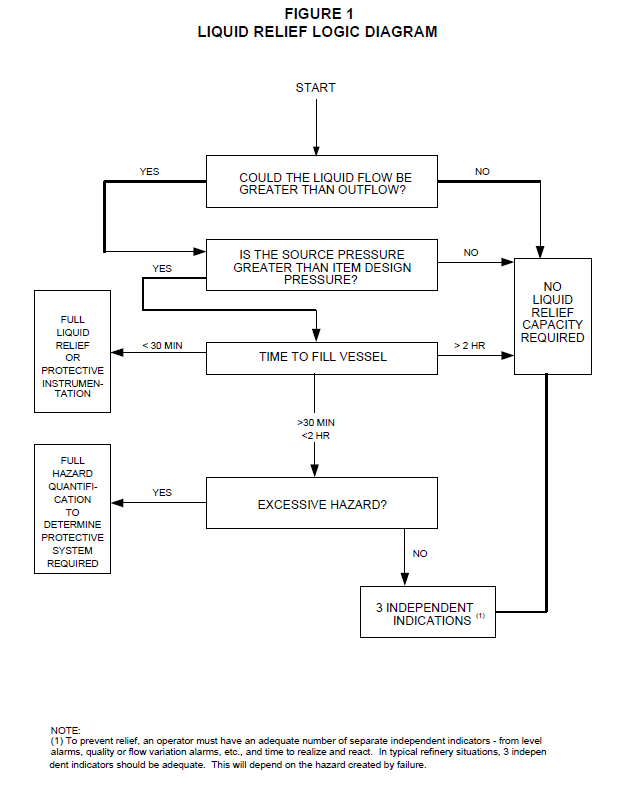
© 2026 Inflection Point Engineering, LLC. All rights reserved. The content of this page — including calculation methods, reference data, written analysis, interactive tools, and source code — is the intellectual property of Inflection Point Engineering, LLC and is protected under applicable copyright, trademark, and trade secret laws. Unauthorized reproduction, redistribution, modification, or derivative use in whole or in part is prohibited without prior written consent.
Disclaimer. This material is provided for informational and educational purposes only and does not constitute professional engineering advice. Calculations, reference data, and methodologies are based on published standards and accepted engineering practice but are not a substitute for engineering judgment, site-specific analysis, or review by a licensed Professional Engineer. Inflection Point Engineering, LLC makes no warranties, express or implied, regarding the accuracy, completeness, or fitness for a particular purpose of any content presented here, and shall not be liable for any direct, indirect, incidental, or consequential damages arising from its use. Users assume all risk associated with applying this content to real-world design, operations, or decisions.
© 2026 Inflection Point Engineering, LLC. All rights reserved.